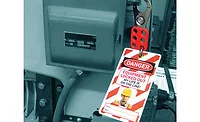
Lockout/Tagout
While OSHA's lockout/tagout standard has been in effect since 1989, hazardous energy release incidents continue to be a problem. The Bureau of Labor Statistics reported 189 workplace deaths caused by workers being caught in machinery in 1997, a 29 percent increase from the previous year. More than half of these fatalities happened while workers were performing service- or maintenance-related tasks.
In 1998, lockout/tagout violations ranked fourth on OSHA's top ten list of most frequently cited standards (3,532 violations), and fourth on the top ten list of serious violations (2,537 serious violations).
Despite these alarming numbers, lockout/tagout is still viewed by many as a burdensome, production-slowing task. Companies that fail to recognize and control machine hazards face regulatory fines and risk serious and costly machine-related incidents. Effective lockout programs can prevent these predictable losses.
More than basics
While incidents involving improper lockout occur for various reasons, they can generally be attributed to management system failures. Management errors such as inadequate training, poor energy control procedures and a lack of lockout/tagout program emphasis all increase the likelihood of incidents.The basic elements of a lockout/tagout program include: conducting an application and exposure survey; developing a written program; developing machine-specific energy control procedures; providing protective appliances; employee training; and annual program/procedure review. While these fundamental components may suffice for compliance purposes, additional elements are needed for a lockout/tagout program to be a success. To get beyond OSHA compliance, your program should include:
Keeping a guard up
Having to perform lockout on a machine each time a routine maintenance task is performed is time-consuming and slows production. A key to maintaining or improving productivity is to eliminate maintenance task hazards by using machine guarding or other methods of protection. OSHA advises that as long as guarding is not removed or bypassed, the lockout/tagout standard does not apply.Consider the jamming of machines such as conveyors, packagers and labelers. If employees are exposed to injury or must bypass safety guards to unjam the machine, it is considered "service or maintenance" under the OSHA standard, and lockout would therefore be required each time the employee performs this function. Since the operating controls are generally not considered to be isolating devices, lockout is usually accomplished at the local disconnect or at the breaker (assuming electrical energy is the only type of energy encountered).
To do this each time the machine jams is a burden, and, consequently, a disincentive to follow lockout/tagout is established and workers may feel pressure to take risks. If guarding (or another alternative measure) is provided to effectively protect workers from hazardous parts of machinery during the unjamming operation however, the task would be considered part of "normal production operations," and lockout would not be required.
OSHA also advises that if servicing is performed in a way that prevents employee exposure to unexpected activation of the machinery or equipment or to the release of stored energy, such as by the use of tools and/or alternative procedures that keep the employee's body out of the areas of potential contact with machine components or that otherwise maintain effective guarding, the standard does not apply. Thus, lockout is not required if it can be demonstrated that the alternative means enable the servicing employee to clean, unjam or otherwise service the machine without being exposed to hazards.
Similarly the lubrication of power transmission apparatus and other moving parts is a frequent and necessary maintenance task. If the apparatus is guarded (e.g., with a fixed, enclosure guard) the lubrication task will likely require removal of the guard to gain access. If employees are exposed to injury as a result, the equipment must be de-energized and locked out. Providing a small porthole in a guard or enclosure can often allow for the remote lubrication of equipment, making guard removal unnecessary. As long as the guarding adequately protects employees from injury, lockout would not be required. By engineering hazards out of machines, both safety and productivity can be increased.
Performance requirements
An effective lockout/tagout program will also establish specific performance requirements for controlling hazardous energy during the service or maintenance of machines, equipment and processes (MEP). These performance requirements should be spelled out in a written policy that defines responsibilities for carrying out the program, and in "energy control procedures" (ECP), specific to each MEP. ECPs should describe the:
- machine, equipment or process to be locked/tagged out;
- intended use of the procedure and/or type of service/maintenance to be performed;
- types and magnitude of hazardous energy associated with the MEP;
- type and location of the isolating device(s);
- personnel involved;
- specific procedures and sequences for de-energizing, verifying and locking/tagging out the MEP; and
- specific steps for re-energizing the machine and restoring it back to normal operation.
ECPs must include specific requirements for testing a machine or equipment to verify the effectiveness of lockout devices and other energy control measures. ECPs should be modified as necessary to reflect changes in the equipment, method or location of isolation, energy sources, and/or involved employees.
Confirming the successful lockout of machines is critical to ensuring personnel protection. ECPs must therefore include specific requirements for testing a machine or equipment to verify the effectiveness of lockout devices, and other energy control measures. Prior to starting work on a MEP that's been locked/tagged out, an authorized employee must verify that isolation and de-energization of the MEP has been accomplished. The MEP must be checked by use of test instruments and/or visual inspection to verify that energy isolation has been accomplished, and equipment operating controls should be operated to verify that the equipment cannot be restarted.
With electrical energy, a qualified person should use test equipment to verify that all circuit elements and electrical parts of equipment to which employees could be exposed are de-energized. When appropriate, tests should also be performed to determine if any energized condition exists as a result of an inadvertently induced voltage or backfeed. Such unexpected energization could occur even though specific parts of the circuit have been de-energized and presumed to be safe, so additional precautions (e.g., grounding) may also be necessary.
Combat carelessness
With the pressure and stress of modern life, it's easy for workers to get careless. When working with industrial machinery, a moment of carelessness can easily result in a serious injury. The greatest benefit of a lockout/tagout program is that even if employees get careless, they'll be protected against injury.SIDEBAR: Helpful LO/TO hints
- Develop procedures that are easy for employees to understand and implement.
- Build lockout capability into machines.
- Have lockout materials and hardware readily available.
- Place lockout stations near machines that require frequent service or maintenance under lockout.
- Assign personal locks, tags and appliances to authorized employees.
- Post written energy control procedures in clear plastic sleeves at or near the machines to be serviced.
SIDEBAR: Exception to the rule
OSHA includes a "minor servicing exception" in its Control of Hazardous Energy (lockout/ tagout) standard that provides employers with flexibility in performing such common tasks as unjamming, lubricating, cleaning and adjusting machines. The key to using this exception is to eliminate maintenance task hazards by using machine guarding or other methods that provide effective protection. To take advantage of this exception, the servicing activity must:- be minor;
- take place during normal production operations;
- be routine, repetitive and integral to the use of the equipment for production; and
- be performed in a manner that protects employees from hazards by effective alternative means.
Links
Looking for a reprint of this article?
From high-res PDFs to custom plaques, order your copy today!