MANAGING BEST PRACTICES: The most basic of safety tools

If you were to boil down safety management into concise and essential elements, what would they be? Here’s my take. The fundamental elements from which all occupational safety management programs evolve include: 1) Safety is the likelihood that no harm will result when hazards are controlled; 2) hazards are comprised of conditions and acts; 3) harm is an unwanted event such as an injury, illness, or property damage; and, 4) management is practices taken to achieve a desired result.
Job safety analysis
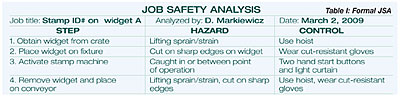
The foundation of all occupational safety management programs hinge on some form of safety assessment, such as a Job Safety Analysis (JSA). A JSA has three main parts: 1) job step; 2) hazard; and 3) control. JSAs may be informal or formal. Every job in a work organization should be assessed even before the actual work commences.An informal JSA is a non-documented practice. A formal JSA is documented. An example of a formal JSA is shown in Table I below:
JSAs evolve from basic to advanced depending upon the complexity and of the work being performed and sophistication of the organization.
5 key definitions
- Hazards: Hazards are anything that may
cause harm including chemical, physical, ergonomic,
electrical, biological, radiological, and psychological
acts or conditions. Unsafe acts generally cause more
harm than unsafe conditions. Hazards that cause injury
are easier to recognize than hazards that cause illness.
Hazards and exposure should be described with action verbs. Examples include: impact with falling object; fall from elevated surface; and, contact with electrical current.
- Harm: Harm generally results from a
sequence of events that have a root cause being either a
condition or act, or both. Some people may be more prone to harm than other people. Management has control over all conditions in the workplace and influences
all acts through rewards and punishments.
Harm may be described in categories that include death, recordable injury, first-aid, and near-miss. Proportionally, there are very few deaths and many near-misses in occupational settings. To prevent death management must focus on controlling near-misses.
An injury happens immediately. An illness takes time, sometimes years, to develop. If harm doesn't occur in a snap of the fingers, it is generally classified as an illness. Some researchers claim that significantly more workers die from workplace illness than through injuries, but this claim must be viewed in the longterm and big picture of all workplace exposures.
- Controls: The hierarchies of controls, from
most effective to least effective, are: Elimination;
Substitution; Engineering Controls e.g. ventilation;
Warnings e.g. signs; Administrative Controls e.g.
training; and Personal Protective Equipment (PPE).
PPE should only be used while other controls are
being investigated or installed.
- Risk: Risk (reciprocal of safety) is the likelihood
that harm will result when hazards are uncontrolled.
The acceptance of risk should be made jointly
by management and employees. An acceptance of risk
implies an awareness of the risk, which is generally
accomplished through training.
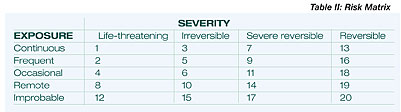
Risk may be assessed formally by a matrix that considers frequency and severity. An example of a risk matrix is shown in Table II above.
Risk matrices are supported by ranking schemes based on numbers; such as: High Risk (1-5); Serious Risk (6-9); Medium Risk (10-17); and, Low Risk (18-20). A desired result (management practice) may be to be proactive on all high/serious risks and be reactive to medium/low risk.
- Measurements: Measurements keep management on track to reach a destination. Measurements come in many forms including inspections, audits, assessments, investigations, and records. The basic measurement for most workplaces is the OSHA 300 Form for recording and tracking employee injury and illness.
Looking for a reprint of this article?
From high-res PDFs to custom plaques, order your copy today!


