ISHN logo
search
cart
facebook twitter linkedin youtube
  • Sign In
  • Create Account
  • Sign Out
  • My Account
ISHN logo
  • NEWS
    • Today's News
    • Global Safety News
    • Government Regulations
  • PRODUCTS
    • Product Innovations
    • Featured Products
  • TOPICS
    • Environmental Health and Safety
    • Facility Safety
    • Workplace Health
    • Occupational Safety
    • PPE
    • More Topics
  • CONSTRUCTION
  • TECHNOLOGY
  • COLUMNS
    • Best Practices
    • Dave Johnson: What’s going on
    • Editorial Comments
    • Leading Safety
  • MULTIMEDIA
    • ISHN Podcast
    • Videos
    • Cold Stress Education Quiz
    • Webinars
    • White Papers
  • MORE
    • Buyer's Guide
    • Newsletters
    • Convention Companion
    • Polls
    • Events
    • ISHN Store
    • Sponsor Insights
  • EMAGAZINE
    • eMagazine
    • Archived Issues
    • Contact
    • Advertise
  • JOIN TODAY!
Columns

MANAGING BEST PRACTICES: Workplace developmental hazards

By Dan Markiewicz MS, CIH, CSP, RMP
December 9, 2009


Figure 1
Workplace Reproductive/Developmental Hazards

Examine Figure 1 closely. There are huge implications for U.S. employers and EHS pros if the concepts are correct, which I believe they are.

First, let’s consider the term “unborn child.” U.S. employers will not have a choice if this term is politically correct or not. The term is mandated under the United Nation’s Globally Harmonized System for Chemical Labeling (GHS), and where applicable will appear as a precautionary (P) or hazard (H) statement on chemical product labels, safety data sheets, and signs. To learn more about P and H statements under GHS visit http:// www.ilpi.com/MSDS/ref/hstatements.html.

An example of the term unborn child used as an H statement on an SDS is shown in Figure 2. Figure 2 is a clip from a current SDS developed by Glenn Springs Holding, Inc.; Dallas, TX (the entire SDS can be found at http://msds.oxy.com/DWFiles/M41280_ROW_ BE%233.pdf). Manganese in the product triggers the H360 statement. The yellow highlight is for purpose of this article only and does not appear on the SDS. The SDS is GHS compliant now because the manufacturer ships the product globally. GHS is underway in Europe and many Asian and other countries.

If your company is global, it is probably doing GHS now; if not, wait for the U.S. to catch up. Regardless of what the U.S. does or doesn’t do with GHS, if you get chemical products from a global supplier, GHS is coming your way.
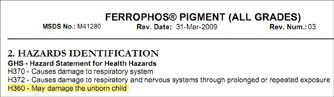
Figure 2 - SDS H360 statement for unborn child

OSHA GHS

OSHA issued its proposed rule to align the GHS with the agency’s hazard communication standard on September 30, 2009. The proposed rule can be found at http://edocket.access.gpo.gov/2009/pdf/E9-22483. pdf. OSHA defines the differences between the terms reproductive and developmental on page 50463 of the proposed rule. Reproductive effect interferes with an employee’s fertility. Development “interferes with the normal development of the conceptus either before or after birth, which is induced during pregnancy or results from parental exposure.”

Figure 3 shows how the OSHA sign and label for lead (i.e. OSHA substance specific standards) must change to meet GHS. Yellow highlights are for purpose of this article and do not appear within the proposed rule.

When the Hazcom rule is final (assumes the language in Figure 3 is unchanged), employers will be required by OSHA to address developmental toxicity and consider possible damage to the unborn child.

Can OSHA do this? Congress authorized OSHA to assure protection for healthy working adults. OSHA can establish law to protect the fertility of an employee, but it is difficult is understand how it can establish law to protect an unborn child. The permissible exposure limit for lead is established to protect an employee. An unborn child is not an employee and may or may not be more sensitive to exposure to lead.
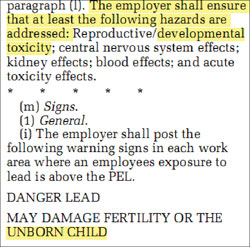
Figure 3
Clip OSHA Proposed Hazcom Rule (page 50544)

Worker population

The movement to GHS and its approach to developmental toxicity comes at a critical time for U.S. employers. Women are now the majority of the U.S. workforce. Approximately 80 percent of all women will become pregnant sometime during their working lifetime. In 2007, more children were born in the U.S. than ever before, surpassing the Baby Boom Generation (1946-1964). As the recession subsides, births will be up again in record numbers. This means a record number of unborn children will be exposed to developmental toxicity in the workplace.

Dynamic and global

A main reason dynamic and global appear on the developmental side in Figure 1 is that EU REACH will continue to generate new toxicological studies to determine if chemicals have CMR (carcinogen, mutagenic and reproductive) effects. Employers worldwide, including U.S., will be impacted by these studies. GHS and REACH could provide ammunition for some people to launch lawsuits if a chemical interferes with normal development and is “induced during pregnancy or results from parental exposure.”

Is the concept correct?

I seek your views on the concepts in Figure 1. Please drop me an email at Dan.Markiewicz@gmail. com if you disagree with any of the concepts. If the concepts are correct, how should EHS pros manage the right side?

Share This Story

Looking for a reprint of this article?
From high-res PDFs to custom plaques, order your copy today!

Dan markiewicz 200px
Dan Markiewicz, MS, CIH, CSP, RMP, is an independent environmental health and safety consultant and a long-time columnist. He can be reached at (419) 356-3768 or by email at dan.markiewicz@gmail.com.

Recommended Content

JOIN TODAY
to unlock your recommendations.

Already have an account? Sign In

  • forklift safety

    Exploring the latest technologies in forklift safety

    With more staff and more stock in warehousing now more...
    Facility Safety
    By: Josh Cramer
  • welding

    All about welder’s flash or arc eye

    A flash burn is a painful inflammation of the cornea,...
    Environmental Health and Safety
  • dangerous jobs

    The 10 most dangerous jobs in the U.S.

    On-the-job deaths have been rising — hitting the highest...
    Government Safety Regulations
    By: Benita Mehta
Manage My Account
  • eMagazine Subscriptions
  • ISHN Newsletter & Other Newsletter Alerts
  • Online Registration
  • Manage My Preferences
  • Subscription Customer Service

More Videos

Sponsored Content

Sponsored Content is a special paid section where industry companies provide high quality, objective, non-commercial content around topics of interest to the ISHN audience. All Sponsored Content is supplied by the advertising company and any opinions expressed in this article are those of the author and not necessarily reflect the views of ISHN or its parent company, BNP Media. Interested in participating in our Sponsored Content section? Contact your local rep!

close
  • man wearing the the Sundström SR200 Full Face Mask Respirator
    Sponsored byOHD

    5 Fit Testing Mistakes That Could Cost You

  • This image shows Magid AcuSpex polarized blue mirrored safety glasses.
    Sponsored byMagid Glove and Safety

    Construction PPE Guide: What Crews Need for Each Task

  • lone worker in confined space
    Sponsored byAlphasense Ltd.

    GET THE LEAD OUT of your Safety Oxygen Sensors!

Popular Stories

SpaceX 7 launch

OSHA Investigating Fatal Fall at SpaceX Starbase

Automated loading dock equipment

After March 2026 Rivian Death, Safety Managers Reassess Loading Dock Systems Under OSHA's Warehouse Emphasis Program

psychology in the workplace

Most Workplaces Measure Psychological Safety, Ignoring Psychosocial Risks

top 10 most dangerous jobs

Poll

Seasonal Readiness

With the federal heat stress prevention rule on the horizon, which area of your safety program needs the most attention?
View Results Poll Archive

Products

Surviving an OSHA Audit A Management Guide, 2nd Edition

Surviving an OSHA Audit A Management Guide, 2nd Edition

See More Products

ISHN Podcasts

Related Articles

  • MANAGING BEST PRACTICES: Talking about developmental hazards

    See More
  • MANAGING BEST PRACTICES: Time to manage psychosocial hazards

    See More
  • MANAGING BEST PRACTICES: How to implement best practices

    See More

Related Products

See More Products
  • 1119906652.webp

    Alive and Well at the End of the Day: The Supervisor's Guide to Managing Safety in Operations, 2E

See More Products

Related Directories

  • e-Hazard

    E-Hazard is dedicated to building an electrical safety culture with you. Our electrical engineering services and training will prepare your team for any electrical safety needs or concerns. E-Hazard can help with electrical training, arc flash studies, electrical audits, electrical safety programs, LOTO, infrared scanning, NFPA 70B, consulting and much more.
×

Become a Leader in Safety Culture

Build your knowledge with ISHN, covering key safety, health and industrial hygiene news, products, and trends.

JOIN TODAY
  • RESOURCES
    • Advertise
    • Contact Us
    • Directories
    • Manufacturing Division
    • Store
    • Want More
  • SIGN UP TODAY
    • Create Account
    • eMagazine
    • Newsletters
    • Customer Service
    • Manage Preferences
  • SERVICES
    • Marketing Services
    • Reprints
    • Market Research
    • List Rental
    • Survey/Respondent Access
  • STAY CONNECTED
    • LinkedIn
    • Facebook
    • YouTube
    • X (Twitter)
  • PRIVACY
    • PRIVACY POLICY
    • TERMS & CONDITIONS
    • DO NOT SELL MY PERSONAL INFORMATION
    • PRIVACY REQUEST
    • ACCESSIBILITY

Copyright ©2026. All Rights Reserved BNP Media, Inc. and BNP Media II, LLC.

Design, CMS, Hosting & Web Development :: ePublishing
