Respirator Selection 101
Deciding the type of respirator that is appropriate for a given situation requires understanding the job-specific variables, including the identity and concentration of contaminants that are present (or may be present) in the work area. The safety director or industrial hygienist must understand the different types of respirators and their protective capabilities to determine the options that exist. Other factors, including worker health, worker comfort, cost, training and preference should also be taken into consideration.

Finding help
Most personal protective equipment manufacturers and distributors offer recommendations on choosing respirators. These recommendations may be available as an online or published guide, or may even take the form of an onsite analysis of the workplace. Regardless of these recommendations, it is ultimately the responsibility of the employer to ensure that proper respirators are being used for worker protection, and that they meet all local, state and federal regulations.The OSHA Web site, www.osha.gov, offers a wealth of information useful in the selection process. One of the more recent additions to the site is the Respirator Selection eTool. This eTool steps you through the decision-making process of selecting a respirator, according to the NIOSH Respirator Decision Logic (RDL) and the OSHA standard for respiratory protection (29 CFR 1910.134).
Certain applications and/or situations will limit the types of respirators that may be used, and this is the first consideration that should be made when selecting a respirator. For example, in abrasive blasting, a Type CE respirator must be used to not only provide respiratory protection, but also to provide protection to the neck and torso from the rebound of the blast media. Another example involves respirators that are used in atmospheres that are deficient in oxygen content (less than 19.5 percent), contain concentrations of a contaminant that would be considered immediately dangerous to life or health (IDLH), or have the potential for either of these to occur due to the nature of the work being performed. In these instances, workers must wear a self-contained breathing apparatus (SCBA) or pressure-demand supplied air respirator with auxiliary escape cylinder.

Know the contaminants
Safety officers and industrial hygienists must next understand the contaminants and their exposure levels. The American Conference of Governmental Industrial Hygienists (ACGIH) annually publishes its "Threshold Limit Values and Biological Exposure Indices." This is perhaps the most widely used guide to exposure levels, ceiling values and other information on specific contaminants.
A hazard ratio should be determined by dividing the concentration in the workplace by the Threshold Limit Value (TLV) or other occupational exposure limit. For example, if the concentration level is 50 mg/m3 for a contaminant with a TLV of 2 mg/m3, then the resulting hazard ratio would be 25 (50/2). This means that a respirator with a protection factor greater than or equal to 25 should be selected. If the concentration level is equal to or above the IDLH level, or if oxygen deficiency is present, only an SCBA or pressure-demand supplied air respirator with auxiliary escape cylinder may be used.

What's your type?
Now that you have some understanding of compliance issues, there are many other factors that you should be familiar with to ensure proper and effective respirator use, and to enhance worker comfort and productivity.Many different types of respirators are available, such as negative pressure air-purifying, supplied air (or continuous flow) respirators (SARs), powered air purifying respirators (PAPRs), and self-contained breathing apparatus (SCBAs). Each type of respirator has distinct advantages and disadvantages that need to be considered as they relate to worker comfort, productivity and protection.
Negative Pressure - Negative pressure air-purifying respirators (APRs) are the most widely used type of respiratory protection in the workplace and can take the form of a filtering facepiece or an elastomeric facepiece with cartridges and filters. While these "lung-powered" respirators have some benefits, they typically have low assigned protection factors (APFs) (10 for standard half-mask, 50 [NIOSH] or 100 [ANSI] for full facepiece). See Table 1 for a breakdown of negative pressure APR advantages and disadvantages.
SCBA - SCBAs include a compressed air cylinder, filled with breathing air, which is worn on the user's back to supply air to a pressure demand-style facepiece. These respirators, generally accepted to have an APF of 10,000, are widely used for firefighting, confined space entry, IDLH atmospheres and unknown atmospheres. See Table 2 for a breakdown of SCBA advantages and disadvantages.
After the events of last September, it became evident that there was a need for a NIOSH Chemical, Biological, Radiological and Nuclear (CBRN) Standard for firefighting SCBAs, which is now available.
SAR - Supplied air respirators are widely used in general industry. Breathing air for SARs can be supplied by a large compressor system, cascade system of air cylinders or portable free-air pump that transports breathing air through an air supply hose to the respirators.
Although both NIOSH and ANSI give SARs lower APFs than SCBAs (25 and 1,000 for hood-style continuous flow SARs, respectively), a well-known workplace protection factor study of continuous flow SAR hoods and helmets, conducted by the Organization Resources Counselors, illustrated that most of the respirators tested can provide assigned protection factors greater than or equal to 1,000. In fact, the top performing hood-style SAR was given a study protection factor of 10,0001. See Table 3 for a breakdown of SAR advantages and disadvantages.
PAPR - Powered air purifying respirators are widely used in general industry, oftentimes in the same facilities where SARs are used. PAPRs use a battery-powered blower to pull air through filters or cartridges that are designed to remove specific contaminants from the air. Clean air is delivered to the respirator wearer through a breathing tube attached to the respirator hood.
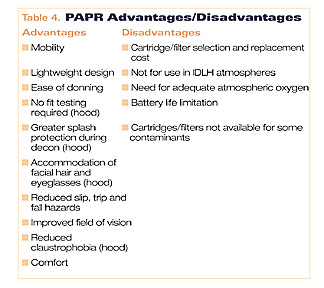
PAPRs are generally afforded the same protection factors as continuous flow SARs, assuming appropriate cartridge selection and similar headpieces. A NIOSH standard for PAPRs for Chemical, Biological, Radiological and Nuclear applications is on the horizon, which will dramatically increase the suitable applications for this type of respirator. See Table 4 for a breakdown of PAPR advantages and disadvantages.
Take the time
Safety directors and industrial hygienists must consider a number of different criteria when determining the protection that is appropriate and suitable for a given job at a given workplace. One thing is certain: proper care in respirator selection can improve worker productivity, save lives and reduce an organization's overall operating costs. With this in mind, taking the time to properly select respirators just makes sense.SIDEBAR: What exactly is an APF?
The protection factor that a respirator affords its user is defined as the ratio of the concentration outside the respirator to the concentration inside the respirator. Assigned protection factors (APFs) represent the minimum expected workplace level of respiratory protection that would be provided by a properly functioning (and properly worn) respirator or a class of respirators to properly fitted and trained users. APFs are normally given to an entire class of respirators, such as negative pressure half-mask air-purifying respirators.OSHA acknowledges the assigned protection factors (APFs) published in the NIOSH RDL for airborne contaminants not covered by substance-specific standards. However, the organization also acknowledges the fact that many employers, respirator manufacturers and industrial hygienists recognize the more current ANSI Z88.2-1992 industry consensus standard as a more accurate portrayal of a respirator's protective capability.
OSHA will be proposing a new table of APFs in the near future to eliminate confusion, provide for consistent enforcement and reduce the potential for inadequate employee protection.
Looking for a reprint of this article?
From high-res PDFs to custom plaques, order your copy today!


