Respiratory Recommendations
Background
Building materials that have been damaged due to flooding or continuous moisture damage are susceptible environments for the growth of fungus. The term "fungi" includes organisms such as yeasts, molds, mildews, and mushrooms. Fungi can exist as single cells or as threadlike strands that may branch extensively. Fungi normally reproduce as spores. Spores can be released into the air as part of the mold's natural reproduction process or if the mold is disturbed.Molds are known to cause a variety of health effects via ingestion, inhalation, and skin contact. These can include allergenic effects, asthma, runny nose, hypersensitivity pneumonitis, organic dust toxic syndrome, irritation of the eyes, skin, nose, throat and lungs, as well as infection of immune-compromised or immune-suppressed individuals. Health effects only occur when persons are directly exposed to the molds - no person to person transmission has been documented.
Some molds such as Aspergillus, Fusarium, Penicillium, Trichoderma, Memnoniella and Stachybotrys chartum are known to produce toxic substances known as mycotoxins. These may cause mucous membrane irritation, skin rash, nausea, immune suppression, acute or chronic liver damage, acute or chronic central nervous system damage, endocrine effects, and cancer. The toxins are typically contained in or on the spores, but a few have been shown to be volatilized (exist as a vapor).
Fungi can also produce volatile organic compounds (VOC) that are thought to be the source of odors associated with mold and mildew. Inhalation of the VOCs may cause symptoms such as headaches, nasal irritation, dizziness, fatigue and nausea, which are typically not life-threatening.
Prevention & remediation
The best way to prevent mold contamination is to prevent conditions that foster mold growth from occurring. Clean up water damage to building materials quickly. Fix leaks. Maintain a moderate level of relative humidity (50 percent). Prevent dirt build-up in HVAC systems.
During remediation work, proper containment should be used to keep spores from spreading. Use of biocides, such as chlorine bleach, is not necessarily recommended and dead mold may still cause allergenic or toxic effects. A thorough discussion of investigation, evaluation and cleaning is given in the EPA guidelines.
Personal protective equipment
No published exposure limits exist from EPA or OSHA for biological organisms. Sampling may be done, but results are often left open to interpretation since there are no published U.S. federal standards for comparison.EPA's selection of clean-up methods, personal protective equipment (PPE) and containment are determined based upon the size of the contaminated area. Larger areas require more stringent measures. Professional judgment should also be used depending on the toxicity of the mold (if known), possibility of hidden mold, the potential for aerosolizing the mold, or if persons with asthma, allergy or immune suppressive disorders are present near the remediation work.
Using PPE does not eliminate the risk of exposure or illness. But appropriate PPE including gloves, goggles, disposable coveralls, full body clothing, headgear, foot coverings, and respiratory protection might help reduce exposure.
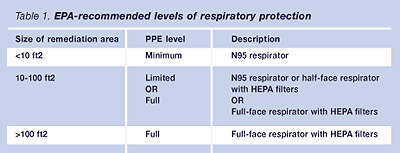
EPA-recommended levels of respiratory protection are presented in Table 1. There is some confusion because the descriptions of these levels do not match exactly with descriptions presented later in the same guidelines.
Plus, NIOSH no longer approves HEPA filters with negative pressure respirators. Under 42 CFR 84, HEPA filters are only approved with powered air purifying respirators (PAPRs). For negative pressure respirators, 100 level filters (N100, R100, or P100) may be used in place of HEPA filters. But a less efficient filter may be acceptable for certain remediation work. No respirator removes all contaminants, and the actual reduction of exposure to the user will depend upon many factors besides filter. See Table 1.
These PPE levels are defined later in the EPA document as follows:
Minimum: When cleaning up a small area affected by mold, you should use an N95 respirator. This device covers the nose and mouth, will filter out 95 percent of the particulates in the air, and is available in most hardware stores. In situations where a full-face respirator is in use, additional eye protection is not required.
N95 filters are tested by NIOSH to be at least 95 percent efficient against particles in the most penetrating size range. Filtration efficiency may be greater for particles that are either smaller or larger. The actual reduction of exposure to the user will depend upon many factors besides filter efficiency including, but not limited to, proper donning, maintenance, face to facepiece seal, whether it is a half-mask or a full-facepiece respirator, etc.
Limited: Limited PPE includes use of a half-face or full-face air-purifying respirator (APR) equipped with a HEPA filter cartridge. These respirators contain both inhalation and exhalation valves that filter the air and ensure that it is free of mold particles. Note that half-face APRs do not provide eye protection. In addition, the HEPA filters do not remove vapors or gases.
Please see the above statement regarding HEPA filters. Table 1 also includes N95 respirators in this category. Workplace protection factor studies have shown that both filtering facepieces and elastomeric facepieces with replaceable filters meet or exceed the ANSI assigned protection factor of 10 for half-mask respirators.
Full: In situations in which high levels of airborne dust or mold spores are likely or when intense or long-term exposures are expected (such as the cleanup of large areas of contamination), a full-face, powered air-purifying respirator (PAPR) is recommended. Full-face PAPRs use a blower to force air through a HEPA filter. The HEPA-filtered air is supplied to a mask that covers the entire face or a hood that covers the entire head. The positive pressure within the hood prevents unfiltered air from entering through penetrations or gaps.
Table 1 does not mention PAPRs. It is unclear if EPA is recommending a negative pressure full facepiece respirator, a PAPR with a full facepiece, a PAPR with a hood, or all of the above. Other types of respirators that offer equivalent or higher levels of protection, such as a supplied air respirator or a self-contained breathing apparatus (SCBA), may also be appropriate.
Note: VOCs or volatile toxins produced by mold can include alcohols, aldehydes, ketones, aromatics, amines, terpenes, chlorinated hydrocarbons, and sulfur-containing compounds. These are thought to be at orders of magnitude lower than what is typical in industry. A particulate filter designed for nuisance level organic vapors may be appropriate for exposures to some of these chemicals at levels that are well below the exposure limits. Gases and vapors associated with disinfectants (such as chlorine) may also warrant the use of an appropriate chemical cartridge in conjunction with the particulate filter.
The use of NIOSH-certified respirators must be accompanied by a full respiratory protection program as specified in OSHA 29 CFR 1910.134.
For more info
An extensive list of resources and references is given at the end of the guidelines. Two in particular that may be helpful are the New York City Department of Health (NYCDH) "Guidelines for Assessment and Remediation of Fungi in Indoor Environments" and the NIOSH "Martin County Courthouse and Constitutional Office Building, Stuart Florida. HETA 93-1110-2575."For complete copies of these documents contact either the U.S. EPA (800-438-4318), NIOSH publications (800-356-4674) or the New York City Department of Health (212-442-3372).
You should also contact your local health department and be alert to supplements, modifications, or additional recommendations in the future.
Information provdied by 3M OH&ESD, St. Paul, Minn.
Looking for a reprint of this article?
From high-res PDFs to custom plaques, order your copy today!


