Welding safety
Fire safety
Fire is always a hazard when it comes to maintenance or repair welding. Prior to welding or torch cutting, you should inspect the work area. Any combustible materials must be moved a minimum of 35 feet from the welding area. Any combustibles that can’t be moved must be covered with a fire-resistant shield. Welding sparks and slag fly everywhere, so any holes or cracks in the floor or walls within 35 feet of the welder must be protected.A fire watch, a person standing nearby with a fire extinguisher, is crucial in the event of a fire. This person should remain in the area for a half-hour after the welding is done. If welding is done after shift workers leave, the guard should be told to pass the area on rounds.
Chemical safety
Any chemical containers to be welded or cut with a torch must be thoroughly cleaned of flammable materials or greases, tars, acids, or other explosive or toxic materials.Personal protection
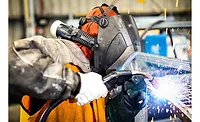
Welding emits ultraviolet light, so every welder and helper should wear suitable helmets, goggles, or cutting glasses. Lenses are filtered and the amount of the filter is numbered — welders helper’s glasses might be a 2.0, brazing goggles might be a 3.0 or 4.0, and the filter for an arc welding helmet might be a 14.Welding flash, which usually occurs when the welder does not get the hood down in time, is the most common eye injury. Although it is painful when radiation burns the cornea, it’s usually not a serious injury. However, watching the welding arc for long periods of time could lead to serious injury.
The face and other parts of the body also need protection from burns, so the hood should cover the face, head, and neck. Shirts should be long sleeved and pockets should be kept buttoned to keep out the sparks. Wool is recommended because of the flame resistance. Man-made fabrics such as polyester, which burns and melts, must be avoided.
A variety of bibs, aprons, capes, and sleeves made of leather or flame-resistant fabric can be used for protection. Footwear should be pull-on high-topped shoes or boots, and flame-resistant gloves should be worn.
Respiratory protection
Fumes, a by-product of welding, can be expected from even simple operations and necessitate the use of respiratory protection or ventilation. Simple operations lead to fumes like carbon monoxide, nitrogen oxide, and ozone. But extra precautions must be taken if you are welding metal coated with or containing zinc, cadmium, chromium, copper, fluoride, lead, manganese, or vanadium, because the resulting fumes can cause a condition known as metal-fume fever. Also beware of any metal that has been coated or painted.Natural ventilation is acceptable if there is space available to each welder of 10,000 cubic feet, the ceiling is more than 16 feet high, the job is not in a confined space, or you are not welding any of the above mentioned materials. Otherwise you will need to provide mechanical ventilation and/or some type of respiratory protection.
Cylinder safety
When using an oxygen-fuel mixture for welding and cutting, do so with care. Not only is the fuel mixture highly flammable, it is compressed within cylinders.Acetylene, the most common gas used with oxygen, can be dangerous. So it is important to know the following facts:
- When burned with oxygen, acetylene produces a higher flame temperature (3,300ÞC) than any other gas used commercially;
- The flammable range of acetylene is from 2.5 to 81 percent in air;
- Acetylene is only slightly lighter than air, which means than it neither sinks nor rises rapidly. Instead, it tends to stay in the area where it escaped; and
- In normal atmospheres, acetylene should not be used at a pressure greater than 15 psig, unless connected to a manifold.
As with any compressed gas, the cylinder shall be marked with the chemical or trade name. The cylinders should be stored standing up and be tied, chained, or kept in a rack.
Valve caps or hoods should be over the valve any time the cylinder is not in use. Even empty cylinders have enough pressure to be dangerous if the valve stem is broken.
Roll cylinders on the bottom edge or move with a hand truck, never drag or lift them in a sling.
Oxygen precautions
When cutting with oxygen, the metal is heated by the burning fuel gas and cut by the reaction of metal and oxygen. While not as flammable as the fuel gases in welding, oxygen should be treated with a lot of respect. Use the same precautions you would with any compressed gas.Oxygen, as it comes out of a cylinder, has many of the same properties as vapor from liquid oxygen, so keep oil and other petroleum products away. Each oxygen gauge should be marked “Oxygen – Use No Oil.”
Never use gauges or regulators that are broken or cannot be read for oxygen, or any compressed gas. Common practice is that the hoses used for oxygen and acetylene are color coded — red for fuel and green for oxygen.
Electrical safety
Arc welding uses electricity as an energy source, so electric shock is a primary concern of the welder. Accidental contact with live electrical parts is to be avoided. Hazardous situations include damp areas, hot and humid conditions that would cause sweat, and cramped spots where the likelihood of touching conductive parts is high. These problems can be partially solved by insulating the conductive parts near the welder, by the use of dry gloves and clothing in good condition, and by wearing electrically protective footwear.Sidebar: Welding safety requirements
OSHA standards —1910.252 General Requirements, Welding, Cutting, and Brazing ;
1910.253, Oxygen-Fuel Gas Welding and Cutting; and
1910.254, Arc Welding and Cutting.
Other reference materials —
Safety in Welding and Cutting, by the American Welding Association: and
NFPA Standard 51B, 1962 Standard for Fire Prevention in Use of Cutting and Welding Processes.
Looking for a reprint of this article?
From high-res PDFs to custom plaques, order your copy today!



.webp?t=1721257160 "download (1).jpg")
