Proactively Prevent Incidents and Injuries with JSAs
A Job Safety Analysis (JSA) is an important tool that EHS professionals can use to identify and mitigate hazards associated with difficult tasks or job sites.
During a JSA, EHS professionals will identify any potential hazards that accompany each step of a task and will evaluate these hazards’ risks based on two factors: the probability of the hazard occurring and its severity. After completing this risk assessment, safety professionals can ensure that the appropriate measures are taken to prevent the hazards from occurring.
This article discusses how conducting JSAs can help you identify previously undetected risks and promote a culture of safe work procedures. It will also explore the ways in which safety management software can assist safety professionals with their job safety analyses.
Why conduct JSAs?
JSAs offer many benefits to both employers and workers. When a JSA is performed correctly, it can be an effective accident prevention tool that increases workplace safety and productivity and reduces workplace injuries, accidents and workers’ compensation claims.
Sharing the results of a JSA with employees helps to create a work environment in which employees have the information they need to do their jobs in a safe manner. The JSA process plans out the steps of a job so that all workers involved know when to perform their assigned tasks, as well as the proper procedures, tools and PPE to use. As a result, JSAs can help reduce the completion time of a project.
In addition, sharing and discussing the findings of a JSA as a team can encourage better communication among workers, supervisors and safety professionals.
Because JSAs reinforce proper health and safety procedures, they also allow more experienced employees to maintain their safety awareness and help prevent seasoned workers from becoming complacent.
For new employees, a JSA can serve as a helpful teaching resource during the initial job training process and can be used to brief workers on proper procedures for jobs that will be done infrequently.
Overall, job safety analyses are an excellent tool that organizations can leverage to continually improve standard procedures and promote safe and smooth operations.
What are the steps of a JSA?
Selecting a job or task to analyze is the first step of the JSA process. Best safety practices recommend you conduct JSAs for high-risk tasks in which accidents occur frequently. However, JSAs can also be conducted for jobs that are done infrequently, or for jobs that involve new work procedures, as workers may be at a greater risk of accident or injury while performing unfamiliar tasks.
Once you select a task to analyze, break the task into a series of sequential steps. To do this, safety specialists will often observe an employee completing the task as it is normally carried out, and will check with the employee to ensure that they have recorded the basic steps of the task accurately.
After you confirm that the task’s steps have been represented correctly, they will list any hazards that could occur during each of the steps.
Using a tool called a risk matrix, you can then determine each hazard’s risk by evaluating the likelihood that the hazard will occur, and its severity. Within the risk matrix, each probability and severity level is weighted with a set number of points. Once severity and probability levels are determined for a potential hazard, the two values’ points are then multiplied together to produce the hazard’s risk level.
For example, a serious risk level will be calculated for a hazard that has been determined to have a likely level of probability and a moderate severity, while a low risk level will be calculated for a hazard that has been determined to have a minor severity and a rare chance of occurring.
After the risk assessment process is complete, your next step is to set controls to eliminate or reduce hazards to acceptable risk levels. The JSA then moves to the review process, so that workers, supervisors and safety professionals may provide feedback before the results of the JSA are disseminated to all employees who will be performing the task.
How can safety management software help?
Safety management software offers features to streamline and enhance the JSA reporting process, allowing safety managers to upload supporting documents (including photographs) to a JSA checklist, export JSA data to other applications, or monitor job safety analysis metrics across several locations or regions.
With features such as auto-fill capabilities to ease the data entry process and tools such as customizable risk matrices to assist you with your risk assessments, investing in safety management software can help speed up the JSA recording process, saving time and energy.
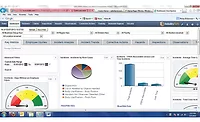
In addition to reducing administrative processes, safety management software also allows organizations to push deeper into their JSA data to discover powerful analytics in minutes.
For example, to confirm that JSAs are being conducted in a timely manner, you can use safety software’s analytic tools to quickly determine the percentage of JSAs that are overdue for review, and you can easily drill down to view JSA hazards by source, department, area and more.
Need to know the most common type of hazard identified during your organization’s JSAs? Safety management software can tell you.
Safety management software also allows for detailed follow-up across an organization. Email notifications can be scheduled to alert key team members of JSAs that have recently been created, or JSAs that are ready for review. Work procedures adapt over time, so it’s extremely helpful that safety management technology can facilitate reminders so that safety managers may regularly review JSA and confirm that previously conducted JSAs are still valid today.
By reviewing JSAs on a regular basis and taking advantage of the valuable tools offered by safety management software, you can establish an ongoing commitment to improving safe business practices.
Looking for a reprint of this article?
From high-res PDFs to custom plaques, order your copy today!