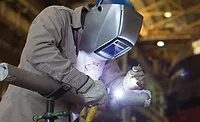
Protect welders from exposures that can cause vision loss

Welding is a full-time job for nearly 400,000 Americans, with many more conducting welding-related operations on a part-time or occasional basis.1 In fact, more than 100 different welding, cutting, soldering and brazing processes are performed across a wide range of industries every day, from manufacturing and construction, to oil and gas and more. Whatever the industry, welders face a host of inherent occupational risks: exposure to harmful radiation, fumes and gases; thermal burns; and airborne slag chips, grinding fragments and debris.
Given the hazards, it is not surprising that welding injuries outpace other occupations: in 2014, injuries requiring days away from work in the category totaled 5,720.2 Nearly 2,000 of those were eye injuries. When welders don’t properly protect their eyes from the arc, they commonly suffer welder’s flash, or photokeratitis, a condition caused by exposure to intense ultraviolet radiation resulting in temporary blindness and extreme discomfort. More extreme eye injuries can result in permanent blindness.
Welding-related injuries are costly to employers, who face medical expenses, legal fees, workers’ comp claims and reduced productivity — and oftentimes even more so to the affected worker, who may experience short-term or permanent vision loss, disability and reduced quality of life.
The good news is, many welding-related injuries are preventable with the proper protection. Today’s welding helmets afford wearers more ways to achieve the safety, comfort and visibility they require to deliver consistent, high-quality results. This article provides tips for selecting effective welding helmets to protect welders at every age and stage of their careers.
Protection first
A welding helmet is the worker’s first line of defense against hazards, and the protection it delivers is twofold. The helmet acts as a barrier that shields the eyes, face, head and neck from intense infrared radiation (heat); flying debris, weld spatter and slag; and sparks and flames. The shell should be constructed of high-quality, durable materials that amply deflect sparks and reduce the risk of burn-through for the specific application.
The helmet’s lens – either passive or auto-darkening – filters out dangerous ultraviolet and infrared radiation. The appropriate lens shade is determined based on the types of materials being welded, the welding process employed and the amps used. Be sure to consult a shade selection chart to confirm that the helmet’s lens protects at a level corresponding to that of the arc radiation generated by the application.
It is also important to note that welding helmets are considered secondary protection. Because they may be raised or removed between welding operations, ANSI-rated safety eyewear is always required as primary protection underneath a welding helmet to reduce the risk of impact.
Comfort and balance support safety
Once basic requirements for impact and radiation protection are met, consider the importance of the welding helmet’s comfort and balance. Together, these factors play a leading role in supporting compliance, safety and productivity. When a helmet doesn’t fit well, it can cause muscle strain and discomfort, which ultimately result in the helmet’s removal to make adjustments.
To promote long-lasting comfort, look for good quality suspensions made of soft, pliable materials that conform comfortably to the head. Avoid rigid plastic suspensions, which are prone to leaving gaps unless overtightened, which results in pinch points and headaches.
And if the helmet’s fit is not secure, it may be bumped out of place on impact. To ensure a secure fit for every individual, look for suspensions with multiple adjustment points. Utilize a floating ratchet that eliminates pinching or squeezing the head when tightened. By enabling workers to adjust crown height and make adjustments easily even while gloves are worn, workers achieve a comfortable, customized fit quickly.
Combination wear considerations
Another factor in delivering reliable balance is the helmet’s interaction with other forms of personal protective equipment (PPE). Welding helmets are commonly worn with hard hats, respirators and hearing protection, and each additional piece of equipment can affect the helmet’s balance. A well-fitting welding helmet provides a reliable foundation for other forms of PPE, while conversely, an ill-fitting helmet’s qualities will be exacerbated by the addition of PPE.
Pairing helmets with hard hats is common, and many mounting systems are available to attach the two. If the helmet will be switched out frequently, look for an easy-to-use, fully adjustable mounting system designed to fit any style of hard hat, and with a brim tab design that allows the welding helmet to fit securely onto the hard hat. For long-term secure situations, look for attachment components that are pre-installed and permanently fixed onto the hard hat for ease of use.
Optic clarity and lens magnification
Welding is detail-oriented work and a clear, unobstructed view is required to ensure clean, precise welds. Be sure the helmet you select features a high-quality lens free of distortions. This is especially important with auto-darkening filter (ADF) lenses, which are comprised of many layers; the larger the window, the greater possibility for distortion. To help ensure product and service quality, look for ADF helmets with at least a two-year warranty.
An aging workforce, which is more likely to require vision correction, may benefit from the optic clarity achieved with magnification lenses. Also referred to as cheater lenses, these inserts afford workers a sharp, close view of the area being welded, which directly supports quality and productivity.
Look to new equipment for top performance
Finally, consider the age of the welding helmets in use. While a helmet purchased 20 years ago may still meet safety requirements today, workers relying on outdated equipment are at a disadvantage when it comes to overall performance. Recent advances such as lighter weight materials and sleek shell designs reduce weight and bulk, while innovations in suspension significantly improve comfort and fit.
New designs also allow for improved combination wear, increasing stability and improving interaction with other PPE.
And a general caution to younger welders: beware of selecting a welding helmet based on good looks alone. While a helmet decorated with flashy graphics may look appealing, remember that its primary purpose is to protect from serious hazards and enable high quality work. Individuals entering the field can make a positive impression by choosing a welding helmet renowned for safety and durability rather than one that simply looks good.
Welders face a variety of hazards, and welding helmets are their first line of defense against burns, impact and eye injuries. Today’s welding helmets offer new designs and features that improve safety, comfort, optic clarity and overall performance so workers can focus on delivering reliable welds, rather than making adjustments to poorly designed PPE. By providing new, high-quality welding helmets, employers can reduce recordables, support quality and improve productivity -- and most importantly, send welders home safe at the end of every shift.
1 Bureau of Labor Statistics, U.S. Dept. of Labor, Occupational Outlook Handbook, 2016-17 Edition, Welders, Cutters, Solderers and Brazers, http://www.bls.gov/ooh/production/welders-cutters-solderers-and-brazers.htm
2 Bureau of Labor Statistics, U.S. Dept. of Labor, Nonfatal Occupational Injuries and Illnesses Requiring Days Away from Work, 2014, http://www.bls.gov/news.release/pdf/osh2.pdf
Looking for a reprint of this article?
From high-res PDFs to custom plaques, order your copy today!