ISHN logo
search
cart
facebook twitter linkedin youtube
  • Sign In
  • Create Account
  • Sign Out
  • My Account
ISHN logo
  • NEWS
    • Today's News
    • Global Safety News
    • Government Regulations
  • PRODUCTS
    • Product Innovations
    • Featured Products
  • TOPICS
    • Environmental Health and Safety
    • Facility Safety
    • Workplace Health
    • Occupational Safety
    • PPE
    • More Topics
  • CONSTRUCTION
  • TECHNOLOGY
  • COLUMNS
    • Best Practices
    • Dave Johnson: What’s going on
    • Editorial Comments
    • Leading Safety
  • MULTIMEDIA
    • ISHN Podcast
    • Videos
    • Cold Stress Education Quiz
    • Webinars
    • White Papers
  • MORE
    • Buyer's Guide
    • Newsletters
    • Convention Companion
    • Polls
    • Events
    • ISHN Store
    • Sponsor Insights
  • EMAGAZINE
    • eMagazine
    • Archived Issues
    • Contact
    • Advertise
  • JOIN TODAY!
Environmental Health and Safety

Text-based gas detection alarms eliminate uncertainty
By Michelle Hammons
Industrial Scientific Corporation

Photos courtesy of Industrial Scientific Corporation.

May 3, 2016

The “Triple Constraint” is a well-known principal of project management. It essentially says that if your project scope expands, you’re going to need more time and money to get it done. While the principal makes a lot of sense, the reality is that we are being asked to do more with less. Budgets are shrinking. Resources are tight. Schedules are rushed. We’re all looking for ways to cut costs and increase productivity.

Where does gas detection fit in a world of doing more with less? In a lot of ways, it creates a high level of complication. Failing to properly train personnel to use gas monitoring instruments can result in expensive false evacuations, injuries, and even death. Yet, effective training takes time and money. The benefits to training are clear, but so are the costs.

So what can we do to keep our people safe without committing to expensive and time-consuming training programs? New technologies in gas detection are addressing that exact question.

Current training

If we look at current gas detection training programs, a significant portion of our efforts are focused on making sure people know how to respond to an alarm event. In order to ensure that responses are appropriate, we have to train our teams to be experts in gas detection. We spend hours instructing workers on the hazards associated with exposure to gases at varying levels. We hope they memorize that 8 ppm of HCN requires immediate action, but 8 ppm of CO is within the acceptable range.

Fortunately, lights and audible alarms are designed to take some of the mystery out of hazardous gas conditions. Gas monitors use different colored lights and varying sounds to convey a variety of messages. However, those lights and sounds require some interpretation. How will your team remember what to do if weeks or even months go by without a gas event? Uncertainty leads to company policies that say to evacuate every time a gas monitor goes into alarm, but are all of those evacuations really necessary?

Training sessions become shorter because you no
longer have to spend hours training personnel to be
experts in gas detection.

Text-based alarms

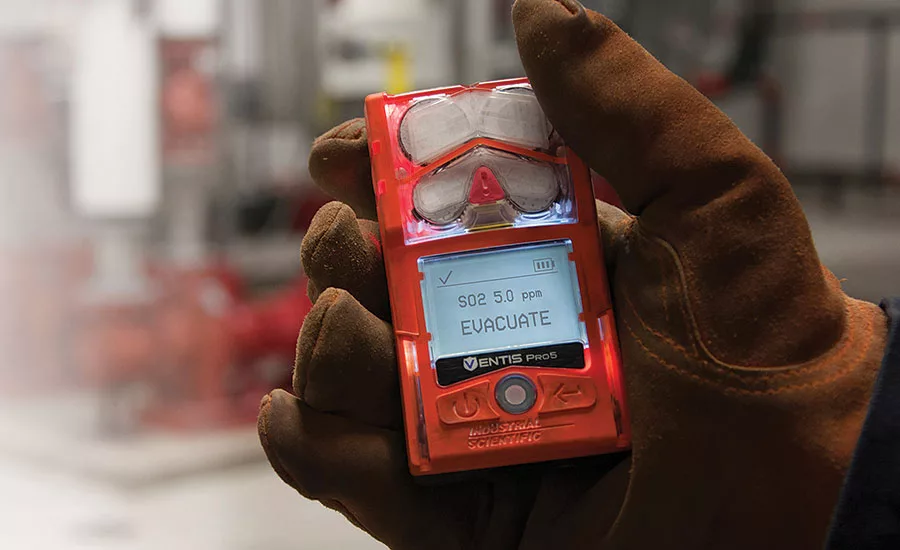
New text-based alarm action messages eliminate confusion and allow teams to focus on taking action in the moment. In addition to displaying traditional gas readings, new technology allows companies to customize a message for each level of alarm for each gas type. For example, instead of seeing an oxygen reading of “18.5 percent vol” and flashing lights, teams can see the word “Evacuate” on their gas monitors. Hesitation is eliminated. No time is lost trying to interpret alarms or remember company policy.

Clear text-based alarm action messages give us a way to make sure that everyone, regardless of experience level, knows what to do in the event of a gas event. Whether an employee has years of gas detection experience or is a temporary worker on his first day, a gas monitor that provides clear text instruction shifts the focus away from understanding the nuances of gas detection to taking appropriate action.

Less to memorize

The impact of text-based alarm action messages is immediate and significant. Training sessions become shorter because you no longer have to spend hours training personnel to be experts in gas detection. Instead of dedicating time to how to respond to various levels of hydrogen sulfide (H2S), for example, the alarm action messages can say “Use Respirator” for a low alarm and “Evacuate” for a high alarm. There’s less critical information for our teams to memorize, which means we can address things like how to safely evacuate with more emphasis than before.

Another advantage to alarm action messages is that they can reduce the number of needless evacuations and work stoppages. With clear instructions such as “PPE Required” or “Ventilate,” our teams are made aware of the hazard and are instructed on what to do next. The messages can be used to make it very clear when evacuation is required and when there are other steps that should be taken.

Possibly the most critical advantage of using text-based alarm action messages is the clarity that they provide in times of emergency. Not only do instrument operators not need to recall what the various levels and concentrations of gases mean, any hesitation that might occur because of the criticality of the moment is reduced.

Do more with less

With the introduction of text-based alarm action messages, we are finally able to defy the “Triple Constraint” and do more with less. The alarm action messages help to lower our training costs, reduce false evacuations, and improve response times by providing clear text-based instruction during alarm events.

KEYWORDS: gas detection

Share This Story

Looking for a reprint of this article?
From high-res PDFs to custom plaques, order your copy today!

Michelle Hammons serves as Product Manager at Industrial Scientific and can be reached at 1-800-DETECTS.

Recommended Content

JOIN TODAY
to unlock your recommendations.

Already have an account? Sign In

  • forklift safety

    Exploring the latest technologies in forklift safety

    With more staff and more stock in warehousing now more...
    Facility Safety
    By: Josh Cramer
  • welding

    All about welder’s flash or arc eye

    A flash burn is a painful inflammation of the cornea,...
    Environmental Health and Safety
  • dangerous jobs

    The 10 most dangerous jobs in the U.S.

    On-the-job deaths have been rising — hitting the highest...
    Construction Industry Safety and Health
    By: Benita Mehta
Manage My Account
  • eMagazine Subscriptions
  • ISHN Newsletter & Other Newsletter Alerts
  • Online Registration
  • Manage My Preferences
  • Subscription Customer Service

More Videos

Sponsored Content

Sponsored Content is a special paid section where industry companies provide high quality, objective, non-commercial content around topics of interest to the ISHN audience. All Sponsored Content is supplied by the advertising company and any opinions expressed in this article are those of the author and not necessarily reflect the views of ISHN or its parent company, BNP Media. Interested in participating in our Sponsored Content section? Contact your local rep!

close
  • man wearing the the Sundström SR200 Full Face Mask Respirator
    Sponsored byOHD

    5 Fit Testing Mistakes That Could Cost You

  • This image shows Magid AcuSpex polarized blue mirrored safety glasses.
    Sponsored byMagid Glove and Safety

    Construction PPE Guide: What Crews Need for Each Task

  • lone worker in confined space
    Sponsored byAlphasense Ltd.

    GET THE LEAD OUT of your Safety Oxygen Sensors!

Popular Stories

SpaceX 7 launch

OSHA Investigating Fatal Fall at SpaceX Starbase

Worker Impairment

How to Tell When a Co-Worker is Impaired? A Safety Pro’s Challenge

Automated loading dock equipment

After March 2026 Rivian Death, Safety Managers Reassess Loading Dock Systems Under OSHA's Warehouse Emphasis Program

top 10 most dangerous jobs

Poll

Seasonal Readiness

With the federal heat stress prevention rule on the horizon, which area of your safety program needs the most attention?
View Results Poll Archive

Products

Surviving an OSHA Audit A Management Guide, 2nd Edition

Surviving an OSHA Audit A Management Guide, 2nd Edition

See More Products

ISHN Podcasts

Related Articles

  • Gas detection advances eliminate worker excuses

    See More
  • ISHN0717_F3_pic.jpg

    Environmentally-friendly gas detection

    See More
  • Subscription based gas detection: When will you make the switch?

    See More

Related Directories

  • WatchGas Detection

    Founded in 2018 in Rotterdam, WatchGas manufactures the SST Range of portable gas detectors, including multi-gas and single-gas devices. Unlike others, we focus on compliance, ensuring reliable, cost-effective solutions without hidden fees. With global offices and distributors, WatchGas is your trusted partner for safe, compliant gas detection worldwide.
×

Become a Leader in Safety Culture

Build your knowledge with ISHN, covering key safety, health and industrial hygiene news, products, and trends.

JOIN TODAY
  • RESOURCES
    • Advertise
    • Contact Us
    • Directories
    • Manufacturing Division
    • Store
    • Want More
  • SIGN UP TODAY
    • Create Account
    • eMagazine
    • Newsletters
    • Customer Service
    • Manage Preferences
  • SERVICES
    • Marketing Services
    • Reprints
    • Market Research
    • List Rental
    • Survey/Respondent Access
  • STAY CONNECTED
    • LinkedIn
    • Facebook
    • YouTube
    • X (Twitter)
  • PRIVACY
    • PRIVACY POLICY
    • TERMS & CONDITIONS
    • DO NOT SELL MY PERSONAL INFORMATION
    • PRIVACY REQUEST
    • ACCESSIBILITY

Copyright ©2026. All Rights Reserved BNP Media, Inc. and BNP Media II, LLC.

Design, CMS, Hosting & Web Development :: ePublishing