The cutting edge of hand protection
Form-fitting gloves and cut-resistant materials
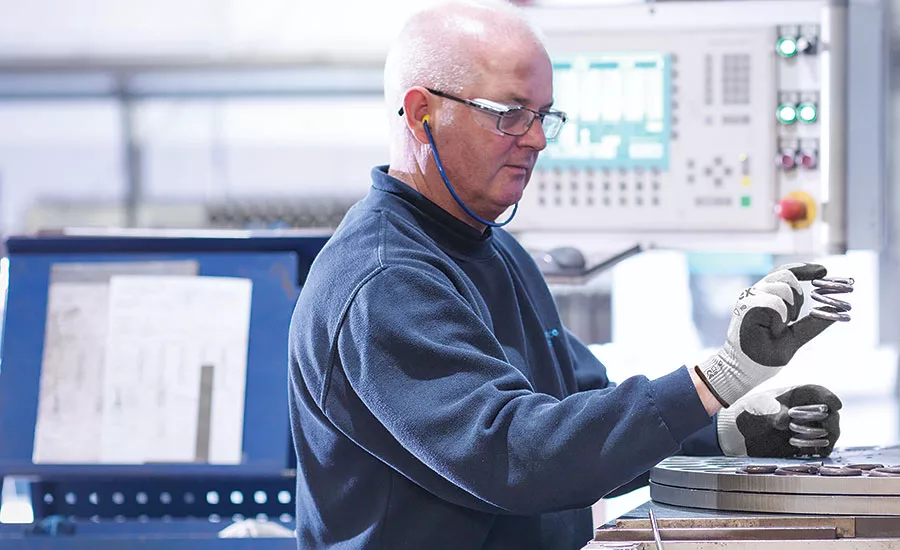
Photo courtesy of Ansell
If you want to understand the evolution of hand protection in the workplace, look no further than the Electrolux plant in Memphis, Tennessee. Nearly half of the plant’s 500 employees are women – well ahead of national numbers showing women making up about 27 percent of the manufacturing workforce. What’s different in Memphis? It’s a newer facility, and everything from automated operations to a brighter, more worker-friendly environment seems to be making the factory more appealing to women. We’re seeing similar trends in factories around the world, even if growth in the U.S. is more measured.1
What does this have to do with hand protection? Practically speaking, it’s creating a significant new demand for industrial gloves in smaller sizes. That may sound simple, but it’s not. Few manufacturers are mass-producing gloves in sizes suitable for women, and the adjustments go beyond size and must account for variances in muscle fatigue and dexterity. Additionally, the changing nature of manufacturing jobs – including an increasing emphasis on final assembly as heavy assembly becomes increasingly automated – shifts the focus for gloves toward dexterity, tactility and comfort. And understand: Every innovation in hand protection is driven by a desire to improve the comfort, performance and protection of today’s workers.
Enter ergonomics
Manufacturers are driven to design and engineer gloves that provide the protection necessary for the job, and that are compliant with current regulations. Minimizing hand fatigue and discomfort are important considerations, and new trends around form-fitting gloves in lightweight materials with second skin-like feel are driving innovation in the market. Studies consistently show comfort is the No. 1 universal user need. This requires R&D teams to think differently about muscle performance, hand fatigue and the materials used in today’s gloves.
Some categories of hand protection are obvious – such as cut-prevention or protection from fire or chemicals, for example – but there are other pieces to the hand protection puzzle that aren’t as obvious. Nearly two-thirds of reported occupational injuries can be classified as repetitive stress reactions, and these can be debilitating and incredibly costly to both worker and employer. Consider this: Workers who suffer repetitive stress injuries, on average, require 23 days to fully recover—14 more than the average for all other injuries. And these injuries cost employers some $80 billion per year.2
Repetitive stress injuries are tied to certain tasks and the impact of those tasks on the muscles and surrounding joints. These injuries and conditions, such as carpal tunnel syndrome (the most common repetitive stress injury, affecting more than eight million people in the U.S. alone),3 are real and can be chronic. Gloves play a factor. The question becomes: Are they helping to prevent these issues, or are they contributing to them?
Having the right glove for the job is critical. For workers handling oily parts, this means improving grip so less muscle effort is required to hold or use a tool or machine part. Alternatively, the wrong glove can exacerbate a problem by inhibiting motion. A certain design or material (such as leather, which is bulky) may make the movement required to complete a task more difficult. However, the same glove that works against certain movements may be perfectly suited for others. With that in mind, it is essential for R&D teams to understand the various tasks and movements of workers. From there, it’s possible to design and engineer gloves that at least minimize any resistance from the glove and, at best, actually support and encourage the movements necessary for the job. That is the science of ergonomics, and it’s a new frontier in innovation within glove design.
Cut protection
Improving the comfort and performance of gloves through the use of new materials and innovative, ergonomic design is critical for any number of reasons – not the least of which is simply improving the rate of compliance for workers needing hand protection. The evolution in comfort, however, cannot come with any sort of compromise in protection. Hand injuries in the workplace account for 13 percent of all industrial injuries, and cuts can be especially costly with an average price tag of almost $22,000 per incident.4
Employers are aware of the risks and increasingly are requiring their workers to wear gloves with cut protection. Unfortunately, many businesses are overprotective, insisting upon gloves with ANSI cut levels beyond the needs of the job. This can be counterproductive, because those gloves may be heavier, less comfortable and may not perform as well as gloves better matched to the job. Asking workers to wear gloves ill-suited for the job can push them to remove the gloves altogether, putting their hands at greater risk and the plant in non-compliance.
It doesn’t have to be this way. New in-house yarns specifically provide cut protection while reducing the cost of materials. Historically, many of the most effective cut protection gloves have carried premium price tags, mostly due to the cost of materials. With cost no longer a deterrent, these proprietary yarns and other advanced materials and designs make it possible to deliver lightweight, breathable gloves with multiple levels of ANSI cut level protection. These gloves also provide additional advanced features, such as silicon-free coating, dirt-masking colors, and improved grip and abrasion resistance.
Ultimately, the benefit of all this innovation is simple: There are more choices available to today’s workers than ever before. The tasks men – and women – around the world are performing and the risks associated with them differ across industries. Today’s fabrics are better, lighter and more breathable, allowing improved dexterity and tactility. New coating formulations last longer and improve grip and abrasion resistance. Today’s multipurpose gloves are lighter, and deliver a more comfortable all-day experience, while disposable, single-use gloves are getting lighter and thinner while maintaining their protective qualities.
Bottom line: It is critical for safety managers to maintain their focus on compliance while providing their workers with the most optimal hand protection experience.
1 www2.deloitte.com/content/dam/Deloitte/us/Documents/manufacturing/us-mfg-women-in-manufacturing-2015-study.pdf
2 www.legalmatch.com/law-library/article/repetitive-motion-accident-statistics.html
3 www.legalmatch.com/law-library/article/repetitive-motion-accident-statistics.html
4 2014 USA National Safety Council 2014 INJURY DATA
Looking for a reprint of this article?
From high-res PDFs to custom plaques, order your copy today!