OSHA Hazard Communication Standard (HAZCOM) 1910.1200
History
OSHA's Hazard Communication Standard (HAZCOM) was first adopted in 1983 in the United States with limited scope (48 FR 53280; November 25, 1983). In 1987, scope was expanded to cover all industries where employees are potentially exposed to hazardous chemicals (52 FR 31852; August 24, 1987). OSHA revised its Hazard Communication Standard (HCS) to align with the United Nations' Globally Harmonized System of Classification and Labeling of Chemicals (GHS) and published it in the Federal Register in March 2012 (77 FR 17574).
Why this standard is important
The new standard covers over 43 million workers who produce or handle hazardous chemicals in more than five million workplaces across the country. The modification is expected to prevent over 500 workplace injuries and illnesses and 43 fatalities annually.
Hazards
The OSHA Hazard Communication Standard (HCS) is intended to ensure exposed these workers and their employers are informed of the identities of these hazardous chemicals, associated health and safety hazards, and appropriate protective measures. The HCS covers some 650,000 hazardous chemical products.
Enforcement Statistics
October 2015 through September 2016 – totals for all industries
Citations: 4,911
Inspections: 1,080
Penalty: $3,831,401
#2 on OSHA’s Top 10 Most Frequently Cited Standards
Most Frequently Cited Provisions
- Employers shall maintain any safety data sheets that are received with incoming shipments of hazardous chemicals, and ensure that they are readily accessible during each workshift to laboratory employees when they are in their work areas.
- Chemical manufacturers and importers are required to evaluate the hazards of the chemicals they produce or import, and prepare labels and safety data sheets to convey the hazard information to their downstream customers.
- All employers with hazardous chemicals in their workplaces must have labels and safety data sheets for their exposed workers, and train them to handle the chemicals appropriately.
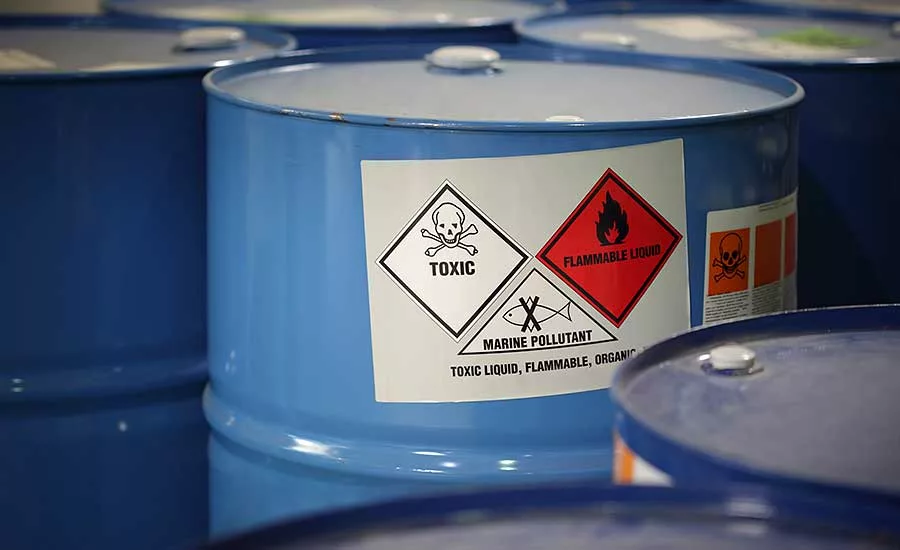
- Chemical manufacturers and importers are required to provide a label that includes a harmonized signal word, pictogram, and hazard statement for each hazard class and category. Precautionary statements must also be provided.
Most cited industries
- Specialty Trade Contractors
- Fabricated Metal Product Manufacturing
- Repair and Maintenance
- Merchant Wholesalers, Durable Goods
- Administrative and Support Services
- Nonmetallic Mineral Product Manufacturing
- Wood Product Manufacturing
- Construction of Buildings
- Machinery Manufacturing
- Food Manufacturing
What must employers do to protect employees?
This occupational safety and health standard is intended to address comprehensively the issue of classifying the potential hazards of chemicals, and communicating information concerning hazards and appropriate protective measures to employees. Classifying the potential hazards of chemicals and communicating information concerning hazards and appropriate protective measures to employees, may include, for example, but is not limited to, provisions for: developing and maintaining a written hazard communication program for the workplace, including lists of hazardous chemicals present; labeling of containers of chemicals in the workplace, as well as of containers of chemicals being shipped to other workplaces; preparation and distribution of safety data sheets to employees and downstream employers; and development and implementation of employee training programs regarding hazards of chemicals and protective measures.
Employers must establish a training and information program for employees who are exposed to hazardous chemicals in their work area at the time of initial assignment and whenever a new hazard is introduced into their work area. At a minimum, the discussion topics must include the following:
- The hazard communication standard and its requirements.
- The components of the hazard communication program in the employees' workplaces.
- Operations in work areas where hazardous chemicals are present.
- Where the employer will keep the written hazard evaluation procedures, communications program, lists of hazardous chemicals, and the required MSDS forms.
The employee training plan must consist of the following elements:
- How the hazard communication program is implemented in that workplace, how to read and interpret information on labels and the MSDS, and how employees can obtain and use the available hazard information.
- The hazards of the chemicals in the work area. (The hazards may be discussed by chemical or by hazard categories such as flammability.)
- Measures employees can take to protect themselves from the hazards.
- Specific procedures put into effect by the employer to provide protection such as engineering controls, work practices, and the use of personal protective equipment (PPE).
- Methods and observations -- such as visual appearance or smell -- workers can use to detect the presence of a hazardous chemical to which they may be exposed.
HAZCOM Standard Compliance Directive
Directive Number: CPL 02-02-079
Old Directive Number: CPL 02-02-038
Subject: Inspection Procedures for the Hazard Communication Standard (HCS 2012)
Effective Date: 07/09/2015
Key Letters of Interpretation
HCS 2012 allows chemical manufacturers and importers to combine hazard statements where the information is related and the combination can shorten the text required on the label. Appendix C.2.2.1 states, “Hazard statements may be combined where appropriate to reduce the information on the label and improve readability, as long as all of the hazards are conveyed as required.” Since the hazard statement, “Causes severe skin burns and eye damage,” includes “eye damage,” it is acceptable to omit the second hazard statement.
Under the HCS, classifiers are required to "evaluate chemicals produced in their workplaces or imported by them to classify the chemicals in accordance with this section." 29 CFR 1910.1200(d)(1). Any such classification must "identify and consider the full range of available scientific literature and other evidence concerning the potential hazards." 1910.1200(d)(2). However, there "is no requirement to test the chemical to determine how to classify its hazards." Id. The classifier must consider not only the hazards of the chemical in the form it is shipped, but also consider the hazards that arise under normal conditions of use and foreseeable emergencies. When performing inspections of classifiers, CSHOs must ensure that the requirement to consider normal conditions of use and foreseeable emergencies is followed by the classifier.
Compliance Assistance
OSHA’s Hazard Communication Standard Fact Sheet offers details on the changes to the standard, describes benefits and provides information on what you need to do and when.
Hazard Communication issues page. OSHA has a technical link page that is devoted to hazard communication issues. The webpage provides easy access to guidance materials, answers to frequently asked questions, and sources of additional information.
Frequently asked questions. OSHA has a question-and-answer section devoted to the HAZOM standard.
Chemical Hazard Communication, OHSA 3084. This informational booklet is intended to provide a generic, non-exhaustive overview of a particular standards related topic.
Hazard Communication in the 21st Century Workplace. OSHA report with detailed information on the history of the standard, material safety data sheets, development of the GHS, guidance on addressing issues and information on HAZCOM studies.
Sponsor: www.bradyid.com, 1-855-395-5693

Looking for a reprint of this article?
From high-res PDFs to custom plaques, order your copy today!