ISHN logo
search
cart
facebook twitter linkedin youtube
  • Sign In
  • Create Account
  • Sign Out
  • My Account
ISHN logo
  • NEWS
    • Today's News
    • Global Safety News
    • Government Regulations
  • PRODUCTS
    • Product Innovations
    • Featured Products
  • TOPICS
    • Environmental Health and Safety
    • Facility Safety
    • Workplace Health
    • Occupational Safety
    • PPE
    • More Topics
  • CONSTRUCTION
  • TECHNOLOGY
  • COLUMNS
    • Best Practices
    • Dave Johnson: What’s going on
    • Editorial Comments
    • Leading Safety
  • MULTIMEDIA
    • ISHN Podcast
    • Videos
    • Cold Stress Education Quiz
    • Webinars
    • White Papers
  • MORE
    • Buyer's Guide
    • Newsletters
    • Convention Companion
    • Polls
    • Events
    • ISHN Store
    • Sponsor Insights
  • EMAGAZINE
    • eMagazine
    • Archived Issues
    • Contact
    • Advertise
  • JOIN TODAY!
Today's Safety NewsEnvironmental Health and SafetyColumnsSafety Industry White PapersOSHA Workplace Training Strategies

Satisfied with your safety management system?

Here’s how to determine efficiency
By Flavio Simon
safety management systems
February 1, 2017

Literature is replete with examples of Safety Management Systems (SMS) that have been put together and implemented in all types of businesses and industries. I venture to say that, besides a variety of creative acronyms and different strategical approaches of implementation, significant portions of most SMSs share the same basic core principles.

It is implicit that any SMS should deliver a number of goals: safety performance, instituting standards and practices, compliance with regulatory requirements, communications and dissemination of information, setting up responsibilities & rights, etc.

I also think that, pragmatically, the ultimate goal of any SMS should be to guide employees to an accident-free workplace. To be realistic, we can define “accident-free” as zero preventable accidents.

Assuming that the above considerations and the ultimate goal are fair and relevant, then how can we determine the efficiency of a particular SMS?


Key performance indicators

One possible answer could be to use key performance indicators (KPIs) that have been established, for instance, by regulatory entities — the Occupational Safety & Health Administration (OSHA), the Department of Transportation and so forth.

Some of these KPIs collect past events, and as such are classified as lagging indicators; other KPIs, classified as leading indicators collect information that happened in the past but suggest important hints about possible future events that, by establishing and implementing preventive actions, could be completely avoided.

Lagging indicators, some examples:

• OSHA recordable injuries

• Vehicle crashes

• Release of hazardous chemicals to the environment

• Citations and fines for non-compliance


Leading indicators, some examples:

• Reporting behavior-based observations

• Reporting unsafe conditions

• Results (scores) of inspections & audits and time to close their respective corrective actions

• Hours of safety training / employee

• Execution of pre & post job safety meetings


Benefits of tracking

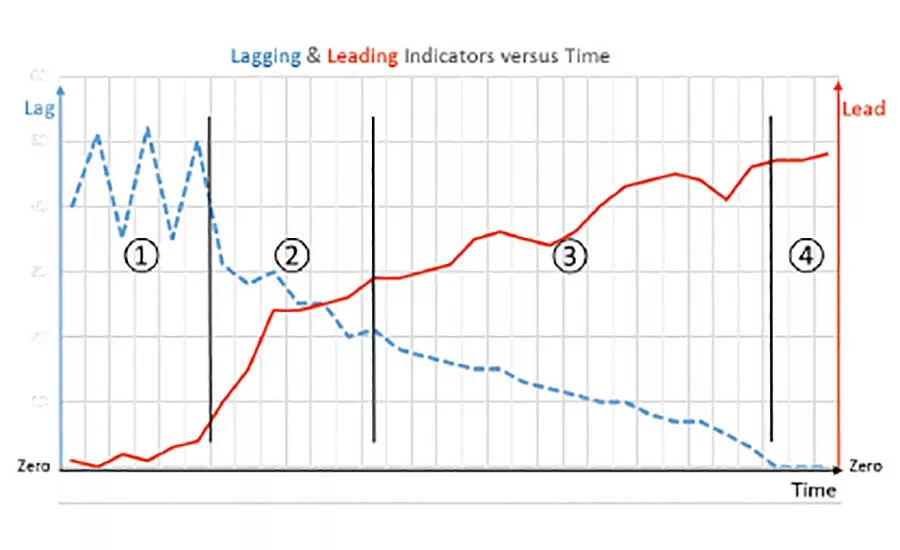
Reporting, recording, managing and tracking lagging and leading indicators versus time, could yield results similar to the following example graph:

The degree of efficiency (rate of improvement) of the SMS would be evidenced by the development of a succession of phases showing a continual improvement of the chosen indicators:

Phase 1 — Pre-SMS: Lagging indicators show a higher than zero value and, frequently, sawtooth pattern that may characterize out-of-control processes. Leading indicators (solid red line) are negligible.

Phase 2 — SMS Kick-off: Lagging indicators start to show improvement (down-trend). Leading indicators, reflecting the participation of the workforce, show improvement by steadily increasing.

Deviation in the ideal behaviors of the lines as seen in the above graph — such as sawtooth pattern, plateaus or, worse, a reversal in the slope over a couple of months — would indicate the necessity to intervene, for instance, with the application of the Deming Wheel methodology, more commonly known as the PDSA Cycle (Plan-Do-Study-Adjust).

Phase 3 — Maintain focus: This is a critical phase where a false sense of achievement sometimes leads to complacency. Continuous effort is necessary to avoid circumstances that may set back past gains and achievements. The occurrence of a preventable accident, a serious nonconformity per se, should trigger a specific PDSA Cycle in order to block the reoccurrence of its root cause(s).

Phase 4 — Celebration: the ultimate goal is achieved, i.e., Lagging indicators indicate zero preventable accidents. Leading indicators remain steady or increasing, thus proving to be vital components of the overall improvement in the safety performance. As with the previous phase, it’s critical to avoid complacency.

Final considerations

  • The efficiency of a SMS can be evaluated by tracking how a number of lagging and leading Indicators evolve over time (phases).
  • Mostly important: an SMS achieves its ultimate efficiency only when it leads to zero preventable accidents over extended periods of time.
KEYWORDS: ISO 45001 occupational health and safety management systems safety management systems

Share This Story

Looking for a reprint of this article?
From high-res PDFs to custom plaques, order your copy today!

Flavio Simon is an HSE, Quality and General Management leader with exposure to business sectors such as O&G, Mining, Civil Engineering and Manufacturing. He spent 15 years as an expatriate, working on numerous multi-cultural projects with English, Spanish and Portuguese-speaking clients and corporations. He holds a BSc in Geology and attended an MBA-intensive course as part of his ongoing continuing education. He is a Certified ASP as well as an ISO 9001 Auditor/Lead Auditor. He authored/co-authored several technical papers and also participated in the API-PIDX Committee that revamped the “RP 76 - Contractor Safety Management for Oil and Gas Drilling and Production Operations”. He is member of AAPG and SPE. He has dedicated the last 11 years of service to the implementation of accident free work environments and prevention of quality non-conformities.

Recommended Content

JOIN TODAY
to unlock your recommendations.

Already have an account? Sign In

  • forklift safety

    Exploring the latest technologies in forklift safety

    With more staff and more stock in warehousing now more...
    Facility Safety
    By: Josh Cramer
  • welding

    All about welder’s flash or arc eye

    A flash burn is a painful inflammation of the cornea,...
    Environmental Health and Safety
  • dangerous jobs

    The 10 most dangerous jobs in the U.S.

    On-the-job deaths have been rising — hitting the highest...
    Construction Industry Safety and Health
    By: Benita Mehta
Manage My Account
  • eMagazine Subscriptions
  • ISHN Newsletter & Other Newsletter Alerts
  • Online Registration
  • Manage My Preferences
  • Subscription Customer Service

More Videos

Sponsored Content

Sponsored Content is a special paid section where industry companies provide high quality, objective, non-commercial content around topics of interest to the ISHN audience. All Sponsored Content is supplied by the advertising company and any opinions expressed in this article are those of the author and not necessarily reflect the views of ISHN or its parent company, BNP Media. Interested in participating in our Sponsored Content section? Contact your local rep!

close
  • man wearing the the Sundström SR200 Full Face Mask Respirator
    Sponsored byOHD

    5 Fit Testing Mistakes That Could Cost You

  • This image shows Magid AcuSpex polarized blue mirrored safety glasses.
    Sponsored byMagid Glove and Safety

    Construction PPE Guide: What Crews Need for Each Task

  • lone worker in confined space
    Sponsored byAlphasense Ltd.

    GET THE LEAD OUT of your Safety Oxygen Sensors!

Popular Stories

SpaceX 7 launch

OSHA Investigating Fatal Fall at SpaceX Starbase

dust explosion

Tennessee OSHA Issues Record $3.1M Fine After Deadly Explosion at Munitions Plant

roofing dangerous jobs Getty.jpg

OSHA Finds Florida Roofing Company Willfully Exposed Workers to Safety Hazards After Worker’s Fatal Fall

top 10 most dangerous jobs

Poll

Seasonal Readiness

With the federal heat stress prevention rule on the horizon, which area of your safety program needs the most attention?
View Results Poll Archive

Products

Surviving an OSHA Audit A Management Guide, 2nd Edition

Surviving an OSHA Audit A Management Guide, 2nd Edition

See More Products

ISHN Podcasts

Related Articles

  • safety management systems

    Satisfied with your safety management system?

    See More
  • inspector on a jobsite

    How to Reset & Revitalize Your Workplace Safety and Health Management System

    See More
  • FAA's safety management system proposed rule should reference existing safety standards, says ASSE (10/26)

    See More

Related Products

See More Products
  • 1118645685.jpg

    Advanced Safety Management: Focusing on Z10 and Serious Injury Prevention, 2nd Edition

See More Products
×

Become a Leader in Safety Culture

Build your knowledge with ISHN, covering key safety, health and industrial hygiene news, products, and trends.

JOIN TODAY
  • RESOURCES
    • Advertise
    • Contact Us
    • Directories
    • Manufacturing Division
    • Store
    • Want More
  • SIGN UP TODAY
    • Create Account
    • eMagazine
    • Newsletters
    • Customer Service
    • Manage Preferences
  • SERVICES
    • Marketing Services
    • Reprints
    • Market Research
    • List Rental
    • Survey/Respondent Access
  • STAY CONNECTED
    • LinkedIn
    • Facebook
    • YouTube
    • X (Twitter)
  • PRIVACY
    • PRIVACY POLICY
    • TERMS & CONDITIONS
    • DO NOT SELL MY PERSONAL INFORMATION
    • PRIVACY REQUEST
    • ACCESSIBILITY

Copyright ©2026. All Rights Reserved BNP Media, Inc. and BNP Media II, LLC.

Design, CMS, Hosting & Web Development :: ePublishing