ISHN logo
search
cart
facebook twitter linkedin youtube
  • Sign In
  • Create Account
  • Sign Out
  • My Account
ISHN logo
  • NEWS
    • Today's News
    • Global Safety News
    • Government Regulations
  • PRODUCTS
    • Product Innovations
    • Featured Products
  • TOPICS
    • Environmental Health and Safety
    • Facility Safety
    • Workplace Health
    • Occupational Safety
    • PPE
    • More Topics
  • CONSTRUCTION
  • TECHNOLOGY
  • COLUMNS
    • Best Practices
    • Dave Johnson: What’s going on
    • Editorial Comments
    • Leading Safety
  • MULTIMEDIA
    • ISHN Podcast
    • Videos
    • Cold Stress Education Quiz
    • Webinars
    • White Papers
  • MORE
    • Buyer's Guide
    • Newsletters
    • Convention Companion
    • Polls
    • Events
    • ISHN Store
    • Sponsor Insights
  • EMAGAZINE
    • eMagazine
    • Archived Issues
    • Contact
    • Advertise
  • JOIN TODAY!
Environmental Health and SafetyIndustrial HygienePPECoronavirus Coverage

Industrial hygienists are vital players in the war against SARSCOV-2
By Greg Richey, CIH, CSP, FAIHA
Industrial Hygiene
May 14, 2020

Industrial hygiene may not be a household name, but our knowledge base is exactly what is needed to help win this fight. The American Board of Industrial Hygiene (ABIH) defines the discipline as (emphasis added):

“Industrial hygiene is the science of protecting and enhancing the health and safety of people at work and in their communities. Health and safety hazards cover a wide range of chemical, physical, biological and ergonomic stressors. Those dedicated to anticipating, recognizing, evaluating and controlling those hazards are known as Industrial Hygienists. They are professionals dedicated to the well-being of people – at work, at home and in the community.”

A major responsibility of Industrial Hygienists (IHs) is to educate both the workforce and management about the hazards in their workplaces. We know how to evaluate hazards and use all the controls available to mitigate risk. For instance:

  • IHs understand the physics of aerosols and how a cough, sneeze or even speech can spread virus-containing droplets through the air, and what it takes to engineer out a hazard using ventilation, filtration and barriers.
  • His understand the chemistry of disinfectants and know what is effective at neutralizing the virus and what it takes to effectively decontaminate a person or surface.
  • IHs understand physical means of virus destruction such as heat, cold, ultraviolet light and ionization.
  • IHs routinely measure the quantity of hazardous substance in a workplace and can verify whether cleaning procedures are working to remove virus surface contamination in a given environment.
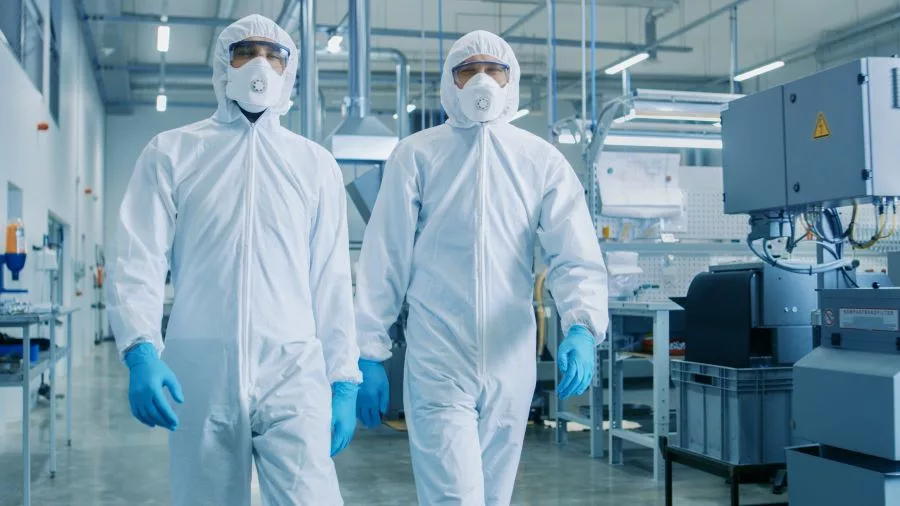
  • IHs know the ins and outs of personal protective equipment, in particular respiratory protection.

IHs know how to devise and educate workers on administrative controls.

Engineering Controls

In the hierarchy of controls engineering controls are at the forefront when it comes to a naturally occurring airborne biological hazard. Where an infection exists isolation of a space by putting it under negative pressure with HEPA filtration is essential to keep the virus from spreading. A NASA study has shown that HEPA filtration can effectively capture the virus even though it is very small (approximately 0.125 micrometers in diameter.)  

Barriers are another means of protecting workers. One example is workers in a meat packing plant working side by side, on a production line. Easily cleaned Plexiglas barriers were placed between each worker. This, along with the other controls, improved employee protection. We’ve likely all seen the see-through barriers going up in grocery stores to help separate checkout clerks from the general public.

Administrative Controls

In the workplace, administrative controls are practices people must participate in to protect themselves. Though social distancing, hand washing, and avoidance of face touching seem like simple rules they must be continually reinforced. Through training sessions, IHs emphasize the importance of these cardinal rules and teach management how to effectively and continually reinforce them.

Housekeeping is of paramount importance in controlling exposure to SARS Cov-2. IHs recommend procedures and disinfectants  that neutralize the virus or wash it away on surfaces and equipment. IHs can verify the effectiveness of a housekeeping procedure.  

Personal Protective Equipment

Respiratory protection is a profound area of expertise for the industrial hygienist. Since 1971 IHs have relied on laboratory certification of respirators by the U.S. HHS Department’s National Institute for Occupational Safety and Health (NIOSH), which at that time took over respirator certification from the US Bureau of Mines. NIOSH certifies respirators for a specific range of uses. Any respirator use requires training and fit testing and IHs are able provide this training to workers in many settings.  

The pandemic poses a unique problem for healthcare workers and others who must wear respiratory protection when dealing with SARS-CoV-2. The respirator of choice for most, the N95 filtering facepiece respirators (FFR) though manufactured in large quantities, are still not sufficient in number to prevent shortages. These FFRs are meant to be disposed of after a single use, but they have to be reused, often for several days due to the shortage. IHs are trained in the function, selection, cleaning and care of respirators and can advise users of the best ways to deal with FFR reuse in this unique situation.

IHs have also been on the forefront of suggesting the pros and cons of alternative face coverings, including suggestions on what not to use. For instance, furnace filters have been suggested as a face covering material, but should not be used because furnace filters may contain fiberglass that may be released. Cotton bandanas, though inefficient at filtration are okay to use when something better isn’t available to prevent an infected person from unknowingly transmitting the virus. IHs specify other PPE too, e.g. eye, hand, and gowns.

KEYWORDS: hazard assessment hazard management industrial hygiene industrial hygienists

Share This Story

Looking for a reprint of this article?
From high-res PDFs to custom plaques, order your copy today!

Greg Richey brings the benefits of 35+ years of experience from both the regulator’s and consultant’s perspectives. A Principal owner and founder of Colden, he serves as co-chair of the firm’s litigation support practice. As an expert in occupational exposure assessment, Mr. Richey has conducted thousands of safety audits and industrial hygiene surveys. Mr. Richey earned a Master of Science in Industrial Hygiene from Temple University and a Bachelor of Science in Fuel Science from Pennsylvania State University. He maintains certification in the comprehensive practice of industrial hygiene with a subspecialty in indoor environmental quality. In addition to being a Certified Industrial Hygienist, he is a Certified Safety Professional and Certified Professional Environmental Auditor.

Recommended Content

JOIN TODAY
to unlock your recommendations.

Already have an account? Sign In

  • forklift safety

    Exploring the latest technologies in forklift safety

    With more staff and more stock in warehousing now more...
    Facility Safety
    By: Josh Cramer
  • welding

    All about welder’s flash or arc eye

    A flash burn is a painful inflammation of the cornea,...
    Environmental Health and Safety
  • dangerous jobs

    The 10 most dangerous jobs in the U.S.

    On-the-job deaths have been rising — hitting the highest...
    Occupational Safety
    By: Benita Mehta
Manage My Account
  • eMagazine Subscriptions
  • ISHN Newsletter & Other Newsletter Alerts
  • Online Registration
  • Manage My Preferences
  • Subscription Customer Service

More Videos

Sponsored Content

Sponsored Content is a special paid section where industry companies provide high quality, objective, non-commercial content around topics of interest to the ISHN audience. All Sponsored Content is supplied by the advertising company and any opinions expressed in this article are those of the author and not necessarily reflect the views of ISHN or its parent company, BNP Media. Interested in participating in our Sponsored Content section? Contact your local rep!

close
  • man wearing the the Sundström SR200 Full Face Mask Respirator
    Sponsored byOHD

    5 Fit Testing Mistakes That Could Cost You

  • This image shows Magid AcuSpex polarized blue mirrored safety glasses.
    Sponsored byMagid Glove and Safety

    Construction PPE Guide: What Crews Need for Each Task

  • lone worker in confined space
    Sponsored byAlphasense Ltd.

    GET THE LEAD OUT of your Safety Oxygen Sensors!

Popular Stories

SpaceX 7 launch

OSHA Investigating Fatal Fall at SpaceX Starbase

dust explosion

Tennessee OSHA Issues Record $3.1M Fine After Deadly Explosion at Munitions Plant

roofing dangerous jobs Getty.jpg

OSHA Finds Florida Roofing Company Willfully Exposed Workers to Safety Hazards After Worker’s Fatal Fall

top 10 most dangerous jobs

Poll

Seasonal Readiness

With the federal heat stress prevention rule on the horizon, which area of your safety program needs the most attention?
View Results Poll Archive

Products

Surviving an OSHA Audit A Management Guide, 2nd Edition

Surviving an OSHA Audit A Management Guide, 2nd Edition

See More Products

ISHN Podcasts

Related Articles

  • Win the war against MRSA

    See More
  • Players in the OSHA arena

    See More
  • depression

    Report: Employers are vital to promoting mental health

    See More

Related Products

See More Products
  • fearless world.jpg

    The Fearless World of Professional Safety in the 21st Century

See More Products

Related Directories

  • The Safety Knife Co. LLC

    The Safety Knife Company has developed a quality range of safety knives for all industries. These knives have no exposed blades and only cut cardboard deep, protecting employees against lacerations as well as product.
  • CO2Meter

    Since 2006, CO2Meter has been a trusted leader in gas detection, monitoring, and analytical solutions designed to protect people, facilities, and processes across critical industries. Our mission is simple to make invisible gases visible through reliable, accurate, and compliant gas detection safety solutions. From carbon dioxide to oxygen deficiency, combustible, toxic, and refrigerant gases, CO2Meter delivers innovative gas safety devices that help organizations meet OSHA, NFPA, and local fire code requirements while safeguarding worker health and environmental integrity. Our portfolio includes fixed and portable gas detection systems, multi-gas sampling data loggers, and industrial monitoring solutions engineered for EHS programs, laboratory safety, manufacturing, food and beverage, cryogenics, and life sciences applications.
  • NASCO Industries Inc.

    NASCO manufactures rainwear for the multi-hazard workplace. Our employee-owners are proud to manufacture products that will protect against Electric Arc Flash (AR), Flash Fire (FR), Chemical Splash, Steam, Hot Water and High Visibility.
×

Become a Leader in Safety Culture

Build your knowledge with ISHN, covering key safety, health and industrial hygiene news, products, and trends.

JOIN TODAY
  • RESOURCES
    • Advertise
    • Contact Us
    • Directories
    • Manufacturing Division
    • Store
    • Want More
  • SIGN UP TODAY
    • Create Account
    • eMagazine
    • Newsletters
    • Customer Service
    • Manage Preferences
  • SERVICES
    • Marketing Services
    • Reprints
    • Market Research
    • List Rental
    • Survey/Respondent Access
  • STAY CONNECTED
    • LinkedIn
    • Facebook
    • YouTube
    • X (Twitter)
  • PRIVACY
    • PRIVACY POLICY
    • TERMS & CONDITIONS
    • DO NOT SELL MY PERSONAL INFORMATION
    • PRIVACY REQUEST
    • ACCESSIBILITY

Copyright ©2026. All Rights Reserved BNP Media, Inc. and BNP Media II, LLC.

Design, CMS, Hosting & Web Development :: ePublishing