Regular air quality tests of confined spaces identify new hazards
Enter at your own risk
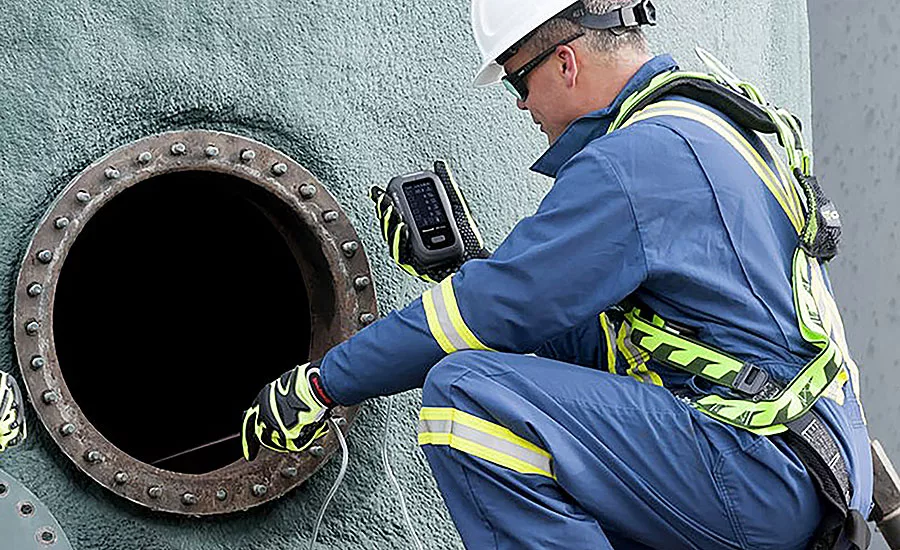
Testing for hazardous gases can be a challenge in the workplace. Invisible, odorless gases can be difficult to detect, which is why it’s important to test the air before entering the space. Everyone should be aware of these hazards so they can take the right steps to protect themselves on the job. The testing process should include the following steps:
When to test
According to the latest safety guidelines, workers should test the air inside the space before entry, continuously while working, and before re-entry. Even if forced air ventilation, like a blower, is being used to replace the atmosphere of a toxic environment and keep it clear, the space should still be tested. Air quality can change quickly in confined settings, so workers shouldn’t assume the air is safe to breathe, even if they recently tested the space.
When testing the space regularly, workers should get a sense of how quickly air quality tends to change. This will help professionals respond to new hazards throughout the day.
It’s also important to remember that testing takes time. Teams and workers should give themselves plenty of time to thoroughly test the space. The process can take anywhere from just a few minutes to an hour, depending on the safety equipment being used.
Access to the space should be regulated. Everyone going into the space should wear the proper safety gear to prevent illness, injury, or death.
How to test
To administer the test, workers need to collect a sample of the air inside the space. The best way to do this is to use a sampling hose so the worker doesn’t have to physically enter during the testing process. Workers need to give the gas detector enough time to collect a sample of the air inside. Many teams make the mistake of not giving the detector enough time to analyze the sample in question, which can lead to inaccurate results.
Most gas detectors will collect between 0.25 and 0.5 liters of air per minute. When pulling air through the sampling hose, it takes two seconds per foot of tubing for the sample to reach the monitor. The gas detector will also need some time to analyze the sample once the air has been collected. Most monitors will analyze 100 percent of the sample in just 120 seconds.
Let’s use a 10-foot sampling hose as an example. Based on the length, it would take about 20 seconds for the sample to reach the gas detector. The device would then need another two minutes to analyze the air in question. Therefore, the entire process would take around 2 minutes and 20 seconds.
Stratification
When collecting the sample, workers should account for what’s known as stratification. Some hazardous gases may be lighter or heavier than others, which means the concentration of the gas may vary throughout the space.
To account for stratification, workers should take samples in 4-foot intervals in every movable direction to make sure the sample is accurate in terms of air quality. The sampling hose can be adjusted so that the worker can collect air moving in different directions.
Cross-sensitivity
Workers also need to be aware of the dangers of cross-sensitivity. Many gas detectors are programmed to detect a single target gas, such as carbon monoxide or hydrogen gas. If the sensor comes in contact with a gas that it is not programmed to detect, it could lead to inaccurate readings.
Some non-target gases may inflate the readings on the meter. In this case, professionals may err on the side of caution and take steps to protect themselves from a higher concentration of gas than what is actually present. This situation rarely poses a threat to safety.
However, some non-target gases will deflate the readings on the meter. In this case, the meter may go down to zero or even a negative number, which is a sign that something is wrong. Users should refer to the cross-sensitivity readings to make sense of this phenomenon.
Most gas detection manufacturers will include detailed instructions regarding cross-sensitivity, so workers can interpret the readings accurately. If the meter reads zero, two hazardous gases may cancel each other out, so workers will still need to wear ventilators when occupying the space.
When using a single-gas monitor, use the following example to account for cross-sensitivity:
Let’s assume the target gas is carbon monoxide. If there is hydrogen gas present in the space, it will affect the final readings. Workers should refer to the chart to determine the cross-sensitivity of hydrogen gas exposure on a carbon monoxide gas monitor. In this case, the cross-sensitivity comes out to 60 percent for hydrogen gas. If there is 50 ppm of hydrogen gas in the space, the meter will show 30 ppm for carbon monoxide (50 x 0.6 = 30). However, if there are multiple gases in the space, the situation will only get more complicated.
Let’s use the same carbon monoxide gas detector but with nitrogen dioxide. If there is 40 ppm of nitrogen dioxide in the air, the cross-sensitivity comes out to -20 percent. This means the meter will show -8 ppm for carbon monoxide when there is only nitrogen dioxide in the space (40 x -0.2 = -8).
Again, having more than one gas in the space will further complicate the situation. To avoid cross-sensitivity, many teams will use multi-gas detectors to test for a range of hazardous gases before entering the space. The built-in sensor will target more than one gas, so workers can quickly make sense of the readings.
Testing for hazardous gases can be complicated and time consuming. Professionals can use this guide to make sure they are thoroughly testing their workplace before entering the space. When in doubt, it’s always best to re-test the space in question until the readings are as accurate as possible.
Looking for a reprint of this article?
From high-res PDFs to custom plaques, order your copy today!