Control air pollution in the workplace
The importance of pollutant capturing when utilizing fume extraction technology
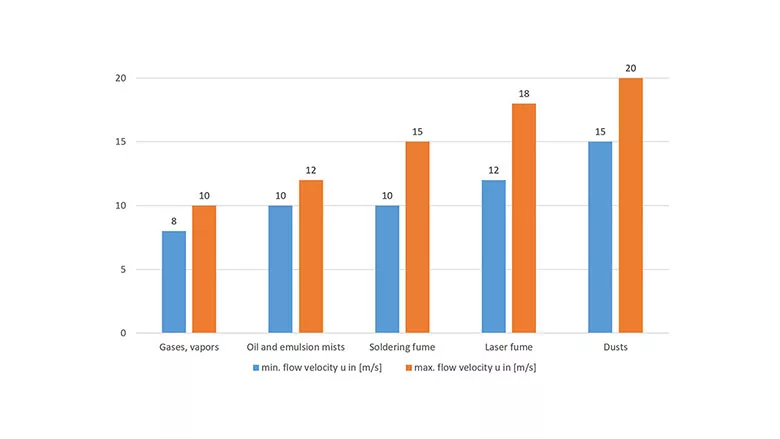
Flow velocities of exemplary industrial emissions
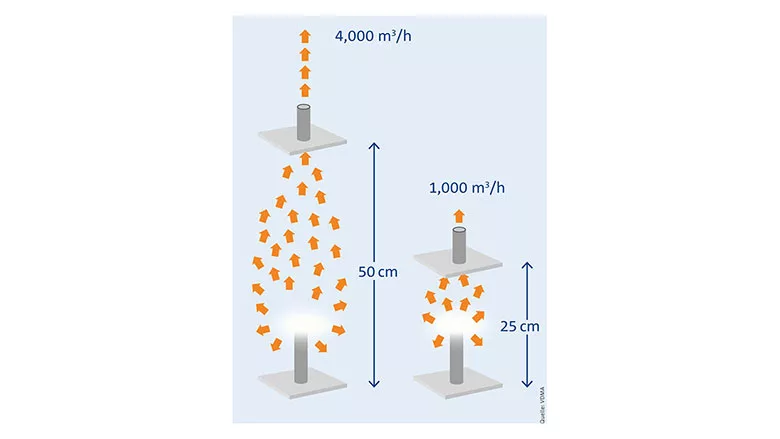
Distance vs. degree of capturing
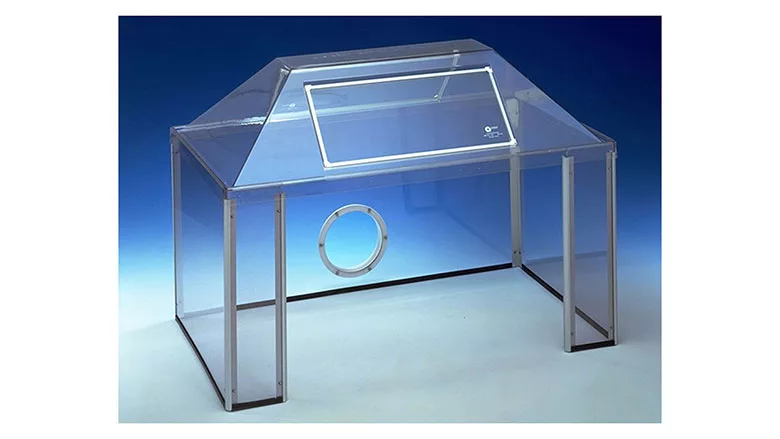
Semi-open extraction cabinet for use, e.g., in laboratories
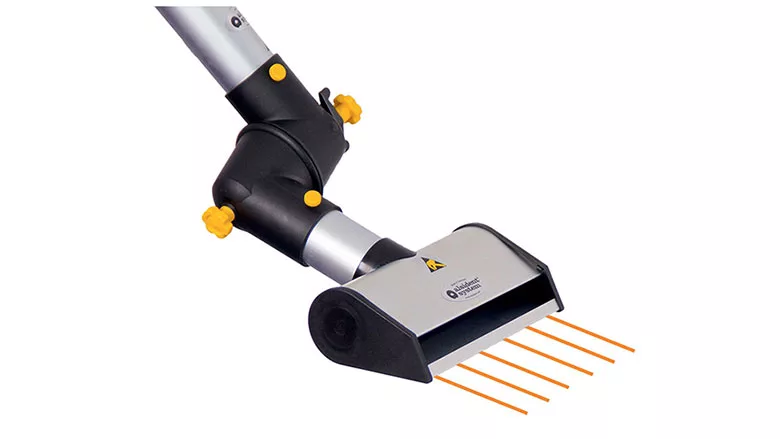
Suction nozzle uses the Coandă effect
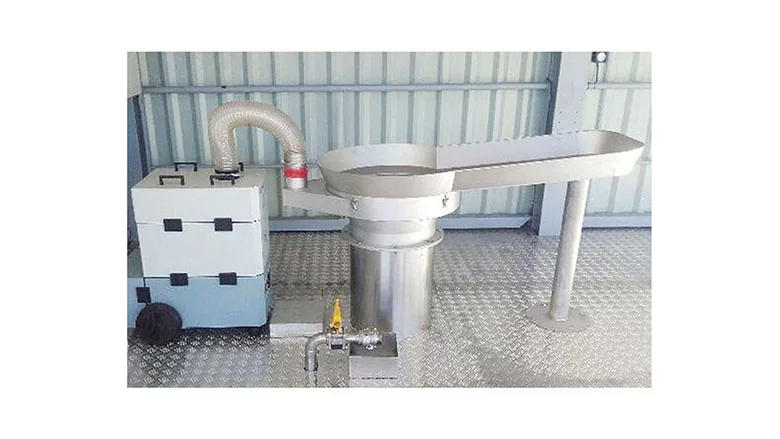
Barrel suction to capture rising dusts
During the last couple of years, utilization of extraction and filtration systems has become standard in many manufacturing companies, in craft businesses as well as in laboratory and research facilities. On the one hand, this is due to legal requirements. On the other hand, it is in the interest of every company to place emphasis on occupational, health and plant protection.
Extraction systems clean the process air, but they should be applied in a targeted manner so that a) the best filter performance, and b) low-noise and energy-efficient use can be guaranteed.
The efficient operation of a fume extraction system is essentially defined by the following important parameters:
- Correct pollutant capturing
- Correct filter configuration
- Extraction performance
The consideration of the material properties with regard to flammability and the potential generation of an explosive air-gas mixture.
The extraction performance of a filter system is defined by the workplace situation, the type of particles, the transport route (hose, pipe, etc.), potential pre-separators and the filter configuration. Resistances in the suction line (pipe walls, pre-separators, filters, etc.) must be overcome with sufficient negative pressure. The capturing situation as well as the necessary material transport speed determine the necessary air volume flow.
The use of suitable filter modules is defined by the type or composition of the air pollutants. Large amounts of pollutants are separated with cleanable filters (cartridge filters), smaller amounts of pollutants with storage filters. Coarse, fine dust and HEPA filters are used here. An additive may be needed to deal with sticky components. Pre-separators ensure that coarse particles are extracted from the air flow before the fume extractor. Spark separators or spark traps ensure that no fire- or explosion-inducing particles get into the extraction system.
In the case of gases, vapors or odors, adsorption (e.g., activated carbon) or chemisorption filters are preferred. With a clever design of the filter configuration, the system can be designed in a situation-appropriate and energy-efficient manner, since every unnecessarily installed filter represents a resistance that the sucked in air flow has to overcome.
The capture of air pollutants is essential for the economical and effective use of an extraction and filtration device. In order to effectively remove airborne pollutants such as dust, fume, vapors, gases or odors, they must be extracted as close as possible to the point of origin. This is the only way to ensure that the largest possible amount of particles is captured. The rule of thumb here is that twice the distance between the emission source and the capturing element requires at least four times the vacuum output of the extraction system. Because the level of the degree of capture forms the basis for the subsequent highest possible filtration, which ultimately results in the efficiency of the overall system and therefore the pollutant residues in the recirculated air. With the correct dimensioning of the extraction and filtration system, users can save a significant amount of energy.
The degree of coverage and the air flow rate play decisive roles in the selection of the ideal collection solution. If this is used after considering all local environmental conditions and influences such as adhesion, air speed of emissions, fluid mechanics or tool movements, the required degree of capturing increases with a minimal air flow.1
Capturing elements
Capturing elements help in the effective removal of air pollutants. They are roughly divided into three types or systems: closed, half-open and open.
Closed systems are workplaces that are hermetically sealed from the environment and have connections for air lines.
Half-open systems are enclosures for the pollutant source with an open side for handling and with a connection for air ducts.
Open systems are form elements that are offered in a wide variety of versions. Their use is defined by shape, geometry, and material. They are usually mounted on extraction arms, the use of which is also defined by the amount and type of pollutant and other parameters such as use under ESD conditions or under fire protection aspects. The diameter of the extraction arms and their installation — directly on the filter system, as table or wall mounting, etc. — results from their practical utilization. Capturing elements can also be attached to suction hoses.
Standardized capturing elements
The following collection elements are primarily applied in industry, trade and research.
Flat top hoods are utilized for detection above the pollutant source, for example during soldering, gluing or laser material processing.
Round top hoods are used in the event of the possible acute formation of clouds of pollutants and in the event of impulsive pollutants. In addition, they have their advantage in the case of thermal harmful gas flows, since warm air rises as it’s known. Application examples are soldering work, micro welding, spot welding or laboratory applications.
Suction nozzles use the Coandă effect, which means that air or gases move along a convex surface instead of detaching and continuing to flow in the original direction of flow. During gluing or cleaning with solvents or when vapors are generated that are heavier than air, these capturing elements are usually positioned flat and to the side of the pollutant source.
Suction pens are suitable for the selective capture of air pollutants. In addition to their use in laser machining processes, they are very often found at hand soldering workstations — especially due to their narrow shape, they are perceived as the least disruptive.
Suction funnels are probably the best-known and most universal collection elements. They combine the advantages of round and flat top hoods with regard to different sources of pollution. They are utilized, among others, during welding, soldering, cleaning, or grinding.
Individual solutions
However, there are also several application scenarios in which standard systems do not achieve the required degree of capture. In these cases, individual solutions must be developed and installed. Customer-oriented suppliers of fume extraction systems will find an optimal alternative together with their customers.
The following three practical cases are examples of such applications:
- Table extraction — an integrated capture solution for extracting gases, vapors and ozone was developed for a worktable with ESD protection by means of ionization.
- Backdraft panel — for use in the laboratory when weighing out fine powders and the associated transferring from one container to the other, a suction cabinet with an extraction system integrated in the rear wall offered the ideal solution.
- Barrel suction — when filling containers, rising dusts had to be captured. This was done by means of a ring nozzle that surrounds the vessel opening.
There are certainly other standardized and application-specific solutions that are not listed here, e.g., suction nozzles on manual soldering systems or welding torches, or detection elements with special geometric shapes, such as suction bells or angular suction funnels.
There is a wide variety of capturing elements — as well as the number of providers. Users should nevertheless attach great importance to the importance of the "correct" capturing and leave their selection or interpretation to appropriate experts. This is the only way to ensure that employees, manufacturing equipment and products are effectively protected from the harmful impact of airborne pollutants.
The article is based on documents and information from Wolfgang Richter, Head of Sales at ULT AG.
Reference
1. Erfassen luftfremder Stoffe – Frische Luft am Arbeitsplatz“, VDMA Allgemeine Lufttechnik, Fachabteilung Luftreinhaltung, Frankfurt/M., 2010, Seite 14
Looking for a reprint of this article?
From high-res PDFs to custom plaques, order your copy today!