ISHN logo
search
cart
facebook twitter linkedin youtube
  • Sign In
  • Create Account
  • Sign Out
  • My Account
ISHN logo
  • NEWS
    • Today's News
    • Global Safety News
    • Government Regulations
  • PRODUCTS
    • Product Innovations
    • Featured Products
  • TOPICS
    • Environmental Health and Safety
    • Facility Safety
    • Workplace Health
    • Occupational Safety
    • PPE
    • More Topics
  • CONSTRUCTION
  • TECHNOLOGY
  • COLUMNS
    • Best Practices
    • Dave Johnson: What’s going on
    • Editorial Comments
    • Leading Safety
  • MULTIMEDIA
    • ISHN Podcast
    • Videos
    • Cold Stress Education Quiz
    • Webinars
    • White Papers
  • MORE
    • Buyer's Guide
    • Newsletters
    • Convention Companion
    • Polls
    • Events
    • ISHN Store
    • Sponsor Insights
  • EMAGAZINE
    • eMagazine
    • Archived Issues
    • Contact
    • Advertise
  • JOIN TODAY!
Today's Safety News

Today's Safety News

Optimizing Results and ROI from Conveyor Safety Training
Martin_Conveyor_Safety_Training.jpg
Martin Engineering
November 26, 2025

By R. Todd Swinderman, President Emeritus / Martin Engineering


The hours spent training production and maintenance teams can lead to variable results.  They might just tick the boxes without providing a return on investment.  Or they can enhance safety, foster team building, and develop a deep understanding of the equipment that boosts efficiency and uptime.  

Training should be robust and encourage problem-solving using modern methods and standards.  Companies that prioritize safety experience fewer safety incidents, less regulatory oversight, and higher productivity and profits.  

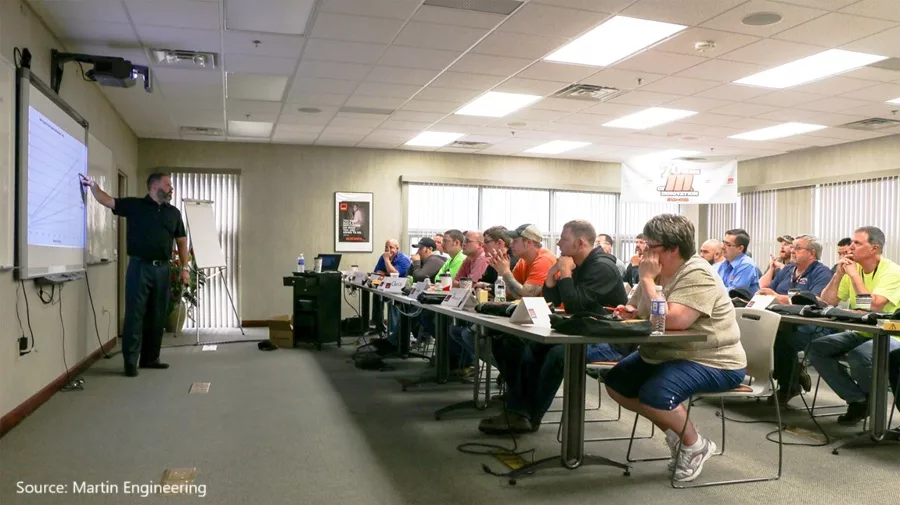
When it comes to conveyor belts, a one-day training session can serve as a refresher, but it is recommended that staff complete a comprehensive course lasting at least 2 days. Conveyors are as complex as they are crucial to operations, and training should include a mix of classroom and hands-on learning, followed by a pilot program to encourage team building and gauge results.

A commitment to safety starts at the top with corporate culture.  A “production-at-all-costs” approach means safety concerns are always present.  Bad habits and injuries often stem from three things: 

  • Lack of funding. 
  • An understaffed maintenance department. 
  • A “run-till-broke” mentality.  

Good safety habits require training and the patience for extra steps.  Cutting corners and labelling it “efficiency” can lead to serious injuries, low morale, downtime, and lost production. 

Everyone who operates, cleans, or maintains conveyors should be trained on the hazards of bulk material handling.  Basic training helps staff identify problems and resolve them safely.  Appropriate safety training emphasizes a basic understanding of conveyor design and operation, as well as the Lock-Out Tag-Out (LOTO) procedures required for working on and around the system.

Over time, production demands cause the conveyor belt speed and capacity to reach beyond the original design specifications.  Systems are incrementally modified to minimize problems associated with the demands.  Advanced conveyor design training for engineers and mechanics is critical for diagnosis and the development of updated solutions.  No two conveyors are identical, so adhering to standard design methods allows a technician to make adjustments that another can recognize and understand.

A walk down “problem belts” before the training helps the instructor focus on site-specific problems and the management’s expectations.  The first day starts in the classroom with the class reviewing typical problems, discussing challenges, and the best practices of safely addressing them.  The class identifies a couple of problem conveyors and splits into small teams.  Each team examines the same problem and brainstorms solutions.  

The class reviews and discusses root causes, solutions, and procedures.  Once the teams reach an agreement, they prepare a short presentation using the knowledge they gained.  The presentations may also include an estimate of the cost of the proposed solutions.  

Management is then invited to listen to the team presentations, ask questions, and show a commitment to safety and communication.  By making the presentations, trainees display knowledge and support for the solutions.  It is critical at this step that the manager(s) who attend the presentations have the authority to act on the proposals and are willing to commit to a pilot program to demonstrate that theoretical results can be translated into reality.

One or more conveyors from the presentation are selected for a pilot program.  Usually, the results of the pilot program are immediately noticeable.  A lapse in maintenance affects the pilot results, so extend the test period to the next scheduled shutdown, with periodic inspections and adjustments made by the equipment manufacturer.

It is incumbent upon management to take safety and maintenance training as seriously as the staff, listen to employees' concerns, and fix the problem correctly the first time.  As research has shown, companies that prioritize safety, training, and updating equipment enjoy fewer safety incidents, less regulatory oversight, higher productivity and greater long-term profits.

The online Martin® Foundations™ Learning Center draws on the collective knowledge and expertise gathered over 80+ years of solving bulk-handling challenges.  Aimed at apprentice technicians and experienced engineers alike, the non-commercial information is offered at no charge and is accessible by computer, tablet, or smartphone.  An extension of the Foundations training curriculum, the Learning Center uses a mix of text, photos, videos, webinars, online events, and live experts available to answer questions.

For more information visit martin-eng.com.

KEYWORDS: manufacturing training

Share This Story

Looking for a reprint of this article?
From high-res PDFs to custom plaques, order your copy today!

Recommended Content

JOIN TODAY
to unlock your recommendations.

Already have an account? Sign In

  • forklift safety

    Exploring the latest technologies in forklift safety

    With more staff and more stock in warehousing now more...
    Facility Safety
    By: Josh Cramer
  • welding

    All about welder’s flash or arc eye

    A flash burn is a painful inflammation of the cornea,...
    Environmental Health and Safety
  • dangerous jobs

    The 10 most dangerous jobs in the U.S.

    On-the-job deaths have been rising — hitting the highest...
    Government Safety Regulations
    By: Benita Mehta
Manage My Account
  • eMagazine Subscriptions
  • ISHN Newsletter & Other Newsletter Alerts
  • Online Registration
  • Manage My Preferences
  • Subscription Customer Service

More Videos

Sponsored Content

Sponsored Content is a special paid section where industry companies provide high quality, objective, non-commercial content around topics of interest to the ISHN audience. All Sponsored Content is supplied by the advertising company and any opinions expressed in this article are those of the author and not necessarily reflect the views of ISHN or its parent company, BNP Media. Interested in participating in our Sponsored Content section? Contact your local rep!

close
  • man wearing the the Sundström SR200 Full Face Mask Respirator
    Sponsored byOHD

    5 Fit Testing Mistakes That Could Cost You

  • This image shows Magid AcuSpex polarized blue mirrored safety glasses.
    Sponsored byMagid Glove and Safety

    Construction PPE Guide: What Crews Need for Each Task

  • lone worker in confined space
    Sponsored byAlphasense Ltd.

    GET THE LEAD OUT of your Safety Oxygen Sensors!

Popular Stories

SpaceX 7 launch

OSHA Investigating Fatal Fall at SpaceX Starbase

dust explosion

Tennessee OSHA Issues Record $3.1M Fine After Deadly Explosion at Munitions Plant

roofing dangerous jobs Getty.jpg

OSHA Finds Florida Roofing Company Willfully Exposed Workers to Safety Hazards After Worker’s Fatal Fall

top 10 most dangerous jobs

Poll

Seasonal Readiness

With the federal heat stress prevention rule on the horizon, which area of your safety program needs the most attention?
View Results Poll Archive

Products

Surviving an OSHA Audit A Management Guide, 2nd Edition

Surviving an OSHA Audit A Management Guide, 2nd Edition

See More Products

ISHN Podcasts

Related Articles

  • New Safety Training Program, Flammable Liquids: Know Your Risk, Available in Online, DVD, and Streaming Video from Summit Training Source

    See More
  • April2021-VelocityEHSFeature-1170x878.jpg

    Let’s move away from one-sided online safety training

    See More
  • electrical warning sign

    Electrical contracting work benefits from safety training

    See More

Related Products

See More Products
  • Optimizing Social Media from a B2B Perspective

See More Products
×

Become a Leader in Safety Culture

Build your knowledge with ISHN, covering key safety, health and industrial hygiene news, products, and trends.

JOIN TODAY
  • RESOURCES
    • Advertise
    • Contact Us
    • Directories
    • Manufacturing Division
    • Store
    • Want More
  • SIGN UP TODAY
    • Create Account
    • eMagazine
    • Newsletters
    • Customer Service
    • Manage Preferences
  • SERVICES
    • Marketing Services
    • Reprints
    • Market Research
    • List Rental
    • Survey/Respondent Access
  • STAY CONNECTED
    • LinkedIn
    • Facebook
    • YouTube
    • X (Twitter)
  • PRIVACY
    • PRIVACY POLICY
    • TERMS & CONDITIONS
    • DO NOT SELL MY PERSONAL INFORMATION
    • PRIVACY REQUEST
    • ACCESSIBILITY

Copyright ©2026. All Rights Reserved BNP Media, Inc. and BNP Media II, LLC.

Design, CMS, Hosting & Web Development :: ePublishing