Healthcare hazards
For example, nurses confront such potential hazards as exposure to infectious diseases and toxic substances, back injuries, radiation exposure and stress. Housekeepers may be exposed to cleaners and disinfectants that can cause rashes and eye and throat irritation and to infectious diseases such as hepatitis from hypodermic needles that have not been properly discarded. Maintenance workers might have to confront electrical, asbestos and solvent hazards.
Despite this diversity of occupations and exposures, healthcare hazards can be divided into four categories:
- hazardous agents
- ergonomic hazards
- physical hazards
- psychological hazards.
A review of each of these categories will help healthcare employers and their workers overcome a wide range of possible injuries and illnesses.
Hazardous agents
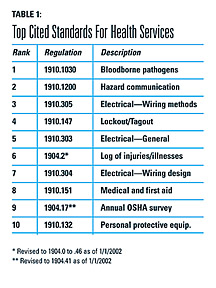
Hazardous agents include biological agents, chemical agents, disinfectants and sterilants, antibiotics, hormones, antineoplastics, waste anesthetic gases, latex gloves, aerosolized medications (e.g., ribavirin) and hazardous waste. Healthcare employees will find these hazardous agents almost everywhere they turn - the operating room, maintenance, the laundry, food services, the laboratory, radiology, even office areas.Not surprisingly, the Bloodborne Pathogens Standard and the Hazard Communication Standard were the top two regulations cited against health services (SIC 80) by the Occupational Safety and Health Administration from October 2000 through September 2001 (see Table 1).
It is important, then, for healthcare employers to develop both an exposure control plan and a hazard communication program, if applicable, as well as to encourage employees to follow safe work practices. Although safe work practices will be facility- and agent-specific, generally employees should:
- Keep hazardous agents labeled properly;
- Avoid eating around hazardous agents;
- Wear proper personal protective equipment, including respirators where necessary;
- Request non-latex gloves if allergic to latex;
- Use tools to apply or handle hazardous agents;
- Avoid recapping needles and use safe and effective alternatives where available;
- Learn where emergency eyewash stations are located;
- Dispose of hazardous agents in proper containers;
- Report leaks and spills;
- Recognize the signs and symptoms of illness relating to hazardous agents; and
- Report exposure incidents.

Ergonomic hazards
Ergonomic hazards include lifting, repetitive motion, standing for long periods of time and eye strain due to poor lighting. Overexertion (including lifting) is the number one cause of injury and illness for health services, with almost 74,000 cases (about 45 percent of all health services cases) in the year 2000. That's a much higher incident rate than all of private industry, which had a 27 percent rate. After the motor vehicles/equipment and meat products industries, hospitals, specifically, have the highest number of nonfatal illness cases of disorders associated with repeated trauma.While OSHA does not have a specific regulation dedicated to ergonomics, the agency recently began a comprehensive plan to reduce ergonomic-related injuries. In fact, OSHA expects to release guidelines for nursing homes this year. The agency will also use the General Duty Clause of the Occupational Safety and Health Act to crack down on "bad actors."
In the meantime, healthcare employers may wish to address their own ergonomics hazards by examining possible ergonomic risk factors of healthcare jobs. These have been identified as noted in Table 2.
In order to control these risks, healthcare employers may want to:
- Provide assist devices for lifting;
- Provide convenient storage of lifting devices;
- Lower items to alleviate reaching;
- Provide handles on carts;
- Encourage team lifts or start a no-lift program;
- Provide redesigned surgical instruments, containers and computer workstations;
- Perform regular maintenance on lifting devices and equipment wheels, cranks and controls; and
- Encourage exercise.
Physical hazards
Physical hazards include toxic, reactive, corrosive or flammable compressed gases and chemicals; extreme temperatures that may cause burns or heat stress; mechanical hazards that may cause lacerations, punctures or abrasions; electrical hazards; radiation; noise; violence; and slips and falls.After overexertion, falls on the same level is the leading cause of injury or illness for health services (15 percent of all cases), followed by contact with objects (11 percent of all cases).
Precautions for this hazard category include:
- Wearing the right shoes;
- Properly cleaning and maintaining floors;
- Reporting leaks and spills;
- Storing cylinders upright;
- Storing flammables in approved, closed containers;
- Wearing proper personal protective equipment, including hearing protection where necessary;
- Maintaining electrical equipment according to manufacturer and company standards;
- Regularly inspecting tools, cords, grounds and accessories;
- Locking and tagging out power sources and switches when servicing or repairing mechanical equipment;
- Learning to recognize and treat the signs of heat stress and drinking plenty of water;
- Not entering restricted radiation areas, unless trained and authorized;
- Treating and interviewing aggressive patients in relatively open areas; and
- Reporting all assaults or threats to a supervisor or manager.
Psychological hazards
Psychological hazards are related to discrimination, technological changes, malfunctioning equipment, tight work schedules, downsizing, overwork, understaffing, paperwork, increased facility size and bureaucracy, violence, dependent and demanding patients, and patient deaths.All of these factors contribute to stress, fatigue, anger, frustration and the feeling of being isolated and powerless. Failure to recognize and treat the sources of stress results in workers who suffer "burnout" (i.e., those who remain on the job but cease to function effectively). Workers are most likely to encounter severe stress in intensive care units, burn units, emergency rooms and operating rooms.
According to the National Institute for Occupational Safety and Health, some of the methods that have successfully reduced hospital worker stress and dissatisfaction include:
- Regular staff meetings to share feelings and innovative ideas;
- Stress management programs;
- Readily available counseling;
- Alternative job arrangements;
- Adequate staffing;
- Reasonable shift schedules;
- Group therapy for staff dealing with chronically ill or deceased patients;
- Organized and efficient work functions and environment;
- Recognition of and action on legitimate complaints;
- Relaxation exercises;
- Opportunities to improve skills;
- More flexibility and worker participation in scheduling; and
- Scheduled rotation of unit assignments.
Being aware
As vital as the healthcare workforce is, they need to be protected from workplace hazards. Breaking healthcare hazards into four categories - hazardous agents, ergonomic hazards, physical hazards and psychological hazards - is one way of approaching healthcare safety. By becoming aware of these hazards and following the precautions presented here, healthcare employers may help to prevent injuries and illnesses in their facilities.Looking for a reprint of this article?
From high-res PDFs to custom plaques, order your copy today!


