PSYCHOLOGY OF SAFETY: Bittersweet impact of an "accident"
On a recent weekend I had one of the most profound and memorable experiences of my life. Indeed, it has affected my perspective on human existence, from appreciating family and friends to facing untimely and arduous challenges. And some of my recollections from that life-changing weekend connect to the special demands of motivating people to actively care for the safety of themselves and others. Let me explain.
Readers familiar with my contributions to ISHN may be surprised to see the word “accident†in the title of this article. For more than two decades I’ve been complaining about the use of this word within the context of industrial safety.
When something occurs “accidentally,†chance and uncontrollable factors are implied. This is not the case for most workplace injuries. Usually someone in the system, either a manager, a coworker, or the victim, had the knowledge and resources to prevent the mishap, but made a risky decision.
Here, however, I am reflecting on a true accident. Like my cancer, the disease I observed last weekend was an accident; but this malady is far more debilitating than my cancer. I’m referring to amyotrophic lateral sclerosis (ALS), better known as “Lou Gehrig’s disease.†This devastating illness attacks the body of more than 5,000 people annually, and ends a person’s life in two to five years. The disease causes successive loss of voluntary muscle contraction, eventually resulting in complete muscle paralysis, inability to communicate, impaired swallowing and breathing, and ultimately death. Mitch Albom, author of “Tuesdays with Morrie,†summarizes ALS as follows:
“ALS is like a lit candle: it melts your nerves and leaves your body a pile of wax. Often, it begins with the legs and works its way up. You lose control of your thigh muscles, so you cannot sit up straight. By the end, if you are still alive, you are breathing through a tube in a hole in your throat, while your soul, perfectly awake, is imprisoned inside a limp husk, perhaps able to blink, or cluck a tongue, like something from a science fiction movie, the man frozen inside his flesh (p. 10).â€
No choice
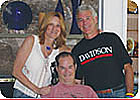
Dick Sanderson grew up in Mendham, N.J., and now resides in Charlotte, N.C. He was diagnosed with ALS a little over a year ago, and the progression of the disease has been rapid. Once a dedicated and talented athlete, Dick can now only move his head slightly and show some facial expression. He receives comprehensive input from the world around him, but can offer only minimal output.Dick can smile, and to my surprise he smiled more than anyone else on that weekend. The steadfast courage Dick Sanderson and his family have shown throughout this onerous and emotional ordeal is inspirational.
For me, the saddest part of this story is that no one did anything to cause this heartbreaking situation. Yet no one complains. Dick’s wife, Dawn, cares for him intently and continuously, with periodic assistance from their 16-year-old son, Trey, and college-aged daughters, Amy and Melissa. I saw Dawn feed Dick through a stomach tube, and witnessed friends and family suction saliva from Dick’s mouth several times per hour.
Seeing this level of actively caring is instantly humbling and sobering. And throughout all of this, Dick Sanderson displays incessant gallantry and grace, as well as a sense of humor. For example, while one of Dick’s high-school friends was singing a song written as a tribute to the Sanderson family, Dick signaled for suctioning as if to say “stop singing.†The audience appreciated the humor of Dick’s request and laughed aloud.
Support of friends
Besides a loving family, Dick has a large circle of dedicated friends supporting him and his positive fight with ALS. When Dick Sanderson revealed his ALS diagnosis, people came from near and far to give personal testimony to his limitless influence in their lives. Numerous friends from his high-school days 37 years ago came, as well as current basketball buddies, business partners, parents of children Dick coached, and friends of their friends.Psychological research has demonstrated the unique value of social support during times of personal struggle — both emotional and physical. But friendship is more than social support, and Dick Sanderson has been an exemplar for developing and cultivating true friendship. Even with all his athletic and artistic talents, Dick has always been humble and friendly to everyone, regardless of their stature and abilities.
You can learn much more about Dick’s friendship-building skills and the extraordinary results of his investment in people by reading the recent book I edited, “The Power of Friendship.†The $19.95 book is available from its creator: Joanne Dean (jdean@thegalecompany.com; phone: 973-543-5224). The proceeds from this collection of essays by Dick’s family and friends benefit the Sanderson family.
Living in the moment
When asked how she does all she needs to do to care for her husband, Dawn replies, “I’m just loving him.†She writes, “This is a very terrible thing we have to face, but knowing we are not facing it alone is so powerful… We don’t look forward or focus on the future, but rather we look back and feel the blessings of the rich and fulfilling life we have shared together.â€In a similar vein, Rod Dorman — a long-time friend of Dick who also has a terminal disease — writes, “It is not about how many days on earth you live; it is about how you live each day… He who lives the most each day wins… All of us have commented ‘how time flies’… That is no longer true for me. Confronting a terminal illness slows time. Every day, I reflect on the fact I have that day to live, and I evaluate whether I am living it well.â€
Relevance to safety
Appreciating the moments of our lives relates to safety in two ways.First, realizing the good fortune of a healthy life motivates us to preserve this gift, including the performance of those somewhat inconvenient safety-related behaviors.
Second, when we are mindful of the present moments of our daily lives, we are less likely to make errors that can put ourselves and others at risk for injury. For example, many multitasking activities, like using a cell phone while driving, put people at risk for unintentional injury, and are clearly contrary to present-moment thinking and living.
We need each other
Sometimes we multi-task because we feel overwhelmed and don’t have enough support from others. But do you ask for help, or do you feel a need to be independent? Perhaps you perceive you haven’t cultivated a level of friendship with coworkers that warrants a request for help.But you can’t do it alone. Fortunately, you are not as dependent on support from others as is Dick Sanderson. But you cannot be as safe as you can be without assistance from friends and colleagues. Sometimes you need help to complete a job safely. Or you may need advice on how to eliminate a hazard. And everyone can benefit from the behavior-based feedback of an actively caring coach.
No one can improve their competence without behavioral feedback, and when it comes to safety, such feedback must come from an observer. Of course, this level of interdependency requires the right work culture — one with people who realize they need each other to help them and their organization be the best they can be, while remaining injury free.
The power of choice
Why should you contribute daily to cultivating a trusting and interdependent work culture? Because you can. You have the power of choice. You can choose to be mindful of everyday hazards and act accordingly, and you can choose to actively care for the safety of others. You can choose to do whatever it takes to maintain your current skills, abilities, and physical condition. Dick Sanderson does not have that choice.So much to lose
Dick Sanderson’s friends convened that weekend to show him love and admiration. Sadly, one by one they also said, “Goodbye.†I will never forget this bittersweet weekend. I will use it as inspiration to appreciate what I have today and what I have to lose if I choose to take a risk at the wrong time.Think of Dick Sanderson smiling through his enormous health challenges — an accident over which he had no control. Now, how can we complain about daily disappointments? How can we justify unsafe and risky acts? Instead, we can smile in knowing we have the power to choose safety over risk and avoid unthinkable loss.
Sidebar: People-Based Safety™: The Optimal Approach to Behavior-Based Safety
Coastal Training Technologies and Safety Performance Solutions are pleased to invite you to participate in upcoming public seminars of People-Based Safety™: The Optimal Approach to Behavior-Based Safety, presented by Coastal and Safety Performance Solutions (SPS).The 2006 Seminar Schedule:
July 14, 2006 - Hampton, VA
August 11, 2006 - Philadelphia, PA
August 25, 2006 - Houston, TX
September 8, 2006 - Minneapolis, MN
September 26, 2006 - Salt Lake City, UT
October 20, 2006 - Roanoke, VA
November 10, 2006 - Charlotte, NC
Exact location information will be emailed to you as it becomes available.
Tuition for the session is $349 per attendee. For more information, call Coastal Training Technologies toll-free at 877-861-2556 or Safety Performance Solutions at 540-951-7233.
Links
Looking for a reprint of this article?
From high-res PDFs to custom plaques, order your copy today!


