ISHN logo
search
cart
facebook twitter linkedin youtube
  • Sign In
  • Create Account
  • Sign Out
  • My Account
ISHN logo
  • NEWS
    • Today's News
    • Global Safety News
    • Government Regulations
  • PRODUCTS
    • Product Innovations
    • Featured Products
  • TOPICS
    • Environmental Health and Safety
    • Facility Safety
    • Workplace Health
    • Occupational Safety
    • PPE
    • More Topics
  • CONSTRUCTION
  • TECHNOLOGY
  • COLUMNS
    • Best Practices
    • Dave Johnson: What’s going on
    • Editorial Comments
    • Leading Safety
  • MULTIMEDIA
    • ISHN Podcast
    • Videos
    • Cold Stress Education Quiz
    • Webinars
    • White Papers
  • MORE
    • Buyer's Guide
    • Newsletters
    • Convention Companion
    • Polls
    • Events
    • ISHN Store
    • Sponsor Insights
  • EMAGAZINE
    • eMagazine
    • Archived Issues
    • Contact
    • Advertise
  • JOIN TODAY!
Columns

PSYCHOLOGY OF SAFETY: Academics vs. consultants Can awareness of distinctions enable synergy?

By E. Scott Geller
September 14, 2006


Five years ago a major consulting firm sent its clients an e-mail in an attempt to dissuade them from attending the annual Behavior Safety Now (BSN) conference. The e-mail stated disappointment in the quality of the conference presentations, and added, “The conference has become a showcase for academics and ‘wannabe’ consultants.” That year I was a keynote speaker at the BSN conference, as I have been every year since its inception.

I began my address with a display of select portions from this e-mail, including the quote given above. Then I admitted to being both an academic and a “wannabe” consultant.

Yes, I’m proud to have been in academia for almost 40 years, meaning I’ve taught and conducted research at a large public university since 1969.

And I’m a “wannabe” consultant. From the start of my academic career I’ve had a passionate desire to translate research-based findings and principles into practical real-world procedures. For the past 30 years, I’ve fulfilled this desire by teaching useful principles and procedures to real-world practitioners and agents of change.

Over the years I’ve become a better consultant. I’ve continued to gain more research-based information, and I’ve learned through feedback how to communicate academic knowledge more effectively — from my oral presentations to written expression in books, magazines, and conference proceedings. But I want to improve further — at teaching practical research-derived knowledge to enrich the health, safety, and human welfare of clients I serve and the public in general. I am a “wannabe better” consultant.
 

Valuing the differences

I learned the hard way to adjust my academic stance when in the public forum. First, I found I needed to refrain from using complex rhetoric, or verbal behavior used to appear intellectual or professional. This is one of academia’s biggest problems — the failure to disseminate research findings with language everyone can readily understand.

What a disappointment to have important principles and applications couched in a scholarly lingo that isn’t readily digested by the public. That leaves the diffusion of information to the less-than-academic “pop psychologists” who often water down good information. But if these individuals don’t put it out there, too often it would not get beyond the ivory towers of academia.

Next I realized I should hold back on naming the “pop psychology” authors I was criticizing. It took the focus away from the point I was making. And I activated in the minds of my audience the names of the very persons I wanted them to forget.

In the academic world we reference everything that is not entirely original. We are careful to recognize the original source of information, even when challenging or discrediting certain aspects of that information. In contrast, consultants rarely reveal the source of material they use or discount, nor do they criticize other consultants or their material. They stick to presenting their own perspective without regard to the origins of that perspective.

I appreciate the consultants’ avoidance of public critique of another consultant’s procedures. Still, the academic in me wishes consultants would give credit to those individuals (usually academics) who first developed a particular approach. I’ve found audiences appreciate hearing where consultants learned the information they share.

One’s competence as a consultant is not diminished by giving credit to the original source of a particular principle or procedure. Indeed, by referring to solid research supporting a particular intervention process, you very likely increase your own credibility. But try to find the primary research-based source rather than crediting an author who merely describes the work of someone else. If you have difficulty finding a primary source, contact an academic. Knowing the sources of information in their discipline is the academic’s forte.
 

Additional differences

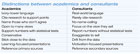
The table on this page summarizes these and additional distinctions between academics and consultants. These differences are not given to pit one against the other, nor to give one more status. I offer these distinctions to increase understanding, and perhaps stimulate beneficial collaboration and mutual learning between academics and consultants. Indeed, I’m convinced each profession can benefit from the strengths of the other.

As an academic I must emphasize the differences listed here are biased. They are merely my own observations, obtained over a 30-year career of attempting to perform effectively in both worlds. I feel privileged to have played the role of both academic and consultant. I have learned from each profession.

The quality of my academic performance has improved as a function of my consulting experiences, and vice versa. For this reason, I believe each profession can benefit significantly from the other. Each can build from the strengths of the other, with each profession improving from the process.
 

How consultants could help academics

  • Consultants can teach academics how to better present their theories and research findings to the public.
  • Consultants can solicit real-world problems in need of research attention.
  • Consultants can pose application-focused questions in need of empirical answers.
  • Consultants can help academics find practical applications for their research findings.
  • Consultants can inspire academics to be more application-oriented in their theories, research, and scholarship.


How academics could help consultants

  • Academics can provide research-based rationale for selecting one intervention approach over another.
  • Academics can increase a consultant’s credibility by providing the primary source of a principle or
  • procedure.
  • Academics can teach consultants how to develop, administer, analyze, and interpret basic assessment devices like perception and culture surveys.
  • Academics can show consultants how to interpret and use data from a statistical analysis.
  • Academics can advise consultants what scholarship to read in order to improve particular aspects of their practice.


I sincerely hope readers will not view this presentation as an attempt to demean academia or the practice of consulting. I want readers to see this as a balanced discussion of strengths and limitations of each profession. More importantly, I hope you see ways academics and consultants can learn from each other, thereby becoming more effective at serving the health, safety, and welfare of those who pay their salaries.

Of course, this type of improvement is more about experiencing greater intrinsic rewards for making bigger and better differences in the human dynamics of work, play, and everything in between.

Share This Story

Looking for a reprint of this article?
From high-res PDFs to custom plaques, order your copy today!

E. Scott Geller, Ph.D., Alumni Distinguished Professor and Director, Center for Applied Behavior Systems, Virginia Tech, and senior partner, Safety Performance Solutions (SPS). For information on related books, training manuals, videotapes, audiotapes, and customized consulting call SPS at (540) 951-7233 (SAFE), email: pbs@coastal.com , and visit www.safetyperformance.com. For information on Dr. Geller’s new book on People-Based Safety, as well as five video/DVD/CD programs, accompanied by workbooks and leader guides produced by Coastal Training Technologies, visit www.people-based-safety.com; email: pbs@coastal.com; (888) 201-8740.

Recommended Content

JOIN TODAY
to unlock your recommendations.

Already have an account? Sign In

  • forklift safety

    Exploring the latest technologies in forklift safety

    With more staff and more stock in warehousing now more...
    Workplace Training Strategies
    By: Josh Cramer
  • welding

    All about welder’s flash or arc eye

    A flash burn is a painful inflammation of the cornea,...
    Environmental Health and Safety
  • dangerous jobs

    The 10 most dangerous jobs in the U.S.

    On-the-job deaths have been rising — hitting the highest...
    Transportation Safety
    By: Benita Mehta
Manage My Account
  • eMagazine Subscriptions
  • ISHN Newsletter & Other Newsletter Alerts
  • Online Registration
  • Manage My Preferences
  • Subscription Customer Service

More Videos

Sponsored Content

Sponsored Content is a special paid section where industry companies provide high quality, objective, non-commercial content around topics of interest to the ISHN audience. All Sponsored Content is supplied by the advertising company and any opinions expressed in this article are those of the author and not necessarily reflect the views of ISHN or its parent company, BNP Media. Interested in participating in our Sponsored Content section? Contact your local rep!

close
  • man wearing the the Sundström SR200 Full Face Mask Respirator
    Sponsored byOHD

    5 Fit Testing Mistakes That Could Cost You

  • This image shows Magid AcuSpex polarized blue mirrored safety glasses.
    Sponsored byMagid Glove and Safety

    Construction PPE Guide: What Crews Need for Each Task

  • lone worker in confined space
    Sponsored byAlphasense Ltd.

    GET THE LEAD OUT of your Safety Oxygen Sensors!

Popular Stories

SpaceX 7 launch

OSHA Investigating Fatal Fall at SpaceX Starbase

Worker Impairment

How to Tell When a Co-Worker is Impaired? A Safety Pro’s Challenge

Automated loading dock equipment

After March 2026 Rivian Death, Safety Managers Reassess Loading Dock Systems Under OSHA's Warehouse Emphasis Program

top 10 most dangerous jobs

Poll

Seasonal Readiness

With the federal heat stress prevention rule on the horizon, which area of your safety program needs the most attention?
View Results Poll Archive

Products

Surviving an OSHA Audit A Management Guide, 2nd Edition

Surviving an OSHA Audit A Management Guide, 2nd Edition

See More Products

ISHN Podcasts

Related Articles

  • PSYCHOLOGY OF SAFETY: Benefits of a behavioral approach

    See More
  • PSYCHOLOGY OF SAFETY: Reinforcement, reward & recognition

    See More
  • PSYCHOLOGY OF SAFETY: The power of safety communication

    See More

Related Products

See More Products
  • fearless world.jpg

    The Fearless World of Professional Safety in the 21st Century

See More Products

Related Directories

  • Alliance of Women’s Safety Apparel Manufacturers (AWSAM)

    The Alliance of Women's Safety Apparel Manufacturers is a collection of specialty manufacturers and distributors committed to providing properly designed and fitted PPE for women. Our foundational pillars are Awareness, Access and Advocacy. Our non-profit organization has 12 Founding Members and aligns the needs of women in the workforce and the companies they work for with specialty manufacturers dedicated to providing appropriate PPE for women. The Founding Members of the organization have made great strides in removing barriers to access that have existed for many years and kept women from being equally protected. Together, we create a platform that increases awareness of products made for women, encourages equal access to appropriately fitting PPE, and advocates for the safety of women in the workforce. In the spirit of co-opetition, we collaborate to envision what is next for women in industry as we work side by side to accomplish our mission, increase our impact, and share the journey with everyone seeking to elevate diversity and equality in their workplace.
  • American Society of Safety Professionals (ASSP)

    The American Society of Safety Professionals (ASSP) is a global association of occupational safety and health professionals who are dedicated to workplace safety. We provide education, safety standards, advocacy and a professional community that supports our diverse members and the profession.
  • Board of Certified Safety Professionals (BCSP)

    Since 1969, BCSP has been setting and certifying the technical competency criteria for safety, health, and environmental practitioners; ensuring safety through certification. In 2019, BCSP developed examCORE a comprehensive educational program for safety certification.
×

Become a Leader in Safety Culture

Build your knowledge with ISHN, covering key safety, health and industrial hygiene news, products, and trends.

JOIN TODAY
  • RESOURCES
    • Advertise
    • Contact Us
    • Directories
    • Manufacturing Division
    • Store
    • Want More
  • SIGN UP TODAY
    • Create Account
    • eMagazine
    • Newsletters
    • Customer Service
    • Manage Preferences
  • SERVICES
    • Marketing Services
    • Reprints
    • Market Research
    • List Rental
    • Survey/Respondent Access
  • STAY CONNECTED
    • LinkedIn
    • Facebook
    • YouTube
    • X (Twitter)
  • PRIVACY
    • PRIVACY POLICY
    • TERMS & CONDITIONS
    • DO NOT SELL MY PERSONAL INFORMATION
    • PRIVACY REQUEST
    • ACCESSIBILITY

Copyright ©2026. All Rights Reserved BNP Media, Inc. and BNP Media II, LLC.

Design, CMS, Hosting & Web Development :: ePublishing