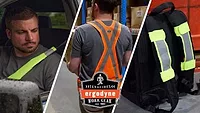
Hi-vis hits prime time
But a Class 1 garment can’t play the role of a Class 2
The commercial I saw is just one of many examples of how hi-vis apparel has “arrived” in the U.S. Look around, you’ll see them everywhere — on road construction workers, of course, but also on building contractors, airline and transportation workers, service personnel and law enforcement. They have become almost an iconic part of the image of the worker.
However, many people, apparently like the directors of the commercial, believe that “a vest is a vest.” Not only is this untrue, but it could open up your organization to liability and, most importantly, put workers at risk. According to the 2011 NSC Injury Fact Book, there were 667 fatalities and 28,958 injuries in work zone crashes in 2009, further confirming that struck-by accidents remain a major workplace hazard.
Most safety professionals are at least aware of ANSI/ISEA 107, the American National Standard for High-Visibility Safety Apparel and Headwear. A surprising number of them, however, are unaware of the important guidelines outlined in the standard and what exactly goes into making a compliant garment. First published in 1999, the ANSI/ISEA 107 standard is currently designated by a 2010 revision. While the standard has undergone some changes in the two revisions since its original publication, the three fundamental aspects necessary to create a compliant garment remain unchanged: background material, retroreflective material and garment design.
Background material
ANSI/ISEA 107-compliant garments must be constructed using either yellow-green (typically called “lime”) red-orange (usually referred to as “orange”) or red background material. Background material is the key component to providing worker conspicuity in the daytime. Usually a fabric, background material used in compliant garments must be tested to and meet strict performance requirements as set forth in the standard.
The most significant requirement for background material is the fluorescence or color requirements. These requirements include both chromaticity coordinates and a minimum luminance factor for each color.
Other requirements include colorfastness (fading) due to perspiration, laundering and light exposure as well as burst strength, tear resistance and dimensional change (shrinking). The standard requires that background fabric used in garments marketed and labeled as compliant to ANSI/ISEA 107 be tested and certified by an independent, accredited, 3rd party laboratory to all performance requirements in the standard.
The 107 standard does not specify what types of materials are required to be used in compliant garments, only that the materials meet these requirements. Synthetic materials such as polyester and nylon are common in ANSI/ISEA 107-compliant garments as their composition is conducive to meeting the standard’s performance requirements. A natural fabric such as cotton may have a difficult time meeting all the performance requirements, most notably because of fading after laundering. In all cases, the user should request that the garment supplier provide a third-party lab compliance certificate for the background material used in their garment.
Retroreflective material
The second element used in the construction of ANSI/ISEA 107-compliant garments is retroreflective material, commonly referred to as “reflective material” or “reflective tape.” By definition, the primary purpose of retroreflective material is to direct light back to its source — with the key component of providing nighttime visibility. Like background material, reflective material must also comply with strict performance requirements and undergo third-party laboratory testing and certification.
The critical performance requirement for reflective material involves measuring the photometric performance of the material or simply put “how brightly does it reflect light back to the light source?” Other requirements include performance after abrasion; temperature exposure; washing and performance when wet to simulate performance in rainfall.
There are two different types of reflective material that can be used in conjunction with background material to create a compliant hi-vis garment. One is silver in color and is commonly called “silver glass bead” or “glass bead.” Silver glass bead reflective material only provides worker visibility when a light source is present for it to reflect back, typically automobile headlights at night. The second type of reflective material is known as “combined performance,” “high gloss” or “prismatic.” Lime, orange or red in color, this material meets the performance requirements of both background material and reflective material providing both daytime and nighttime visibility to the wearer.
Garment design
The third element to ANSI/ISEA 107-compliant apparel is the design of the garment itself. Though it may not be readily apparent to the untrained eye, the look and configuration of hi-visibility apparel is actually quite intentional. The requirements are written to promote maximum visibility of the wearer and configure the background and reflective materials in such a way that they best outline the human form. Compliant garments are divided into groups called Performance Classes. Each Performance Class requires a minimum area of background material, a minimum area of reflective material and for that material to be configured a certain way into a finished item.
Performance Class 1, Class 2 and Class 3 are all types of “top” garment (i.e. vests, jackets, shirts, etc.). Class 1 garments require the least amount of background and reflective materials and provide some enhanced worker visibility. Class 2 garments, far and away the most commonly worn Performance Class, require more background and reflective material than Class 1 and therefore provide greater visibility than Class 1. Class 3 garments provide the greatest worker visibility by requiring the greatest amount of reflective and background materials.
All of these Performance Classes for “tops” require one (1) 360° horizontal band of reflective material encircling the torso to provide visibility of the worker from all angles. For garments without sleeves (Class 1 and Class 2), there must be reflective material in the shoulder areas to provide visibility of the worker when they are bent at the waist. While Class 3 garments do not require reflective material in the shoulder area, it is required to encircle the arms. ANSI/ISEA 107 also provides Performance Class requirements for “bottoms” (pants, shorts, overalls, etc.), known as Performance Class E, as well as a Performance Class for Headwear.
It is important to remember that ANSI/ISEA 107 defines how the garments are constructed and configured; it is not a law that tells users what Performance Class to wear and when. While there are examples provided in the standard of applications of where certain Performance Classes may make sense, it is up to the user to determine what type of ANSI/ISEA 107 garment is appropriate for their application, considering federal as well as state and local laws. Users are encouraged to work with manufacturers of compliant apparel to design garments that meet the needs of their applications.
Now, if someone can just send this article to the TV commercial company…
Looking for a reprint of this article?
From high-res PDFs to custom plaques, order your copy today!