‘Dirty Jobs’ host responds to ISHN editorial
Mike Rowe says Safety Third is "a conversation worth having'
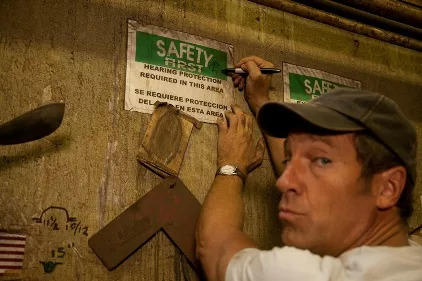
Photo: Mike Rowe
Note: This letter by the Discovery Channel’s “Dirty Jobs” host Mike Rowe is in response to a May issue editorial written by ISHN Chief Editor Dave Johnson about Rowe’s comments on workplace safety. Click here to read Johnson’s piece.
Hi Dave -
Mike Rowe here, Dirty Jobs, etc.
I’m writing to thank you for your article in May’s edition of ISHN, and for sharing with your readers a few of my comments on workplace safety. Over the years, I’ve learned that some Safety Professionals do not always welcome criticism, especially from a smart aleck TV Host. I don’t blame them. No one likes to be second-guessed by a wise guy who needs a bath and has no credentials. Thanks for keeping an open mind, and providing some context for my comments. Here’s some additional background that you’re welcome to share with your readers, if you think it would be of interest.
The comments you attributed to me first appeared in a blog called Safety Third, which I wrote for my website back in 2008. Safety Third told the stories of my various encounters with over-zealous Safety Officers. The first one I recall, involved a very cranky gentleman who demanded I wear a harness while working on a scaffold that was maybe four feet off the ground. When I pointed out that the safety line attached to the harness was longer than the distance between the ground and me, he said, “Don’t argue! Safety First!” Later that same week, a Safety Officer with The Department of Natural Resources interrupted our shoot to insist I put on a life jacket while installing a culvert in a run-off pond. The water in the pond was less than a foot deep. When I asked him to explain the need for a grown man to wear a life jacket in ten inches of water, he offered the same words of wisdom -“Safety First!”
I have never understood the point of ranking virtues and values in order of their importance. If Safety is First, what is Second? Or Fifth? Or Ninth? In the Boy Scouts, we used to say “Safety Always,” which made a lot more sense to me. Safety Third became my default reply whenever someone acted as though my Safety was their responsibility. On Dirty Jobs, I met many such people. And for a while, I actually believed them.
From 2004 to 2008, the Dirty Jobs crew visited more hazardous sites than any other crew in the history of television, from crab boats to coal mines the very tops of the tallest bridges, to crocodile infested swamps. During that time we sat through close to a hundred mandatory safety briefings. We all became intimately familiar with all the basic protocol - lock out tag out, confined space, fall hazards, respiratory precautions, PPE, the endless checklists, etc., etc. Through it all, trained professionals were on hand to remind us, (and our cameras,) that our safety was their top priority.
For a while, it worked. We managed to deliver three seasons of Dirty Jobs with no accidents. Then things started to unravel. Stitches, broken bones, sprains, contusions, falls, a damaged eardrum, second and third degree burns, and many more near misses…it was weird. The job sites were no more dangerous than they’d always been, but the mishaps among my crew were skyrocketing. Then one day, a man was killed while we were shooting in a factory near Pittsburg. He was crushed by the door on a giant coke oven. In the break room, where I was told of the accident, a large banner said, “We Care About Your Safety!” That got me thinking about things like unintended consequences, and the dangers of confusing compliance with real safety.
I found a study on traffic accidents that claimed the most dangerous intersections were those with signs that told you when to walk and when to wait. Intersections with no such signs were statistically safer, apparently because people were more likely to look both ways before crossing the street if there was no blinking sign to tell them when it was safe to do so. According to the theory of Risk Compensation, people subconsciously maintain their own level of “risk equilibrium” by adjusting their behavior to reflect the changes in their surrounding environment. Thus, when the environment around us feels unsafe, we take fewer chances. And when that same environment feels safer, we take more chances. That got me wondering – if companies and Safety Professionals tell us over and over that our safety is their priority, wouldn’t that tend to make us feel safer? And wouldn’t that in turn, prompt us to take more risk, therefore making us…less safe?
I’m no expert, but I think that’s exactly what happened to my crew and me. Over time, we had become convinced that someone else was more committed to our wellbeing than we were. We became complacent. We were crossing the street because the sign told us it was safe to do so. But we weren’t looking both ways.
In 2009, Discovery agreed to air a one-hour special called Safety Third. On Safety Third, I talked candidly about mistakes we’d made on Dirty Jobs, and the unintended consequences of putting Safety First. I argued that many compulsory Safety programs discouraged personal responsibility in favor of Legal Compliance. I asked viewers to consider all the amazing progress that would have never occurred had Safety been valued above all else. (I also pointed out that if big companies really believed that Safety was First they would wrap their employees in bubble pack and send them home.) I concluded by saying that Safety Third was a lot more honest than Safety First, but ultimately, too important and too personal to be reduced to a platitude. But if we had to have one, my vote was for “Safety Always.”
Well, hell. I might as well have suggested that we replace steel-toed boots in favor of flip-flops. Or outlaw hardhats. I got a nasty letter from OSHA, and a flood of angry mail calling me a “bad role model.” NASA was pissed. So were several Labor Unions, and dozens of Fortune 500 companies who took exception to my “irreverent tone.” I even got a snippy letter from PETA, though I’m still not sure why.
Safety Third had ruffled a lot of feathers, but I was thrilled by the response. I answered all the angry mail, and went to speak personally to those organizations and companies who were most offended. For the most part, skeptics came to agree that the underlying concepts of Safety Third – common sense and personal responsibility – were still worth talking about, and conceded that any resulting conversation which might lead to heightened awareness would ultimately be a good thing. Your piece, Dave, is now a part of that conversation, and I’m grateful.
As for the rest of your article, there is one thing I need to address directly. While it’s true that I am “macho” far beyond the accepted definition, I am not as you suggest, “America’s number one blue-collar guy.” I have no “blue collar bona fides” to offer, and no permission to speak for anyone but me. It’s important to be clear about that, because my opinions are not necessarily those of Discovery, Ford, Caterpillar, Kimberly-Clark, Master Lock, Wolverine, VF Corporation, or anyone else with whom I may do business. In fact, I should thank all those companies for their patience with me, as many of my comments on this subject have been taken out of context, and have no doubt caused some internal discomfort.
The truth is, Safety Third has caused me all sorts of headaches over the years, but I still think it’s a conversation worth having. Everyday, workers fall through the cracks of a one-size-fits-all safety policy. Complacency is the real enemy, and I’m pretty sure the way to eliminate it will not involve more rules and more soothing assurances that an individuals safety is someone else’s priority. Workers need to understand that being “in compliance” is not the same as being “out of danger.” That’s not going to happen by repeating the same dogma that’s been out there for the last hundred years, and forcing people to watch thirty-year old safety films that would put a glass eye to sleep.
I realize that Safety Third sounds subversive and irreverent. It’s supposed to. But it’s not a call to completely dismantle accepted procedures and protocols. It’s an attempt to improve upon them, and generate a conversation around a topic that really does affect everyone; hopefully, a conversation that will lead to fewer injuries on the job. A few ruffled feathers seem a small price to pay.
Thanks again,
Mike Rowe
Looking for a reprint of this article?
From high-res PDFs to custom plaques, order your copy today!


![Womens_sizing_NR_HI-RES_900x362[1].jpg](https://www.ishn.com/ext/resources/2022/08/04/Womens_sizing_NR_HI-RES_900x362%5b1%5d.webp?height=200&t=1659651543&width=200 "Womens_sizing_NR_HI-RES_900x362[1].jpg")