What’s your app?
Matching fall equipment to job specifics
|
Recently we read that a deputy director of NIOSH said “Falls kill; they are the top cause of construction fatalities accounting for one-third of on-the-job deaths in the industry.”
Why do we continue to see these disappointing and miserable results in spite of a host of well-intentioned initiatives? Fall protection manufacturers, contractors/employers and workers all share the responsibility. Reliable equipment in the hands of trained personnel is a big part of the solution.
Residential roofing regs
Although a few states have created exemptions, since September 15, 2011, all residential construction companies must comply with 29CFR Part 1926.501 (b)(13).
(13) Residential construction. Each employee engaged in residential construction activities 6 feet (1.8 m) or more above lower levels shall be protected by guardrail systems, safety net system, or personal fall arrest system unless another provision in paragraph (b) of this section provides for an alternative fall protection measure. Exception: When the employer can demonstrate that it is infeasible or creates a greater hazard to use these systems, the employer shall develop and implement a fall protection plan which meets the requirements of paragraph (k) of 1926.502.
Since residential roofers have been required to use fall protection for a relatively short time, some of them are unfamiliar with the products and their appropriate applications. Roofers normally tie-off at the peak of the roof and have a fall hazard that will involve a foot level drop over a sharp edge. Not all equipment is approved for this application. However, the instructions for the product they purchase often end up unread on the ground. For example, recently I had a large customer who has a huge facility that was built in the 50’s.
It required a lot of roof repair, and they hired some high quality sub-contractors to do the work for them. A worker was in the situation where he was on a corrugated roof that gave way. He was in a harness hooked to a retractable. However, as he fell through the roof, he cut the cable on the retractable, fell through the structure to the floor and was seriously injured. This being a large corporation with their own legal team, they went into action against the manufacturer. The manufacturer said, “Did you read our instructions?” Not being familiar with fall protection, the attorneys asked why. After receiving a copy of the instructions, they were shocked to find out the unit was not designed for foot level drops or sharp edges. The wrong equipment had been selected. There was not much they could do in this situation.
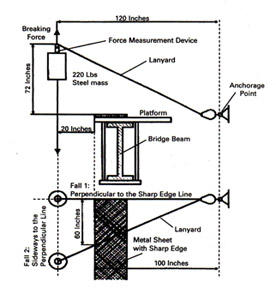
Now they realized that if another accident occurred and a fatality resulted, they could be drawn into a manslaughter case. They began to search urgently for a retractable that was approved for their application. They learned my product line was approved, but asked me to perform a series of tests to verify it. The test was extreme; they wanted a worst-case scenario. They asked that a 282 lbs. rigid test weight be dropped 5 feet over a flamed cut piece of steel. The edge was very jagged and sharp. The 5 feet was chosen to simulate a 6-foot-tall man standing at the edge of a roof, where his D-ring would be approximately 60 inches above the deck. I put a wooden pallet on the ground because I didn’t want to crack my cement, and even I didn’t think this was going to work. I used 6 wire rope retractables and 6 web retractables for the test. To my surprise, I didn’t have to use the pallet. The difference was the internal mechanism of the retractable. In Europe, retractables are held to a higher standard. The units contain a mechanical shock absorber inside the unit. Instead of hitting the edge of the flame cut steel, the wire and the web are allowed to slide over the edge instead of stopping and cutting like an ax.
Some retractables on the market that lock up quickly offer a shock absorber that can be attached at the tie-off point. Instead of the wire deploying from the retractable, the whole retractable moves, causing the line, the wire or web not to cut. The problem is the workers are often unaware of the after-market part and don’t install it. Reading the instructions would solve this problem.
I personally prefer a retractable that is self-contained. Some retractable instructions state that you must set railing or perimeters wire or guard rail around the entire structure to avoid the fall; in that case, why even use a retractable? Unfortunately, being unfamiliar with fall protection equipment, some roofers are buying whatever retractable is available and not bothering to read the instructions.
Certification and inspection of retractables
For years, manufacturers required that a retractable be certified annually. Standard recertification included automatic replacement of selected parts, while all other components were inspected and replaced as needed. The administration process for the user was cumbersome.
Most manufacturers have now abandoned the mandatory annual recertification in favor of increased end user training. Load indicators reveal when a device has been involved in a fall and must be returned for inspection, repair and certification.
Along with the other components of your fall arrest system, your retractable must be inspected before each use. Become familiar with the warnings on the label. Inspect the housing for cracks or severe dents. Check for any missing or lose bolts, nuts or screws. The connection bracket must not be cracked or distorted. Inspect the hook, latch and swivel for distortion. If a carabiner is a part of your system, make certain that it has no distortion or cracks and that it operates properly.
Extend the cable or web line the full length and inspect for kinks, broken wires, abrasion, rust, fraying, nicks, broken or lose stitching, or burns. Test the braking mechanism by giving the line a quick downward tug. If any feature seems questionable, do not use the unit.
This important information helps to avoid serious injury or a possible fatality.
You’ve read this article — you’re aware of the problem; now the responsibility is yours.
Looking for a reprint of this article?
From high-res PDFs to custom plaques, order your copy today!