Emerging leaders build trust; lead with passion
Leadership can be either positional, emergent, or both.
Positional leaders are those who hold a leadership title, though a title alone does not make one an effective leader.
An emergent leader surfaces when he/she earns the voluntary and passionate involvement of those he/she leads. They lead by example and have a strong, positive influence on those around them. Emergent leaders, positional or otherwise, are effective leaders.
To become an emergent leader, TAP into the three tenets of emergent leadership — building Trust, creating Accountability, and leading with Passion.
Build trust
Stephen M.R. Covey, in The Speed of Trust, presents a compelling argument that trust is the one thing that changes everything. According to Dr. Petersen, “safety can only be achieved when both management and employees do it together, when there is confidence and trust existing between them!” In order for people to work together most effectively, they must build strong, high-trust relationships. Three key behaviors build such relationships. (Exhibit 1)
Exhibit 1. The DNA of Trust.
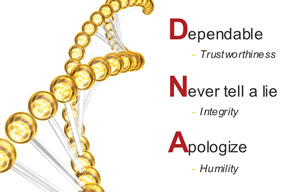
Just as DNA (deoxyribonucleic acid) represents the basic building blocks of life, the DNA of Trust represents the basic building blocks of high-trust relationships.
First, be dependable. When you accept a responsibility or make a commitment, follow through. Peter Northouse in Leadership Theory and Practice cites a study by Bennis and Nanus (1985) finding that transformational leaders create trust by making their own positions clearly known and then standing by them. Through your dependability, others will learn they can trust you to say and do the right thing.
Second, never tell a lie. Be honest in all your communications and always behave with integrity. People will learn that you strive to do the right things for the right reasons and your reputation for integrity will earn you respect. Nothing is more powerful.
Third, acknowledge when you’re wrong and apologize to those affected. Connors, Smith, and Hickman in The Oz Principle, Getting Results Through Individual and Organizational Accountability, claim that most organizations fail due to leadership error, but that many leaders will never admit that fact. When you make a mistake or treat others inappropriately, trust is weakened. If you do nothing, the trust relationship remains sunk and will sink further over time. Acknowledge your error and apologize. When you humble yourself, others respect you and want to follow.
Create accountability
According to world-renowned author and teacher Zig Ziglar, “You must inspect what you expect!” Dr. Peterson adds, “You can’t get a culture of safety excellence without accountability.” The leader must create a culture in which everyone accepts personal ownership for his/her role and voluntarily performs it with accuracy every day. There are four steps to creating accountability (Exhibit 2) and three moments of truth in which the leader’s behavior is critical.
Exhibit 2. The Four Steps to Accountability.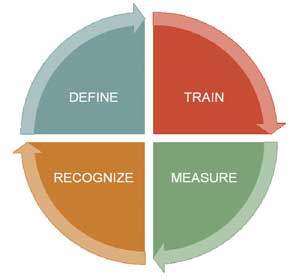
Step 1: Define the safety activities required for each role, from the CEO to the frontline. Everyone must clearly understand what’s expected of them in order to create the presence of safety.
Step 2: Train everyone on those activities to ensure they know how to do them right.
Step 3: Measure their performance with periodic spot checks and conversations to ensure the activities are being performed correctly.
Step 4: Recognize them when they perform their safety activities right, and coach to improve their performance when they do them wrong.
The three moments of truth are…
1. At the beginning of the relationship. Discuss what’s expected and how it will be measured.
2. Every day, as you interact with one another. The two things a leader must do on a daily basis to reinforce safety activities and behaviors are noted in Step 4 above. Positive recognition is much more effective in influencing behavior than criticism or correction. The emerging leader coming to people’s attention must administer both, but positive reinforcement should be used at a ratio of at least 7 to 1 over correction or discipline. The more you recognize strong performance, the less you have to deal with poor performance.
3. The periodic summary, or performance review. Whether formal or informal, you must regularly meet to gain clarity and make adjustments.
Lead with passion
According to John Maxwell, “a great leaders’ courage to fulfill his vision comes from passion, not position.” Passion is discovered, not created. The key to being an up and coming emerging leader is to discover your passion and deploy it fervently so that others are inspired to follow you. MVP GOLD will enable you to do that.
• Mission — what is your main purpose in life?
• Vision — where are you going? What is your unique vision for your life?
• Principles — what are the non-negotiable values on which you will build your life?
• Gifts — what are your talents, skills and abilities?
• Occurrences — what life experiences have equipped you for service?
• Loyalties — where is your heart, your desire? What inflames your spirit?
• Disposition — what is your personality type, your unique preferences?
Passion is contagious. When you discover and deploy yours, it helps others do the same.
Build high trust in your relationships, create a culture of accountability around the work, and lead others with a passion for keeping everyone safe. When you TAP into the three tenets of emergent leadership, a zero-incident culture becomes inevitable.
Bibliography
• Connors, Roger et al. The oz principle; getting results through individual and organizational accountability. New York: The Penguin Group, 2004.
• Covey, Stephen M.R. The speed of trust. New York: Free Press, 2006.
• Maxwell, John C. Today matters. New York: Warner Faith, 2004.
• Northouse, Peter G. Leadership theory and practice. Thousand Oaks, CA: Sage Publications, 2004.
• Petersen, Dan Authentic involvement. National Safety Council, 2001.
• Ziglar, Zig See you at the top. Carrollton, TX: Pelican Publishing, 1977.
Looking for a reprint of this article?
From high-res PDFs to custom plaques, order your copy today!