ISHN logo
search
cart
facebook twitter linkedin youtube
  • Sign In
  • Create Account
  • Sign Out
  • My Account
ISHN logo
  • NEWS
    • Today's News
    • Global Safety News
    • Government Regulations
  • PRODUCTS
    • Product Innovations
    • Featured Products
  • TOPICS
    • Environmental Health and Safety
    • Facility Safety
    • Workplace Health
    • Occupational Safety
    • PPE
    • More Topics
  • CONSTRUCTION
  • TECHNOLOGY
  • COLUMNS
    • Best Practices
    • Dave Johnson: What’s going on
    • Editorial Comments
    • Leading Safety
  • MULTIMEDIA
    • ISHN Podcast
    • Videos
    • Cold Stress Education Quiz
    • Webinars
    • White Papers
  • MORE
    • Buyer's Guide
    • Newsletters
    • Convention Companion
    • Polls
    • Events
    • ISHN Store
    • Sponsor Insights
  • EMAGAZINE
    • eMagazine
    • Archived Issues
    • Contact
    • Advertise
  • JOIN TODAY!
Today's Safety NewsEnvironmental Health and Safety

Health study of Gulf oil spill cleanup workers enters new phase

Research continues four years after the Deepwater Horizon oil spill
April 17, 2014

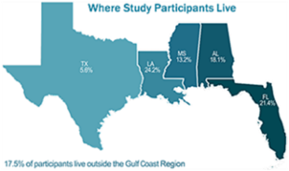
GuLF study participantsNational Institutes of Health (NIH) researchers who are conducting the largest study ever on the potential health effects of an oil spill have a big concern: that participants may not continue participating in the project because it is so long-term.

"It's important that the 33,000 people enrolled in this study stay involved, because these early findings need to be followed up over time," said Dale Sandler, Ph.D., lead researcher for the GuLF STUDY.

All participants are being contacted for telephone interviews to update their health status. Those living within 60 miles of Mobile, Ala., and New Orleans also will be invited to take part in a second comprehensive health exam.

Higher rates of depression and anxiety

Preliminary observations from the first health exam indicated that clean-up workers were about 30 percent more likely to have moderate to severe depression than residents who did no clean-up work. Results were similar for anxiety.

"At this point, it is hard to know if the increased frequency of depression and anxiety in workers is because of exposure to oil and dispersants, or something else about the oil spill experience and its aftermath," said Sandler.

He explained that the research team initially focused on the mental health effects of the spill because high levels of anxiety, depression, and stress were frequently reported after this and other disasters.

"People in Gulf communities have been through so much," Sandler said. "Many have lost their jobs, and there is a lot of general everyday stress and uncertainty in their lives."

Everyone wants answers now

Sandler heads the Epidemiology Branch at the National Institute of Environmental Health Sciences (NIEHS), part of NIH. "We know that everyone wants answers now, and we do, too. But it's important to remember that the GuLF STUDY is intended to be a 10-year study."

The GuLF STUDY (Gulf Long-term Follow-up Study) was launched by NIH in 2010, following the Deepwater Horizon drilling rig explosion. People all along the Gulf Coast and others throughout the country were trained, with support from NIEHS and other federal agencies, to safely assist with the clean-up efforts. Many of these workers are now enrolled in the GuLF STUDY.

Second round will include more exams

NIEHS announced that it has partnered with health clinics at the University of South Alabama College of Medicine and Louisiana State University Health Sciences Center School of Medicine to conduct the second round of health exams. The exams will focus on neurological, respiratory, and mental health issues. Although the exams are being conducted for research purposes, participants will receive results of blood pressure, cholesterol, and diabetes screenings. Participants will be referred for health care as needed. From the first health exam, more than 500 people were referred to primary care providers for health concerns.

Sandler said the team is also using questionnaire data and blood samples to understand the relationships between clean-up work, exposure to oil-related chemicals and dispersants, and physical symptoms.

She also indicated that workers reported more health symptoms, such as wheezing and cough, than non-workers, and some workers were still experiencing these symptoms up to three years after the spill. It is still too soon to determine if clean-up experiences and exposures are leading to increases in chronic diseases, such as lung disease or cancer, or whether any short-term symptoms persist or will dissipate over time.

"The bottom line is we really need the GuLF STUDY participants to stay engaged. If they haven't already done so, we encourage them to call 1-855-NIH-GULF (1-855-644-4853) to schedule their follow-up interview and to participate in the health exam and other study activities," Sandler said.

For more information about the GuLF STUDY, visit www.gulfstudy.nih.gov.

KEYWORDS: Deepwater Horizon niehs NIH

Share This Story

Looking for a reprint of this article?
From high-res PDFs to custom plaques, order your copy today!

Recommended Content

JOIN TODAY
to unlock your recommendations.

Already have an account? Sign In

  • forklift safety

    Exploring the latest technologies in forklift safety

    With more staff and more stock in warehousing now more...
    Workplace Training Strategies
    By: Josh Cramer
  • welding

    All about welder’s flash or arc eye

    A flash burn is a painful inflammation of the cornea,...
    Environmental Health and Safety
  • dangerous jobs

    The 10 most dangerous jobs in the U.S.

    On-the-job deaths have been rising — hitting the highest...
    Transportation Safety
    By: Benita Mehta
Manage My Account
  • eMagazine Subscriptions
  • ISHN Newsletter & Other Newsletter Alerts
  • Online Registration
  • Manage My Preferences
  • Subscription Customer Service

More Videos

Sponsored Content

Sponsored Content is a special paid section where industry companies provide high quality, objective, non-commercial content around topics of interest to the ISHN audience. All Sponsored Content is supplied by the advertising company and any opinions expressed in this article are those of the author and not necessarily reflect the views of ISHN or its parent company, BNP Media. Interested in participating in our Sponsored Content section? Contact your local rep!

close
  • man wearing the the Sundström SR200 Full Face Mask Respirator
    Sponsored byOHD

    5 Fit Testing Mistakes That Could Cost You

  • This image shows Magid AcuSpex polarized blue mirrored safety glasses.
    Sponsored byMagid Glove and Safety

    Construction PPE Guide: What Crews Need for Each Task

  • lone worker in confined space
    Sponsored byAlphasense Ltd.

    GET THE LEAD OUT of your Safety Oxygen Sensors!

Popular Stories

SpaceX 7 launch

OSHA Investigating Fatal Fall at SpaceX Starbase

Worker Impairment

How to Tell When a Co-Worker is Impaired? A Safety Pro’s Challenge

Automated loading dock equipment

After March 2026 Rivian Death, Safety Managers Reassess Loading Dock Systems Under OSHA's Warehouse Emphasis Program

top 10 most dangerous jobs

Poll

Seasonal Readiness

With the federal heat stress prevention rule on the horizon, which area of your safety program needs the most attention?
View Results Poll Archive

Products

Surviving an OSHA Audit A Management Guide, 2nd Edition

Surviving an OSHA Audit A Management Guide, 2nd Edition

See More Products

ISHN Podcasts

Related Articles

  • NIH launches study of health effects on oil spill cleanup workers (3/2)

    See More
  • Policy set to protect oil spill cleanup workers as heat rises along the Gulf (6/10)

    See More
  • Tests on Gulf spill cleanup workers show altered blood chemistry

    See More

Related Products

See More Products
  • 9780849365461.jpg

    Handbook of OSHA Construction Safety and Health, Second Edition

  • 3E

    Safety Professional's Reference and Study Guide, Third Edition

See More Products

Related Directories

  • New Pig

    The world leader in absorbent products, New Pig provides innovative products to help maintain cleaner, safer, more productive work environments.
×

Become a Leader in Safety Culture

Build your knowledge with ISHN, covering key safety, health and industrial hygiene news, products, and trends.

JOIN TODAY
  • RESOURCES
    • Advertise
    • Contact Us
    • Directories
    • Manufacturing Division
    • Store
    • Want More
  • SIGN UP TODAY
    • Create Account
    • eMagazine
    • Newsletters
    • Customer Service
    • Manage Preferences
  • SERVICES
    • Marketing Services
    • Reprints
    • Market Research
    • List Rental
    • Survey/Respondent Access
  • STAY CONNECTED
    • LinkedIn
    • Facebook
    • YouTube
    • X (Twitter)
  • PRIVACY
    • PRIVACY POLICY
    • TERMS & CONDITIONS
    • DO NOT SELL MY PERSONAL INFORMATION
    • PRIVACY REQUEST
    • ACCESSIBILITY

Copyright ©2026. All Rights Reserved BNP Media, Inc. and BNP Media II, LLC.

Design, CMS, Hosting & Web Development :: ePublishing