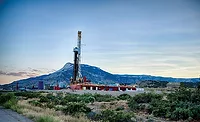
Fracking exposes hazardous silica risks
NIOSH field studies show that workers in the oil and gas industry may be exposed to dust with high levels of respirable crystalline silica during hydraulic fracturing or “fracking,” a process used to “stimulate” well production that involves large quantities of silica sand.
According to NIOSH, hydraulic fracturing sand contains up to 99 percent silica. Worker inhalation of respirable crystalline silica particles can cause silicosis, a lung disease where lung tissue around trapped silica particles reacts, causing inflammation and scarring and reducing the lungs’ ability to take in oxygen. Workers who breathe silica day after day are at greater risk of developing silicosis. Silica can also cause lung cancer and has been linked to other diseases, such as tuberculosis, chronic obstructive pulmonary disease, and kidney and autoimmune disease.
Under the Occupational Safety and Health Act of 1970, employers are responsible for providing safe and healthy working conditions. Employers must determine which jobs expose workers to silica and take actions to control overexposures and protect workers. The OSHA-NIOSH Hazard Alert: Worker Exposure to Silica during Hydraulic Fracturing outlines a combination of engineering controls, work practices, protective equipment, product substitution where feasible, and worker training needed to protect workers exposed to silica during hydraulic fracturing operations.
Investigate safe alternatives
One way to reduce silica exposures is to use alternative proppants (e.g., sintered bauxite, ceramics, resin-coated sand) where feasible. A proppant is a solid material, typically treated sand or man-made ceramic materials, designed to keep an induced hydraulic fracture open, during or following a fracturing treatment. Before using other proppants, it is important to evaluate the health hazards associated with them. If safe proppant alternatives are not feasible, then employers should monitor worker exposures, take measures to prevent exposures to silica, and inform workers of hazards.
Monitor the air to determine
• Collect respirable dust samples to determine which jobs expose workers to silica above exposure limits. Employers should consult with a trained occupational safety and health professional, such as a certified industrial hygienist, or contact OSHA’s free on-site consultation service.
• If air samples show levels above OSHA’s calculated PEL, employers are required to take actions to reduce worker exposures. However, both OSHA and NIOSH recommend that employers take the actions below to keep worker exposures below the NIOSH REL.
Control dust exposures
Engineering controls and work practices provide the best protection for workers and must be implemented first, before respiratory protection is used. Working with industry partners, NIOSH has identified the following control options for hydraulic fracturing operations:
Short-term work practices and procedural changes that can be implemented quickly:
• Mandate the capping of unused fill ports (e.g., cam lock caps) on sand movers. Securing unused fill ports can help reduce the dust released, especially during filling.
• Reduce the drop height between the sand transfer belt and T-belts and blender hoppers. Limiting the distance that sand falls through the air can help reduce dust.
• Limit the number of workers, and the time workers must spend in areas where dust and silica levels may be elevated, and consider ways to perform dusty operations remotely to completely remove employees from these areas.
• Apply fresh water to roads and around the well site to reduce the dust.
Practices that involve equipment changes:
• Enclose points where dust is released. Install thick plastic stilling or staging curtains around the bottom sides of the sand movers to limit dusts released from belt operation. Enclosures can also be added along and at the ends of the sand transfer belt.
• Where possible, use enclosed cabs or booths. Consider configuring operator cabs and booths with HEPA filtration and climate controls to further protect workers.
• Use local exhaust ventilation to collect silica-containing dusts and prevent dust escape. Install dust collection systems onto machines or equipment that can release dust.
• Replace transfer belts with screw augers on sand movers in new designs or retrofits. Dust can be released from the sand moving belt under the sand movers from the actions of belt movement or vibration. Moving sand through an auger system rather than a belt will help contain the sand and reduce dust release.
Provide respiratory protection
When engineering and work practices controls are not feasible, while they are being implemented, or when they do not reduce silica exposures below OSHA PELs, employers must provide workers with respirators. Whenever respirators are used, the employer must have a respiratory protection program that meets the requirements of OSHA’s Respiratory Protection Standard (29 CFR 1910.134). This program must include proper respirator selection, fit testing, medical evaluations and training.
• If respirators are provided, use at least a NIOSH-approved N95 respirator. If the silica level is more than 10 times the PEL, a half-face respirator is not protective and a respirator that offers a greater level of protection (e.g., a full-facepiece respirator, which will protect workers at silica levels up to 50 times the PEL) must be used. Full-face powered air-purifying respirators (PAPR) provide more protection than half-face air-purifying respirators. In general, workers find PAPRs to be more comfortable.
For more information, see OSHA’s Safety and Health Topics page and eTool on respiratory protection at www.osha.gov.
Provide training and information
OSHA’s Hazard Communication Standard requires that employers provide their workers with training and information about hazardous chemicals used in the workplace. Employers must provide training and information to workers in a manner and language that the worker understands. Employers must:
• Prepare and implement a written hazard communication program.
• Provide training and information on the hazards of silica and other chemicals used in the workplace.
• Provide workers access to Safety Data Sheets (SDSs) on silica sand and other hazardous chemicals they are exposed to during hydraulic fracturing operations.
Consider medical monitoring
As part of its National Emphasis Program on Silica, OSHA recommends that employers medically monitor all workers who may be exposed to silica dust levels at or above one-half the PEL. Recommended medical tests include:
• A medical exam that focuses on the respiratory system and includes a work and medical history
• A chest X-ray, evaluated by a qualified professional as described in Directive CPL 03-00-007
OSHA recommends that these tests be repeated every three years if the employee has less than 15 years of silica exposure, every two years if the employee has 15 to 20 years of exposure, and every year if the employee has 20 or more years of exposure.
Looking for a reprint of this article?
From high-res PDFs to custom plaques, order your copy today!