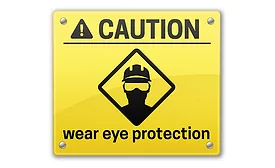
Impact, penetration, harmful dust, smoke, fumes, heat and injurious light radiation are all potential hazards associated with welding. Welding “smoke” is a mixture of very fine particles (fumes) and gases. Depending upon what is being welded, many of the substances in the smoke can be extremely toxic.
Best welding safety practices and equipment are universally applicable. Welding exposes everyone to similar hazards, whether you're responsible for safety at a large, welding-intensive manufacturing company, a billion-dollar engineering-construction firm or a small independent fabricator. Here are 12 tips for improving welding safety in your company, including advice that also improves productivity.
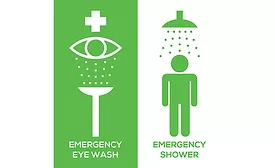
The first 10 to 15 seconds after exposure to a hazardous substance, especially a corrosive substance, are critical. Delaying treatment for even a few seconds may cause serious, permanent injury.
For chemical exposures and splashes, you need more protection than the use of goggles, face shields and other PPE. Showers and eyewashes are a necessary backup in an emergency to minimize effects of chemical contamination.
For guidance, use the American National Standards Institute (ANSI) / International Safety Equipment Association (ISEA) Z358.1-2014 emergency equipment standard.
Striking or scraping: The majority of eye injuries result from small particles or objects striking or scraping the eye, such as: dust, cement chips, metal slivers, and wood chips. These materials are often ejected by tools, windblown, or fall from above a worker.
Unfortunately, the eyes, like much of the rest of the body, become more susceptible to disease and other issues as we get older. Some problems are serious and can lead to blindness, if left untreated. But for people with hearing loss, even a small decrease in vision can affect the ability to lip-read and thus understand better what they hear.
Welding arcs give off radiation over a broad range of wavelengths - from 200 nm (nanometres) to 1,400 nm (or 0.2 to 1.4 µm, micometres). This includes ultraviolet (UV) radiation (200 to 400 nm), visible light (400 to 700 nm), and infrared (IR) radiation (700 to 1,400 nm).
On average, nearly nine in 10 adults (88 percent) spend more than two hours each day using a digital device, with one in 10 people spending at least three-fourths of their waking hours on a digital device.
Any activity that requires intense use of the eyes -- such as extended amounts of driving or reading -- can cause eye fatigue. These include extended periods of: Reading, Writing and Driving.
Have a comprehensive dilated eye exam. A dilated eye exam is the only way to detect many common eye diseases such as glaucoma, diabetic eye disease and age-related macular degeneration in their early stages.