ISHN logo
search
cart
facebook twitter linkedin youtube
  • Sign In
  • Create Account
  • Sign Out
  • My Account
ISHN logo
  • NEWS
    • Today's News
    • Global Safety News
    • Government Regulations
  • PRODUCTS
    • Product Innovations
    • Featured Products
  • TOPICS
    • Environmental Health and Safety
    • Facility Safety
    • Workplace Health
    • Occupational Safety
    • PPE
    • More Topics
  • CONSTRUCTION
  • TECHNOLOGY
  • COLUMNS
    • Best Practices
    • Dave Johnson: What’s going on
    • Editorial Comments
    • Leading Safety
  • MULTIMEDIA
    • ISHN Podcast
    • Videos
    • Cold Stress Education Quiz
    • Webinars
    • White Papers
  • MORE
    • Buyer's Guide
    • Newsletters
    • Convention Companion
    • Polls
    • Events
    • ISHN Store
    • Sponsor Insights
  • EMAGAZINE
    • eMagazine
    • Archived Issues
    • Contact
    • Advertise
  • JOIN TODAY!
Environmental Health and SafetyFacility SafetySafety TechnologyRisk Management

15 tips for using showers & eyewashes

When every second counts
By Dave Johnson
15 tips for using showers & eyewashes
February 7, 2019
  1. The first 10 to 15 seconds after exposure to a hazardous substance, especially a corrosive substance, are critical. Delaying treatment for even a few seconds may cause serious, permanent injury.
  2. For chemical exposures and splashes, you need more protection than the use of goggles, face shields and other PPE. Showers and eyewashes are a necessary backup in an emergency to minimize effects of chemical contamination.
  3. For guidance, use the American National Standards Institute (ANSI) / International Safety Equipment Association (ISEA) Z358.1-2014 emergency equipment standard.
  4. Evaluate your workplace for high-risk areas, potential hazards, and emergency needs. Safety data sheets help your evaluation by providing information on working with a hazardous substance in a safe manner. SDSs also provide information on a substance’s melting point, boiling point, flash point, toxicity, health effects, first aid, reactivity, storage, disposal, PPE and spill handling procedures.
  5. The ANSI/ISEA standard defines “flushing fluid” as any potable (drinking) water, preserved water, preserved buffered saline solution, or other medically acceptable solutions.
  6. The standard does not specify how long the affected body part should be flushed or rinsed. It does require equipment to be capable of providing a minimum of 15 minutes of flushing liquid.
  7. Other references recommend a minimum of 20-minute flushing if the nature of the contaminant is not known.
  8. If the properties of the chemical are known, flushing or rinsing times can be modified: 5 minutes for non-irritants or mild irritants; 15-20 minutes for moderate to severe irritants and chemicals that cause acute toxicity if absorbed through the skin; 30 minutes for most corrosive; and 60 minutes for strong alkalis, such as sodium; potassium or calcium hydroxide.
  9. If irritation persists, repeat the flushing procedure. It is critical to get medical attention as quickly as possible.
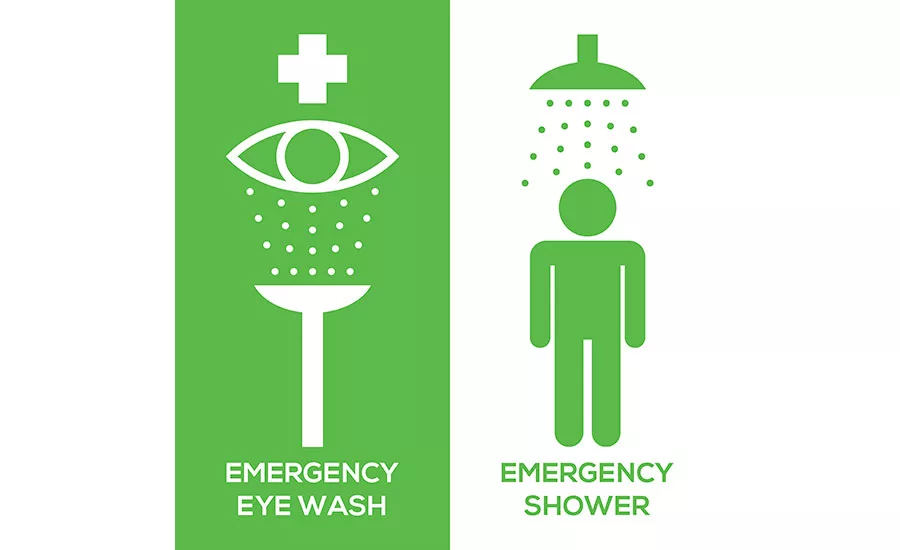
  10. Emergency showers are designed to flush the user’s head and body. They should not be used to flush the user’s eyes. The high rate or pressure of water flow could damage eyes.
  11. Eyewash stations are designed to flush the eye and face area only. There are combination units containing both a shower and an eyewash.
  12. ANSI/ISEA recommends that a person be able to reach showers or eyewashes in no more than 10 seconds. Remember, the victim may not have use of their vision. The standard notes that the average person can walk about 55 feet in 10 seconds – but this does not account for the person’s physical and emotional state in an emergency.
  13. Showers and eyewashes may be required to be closer to a work station if highly corrosive chemicals are being used.
  14. Water temperature should be “tepid” – between 60-100˚F. Temperatures higher than that are harmful to eyes and can enhance chemical interaction with skin and eyes. Long flushing times with cold water can cause hypothermia and may result in not rinsing or showering for the full recommended time.
  15. Showers and eyewashes should be on an unobstructed path; be easily visible; on the same floor as the hazard; and near an emergency exit so emergency response personnel can easily reach the victim.

Sources

The Canadian Centre for Occupational Health and Safety (CCOHS) and the International Safety Equipment Association.


KEYWORDS: emergency safety products emergency showers and eyewashes eye health

Share This Story

Looking for a reprint of this article?
From high-res PDFs to custom plaques, order your copy today!

Djohnson new pic 7.10.22

Dave Johnson was chief editor of ISHN from 1980 until early 2020. He uses his decades of expertise to write on hot topics and current events in the world of safety. He also writes and edits at Dave Johnson’s Writing Shop LLC and is editor-at-large for ISHN. Find him at https://www.facebook.com/Dave-Johnsons-Writing-Shop-101316571547263/, and on LinkedIn at https://www.linkedin.com/in/daveljohnsoneditor/.

Recommended Content

JOIN TODAY
to unlock your recommendations.

Already have an account? Sign In

  • forklift safety

    Exploring the latest technologies in forklift safety

    With more staff and more stock in warehousing now more...
    Facility Safety
    By: Josh Cramer
  • welding

    All about welder’s flash or arc eye

    A flash burn is a painful inflammation of the cornea,...
    Environmental Health and Safety
  • dangerous jobs

    The 10 most dangerous jobs in the U.S.

    On-the-job deaths have been rising — hitting the highest...
    Construction Industry Safety and Health
    By: Benita Mehta
Manage My Account
  • eMagazine Subscriptions
  • ISHN Newsletter & Other Newsletter Alerts
  • Online Registration
  • Manage My Preferences
  • Subscription Customer Service

More Videos

Sponsored Content

Sponsored Content is a special paid section where industry companies provide high quality, objective, non-commercial content around topics of interest to the ISHN audience. All Sponsored Content is supplied by the advertising company and any opinions expressed in this article are those of the author and not necessarily reflect the views of ISHN or its parent company, BNP Media. Interested in participating in our Sponsored Content section? Contact your local rep!

close
  • man wearing the the Sundström SR200 Full Face Mask Respirator
    Sponsored byOHD

    5 Fit Testing Mistakes That Could Cost You

  • This image shows Magid AcuSpex polarized blue mirrored safety glasses.
    Sponsored byMagid Glove and Safety

    Construction PPE Guide: What Crews Need for Each Task

  • lone worker in confined space
    Sponsored byAlphasense Ltd.

    GET THE LEAD OUT of your Safety Oxygen Sensors!

Popular Stories

SpaceX 7 launch

OSHA Investigating Fatal Fall at SpaceX Starbase

Worker Impairment

How to Tell When a Co-Worker is Impaired? A Safety Pro’s Challenge

Automated loading dock equipment

After March 2026 Rivian Death, Safety Managers Reassess Loading Dock Systems Under OSHA's Warehouse Emphasis Program

top 10 most dangerous jobs

Poll

Seasonal Readiness

With the federal heat stress prevention rule on the horizon, which area of your safety program needs the most attention?
View Results Poll Archive

Products

Surviving an OSHA Audit A Management Guide, 2nd Edition

Surviving an OSHA Audit A Management Guide, 2nd Edition

See More Products

ISHN Podcasts

Related Articles

  • Deb Group e-book offers tips for using gloves and creams in the workplace

    See More
  • 15 Tips For Solving Health Mysteries

    See More
  • emergency showers and eyewashes

    4 barriers to using emergency showers

    See More

Related Directories

  • Hughes Safety Showers

    Hughes design and manufacture emergency safety showers, eye/face wash units and decontamination equipment to provide you with a safer working environment, greater protection against serious injury and peace of mind that you’re compliant with crucial safety standards. From mains and tank fed safety showers to portable self-contained eye washes, we have solutions for every environment.
×

Become a Leader in Safety Culture

Build your knowledge with ISHN, covering key safety, health and industrial hygiene news, products, and trends.

JOIN TODAY
  • RESOURCES
    • Advertise
    • Contact Us
    • Directories
    • Manufacturing Division
    • Store
    • Want More
  • SIGN UP TODAY
    • Create Account
    • eMagazine
    • Newsletters
    • Customer Service
    • Manage Preferences
  • SERVICES
    • Marketing Services
    • Reprints
    • Market Research
    • List Rental
    • Survey/Respondent Access
  • STAY CONNECTED
    • LinkedIn
    • Facebook
    • YouTube
    • X (Twitter)
  • PRIVACY
    • PRIVACY POLICY
    • TERMS & CONDITIONS
    • DO NOT SELL MY PERSONAL INFORMATION
    • PRIVACY REQUEST
    • ACCESSIBILITY

Copyright ©2026. All Rights Reserved BNP Media, Inc. and BNP Media II, LLC.

Design, CMS, Hosting & Web Development :: ePublishing