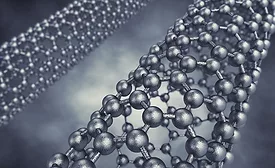
It’s a big day for some teeny tiny particles. Today has been designated “National Technology Day” by the U.S. nanotechnology community. The goal, according to Dr. John Howard, Director of the National Institute for Occupational Safety and Health (NIOSH): to inform the public about nanotechnology, share scientific accomplishments that benefit industry and society, and promote its future possibilities and benefits.
Engineered nanomaterials are fascinating. Just by making stuff smaller researchers have discovered forms of materials and even completely new materials that can be applied as diversely as better drugs, better paints or faster electronics. Using chemicals in a nanoscale version can completely alter their nature.
A leading European scientist says it’s “quite urgent to understand the exact mechanisms of nanotoxicity and make a classification depending on the mechanism.”
That warning from Dr. Vladimir Baulin of the University Rovira i Virgili in Tarragona, Spain comes with a reminder that radioactivity or x-rays “entered our lives the same way,” but that it took some time before researchers understood how they affected living organisms.
Nanotechnology is a broad name given to a wide range of technologies and materials that create, manipulate, or use particles that have one thing in common - their size. Nanotechnology (or nanoscience) involves materials that are extremely small and have dimensions roughly between 1 and 100 nanometres (nm).
How to perform nanomaterial exposure assessment in the workplace
November 11, 2016
Do you think you might have exposure to nanomaterials in your workplace? Never fear! NEAT 2.0 is here!
Engineered nanoparticles are unique. They are generally smaller than both red blood cells and viruses, don’t weigh much, and have a great amount of surface area proportionate to their size.
A report published by the Danish Environmental Protection Agency (EPA) states that inhalation of nanomaterials is the exposure route that provides the most significant health effects to consumers and others.
An international federation of trade unions representing the people who prepare and manufacture food is issuing a warning about the increasing use of nanomaterials by food manufacturers.
For the first time the agency will use TSCA authority to collect data on nanoscale chemicals already in use
March 27, 2015
The EPA is proposing one-time reporting and recordkeeping requirements on nanoscale chemical substances in the marketplace. The agency currently reviews new chemical substances manufactured or processed as nanomaterials prior to introduction into the marketplace to ensure that they are safe.
The European Agency for Safety and Health at Work (EU-OSHA), has published an overview of the issues surrounding the safe use of nanomaterials in the workplace.
The Center for Construction Research and Training (CPWR) has revealed plans for a major research effort to explore how nanotechnology is transforming our industry, and what implications this holds for worker safety.