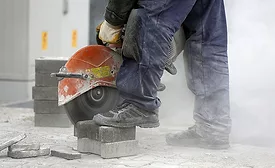
In June 2018, OSHA introduced the silica standard so workers exposed to silica-generating tasks would be protected from the hazards of silica and silica dust. Just over a year in, we have seen some companies still failing to comply, others still in the process, and others doing quite well.
The National Institute for Occupational Safety and Health (NIOSH) has begun offering a series of free, confidential health screenings to coal miners as part of the Coal Workers’ Health Surveillance Program (CWHSP). The screenings are intended to provide early detection of coal workers’ pneumoconiosis (CWP), also known as black lung, a serious but preventable occupational lung disease in coal miners caused by breathing respirable coal mine dust.
Until recently, underground coal miners and mine operators had little way of knowing—in real time—if miners were being exposed to hazardous levels of respirable coal dust during their shifts. NIOSH collaborated with an instrument manufacturer, government partners, labor representatives, and coal industry leaders to develop the continuous personal dust monitor (CPDM), a technology that offers miners, safety personnel, and operators real-time exposure information to help protect miners’ health.
Follow the briefing live on Twitter at #SilicaBriefing
February 9, 2017
The American Industrial Hygiene Association (AIHA®) will hold a congressional briefing on Capitol Hill Feb. 15 that will focus on OSHA’s silica rule. The event, which will be held from 10:00 to 11:00 a.m. ET in room 1540-A in the Longworth House Office Building, will also serve as a case study of the importance of worker health and safety.
From an OSHA Letter of Interpretation:
Scenario: An employee is dry cutting concrete in an outdoor, well-ventilated environment that creates a small amount of dust that never approaches the permissible exposure limit (PEL), and the supervisor advises the employee to put a dust mask on.
Question: Does a supervisor advising an employee to put on a dust mask constitute non-voluntary (required) use even though the generated dust amount is below the PEL?
Reply: Respiratory protection is required when such equipment is necessary to protect the health of the employee or whenever respirators are required by the employer.
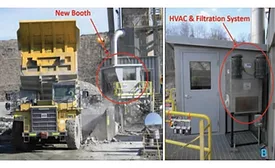
In the 1960s cartoon The Flintstones, Stone Age man Fred Flintstone worked in a quarry while sitting in the open booth of a rock-crusher machine. Presumably, the animators based Fred’s booth on the open designs typical of the 1960s. If they had created it in the 2000s, however, Fred’s booth would have looked vastly different, notwithstanding the fact that his booth was atop a brontosaurus.
Employers covered by OSHA’s final rule on occupational exposure to respirable crystalline silica have until June 23, 2017, to comply with the new construction standard, except for requirements for laboratory evaluation of exposure samples, which begin on June 23, 2018.
From 1986 to 2010, 10 deadly explosions occurred in underground coal mines in the United States. The risk of explosion involves an interrelated chain of events. A source of heat (such as a spark) ignites methane gas in the air of the coal mine tunnel.
A new study at the National Institute for Occupational Safety and Health (NIOSH) underscores the importance of anticipating respiratory disease, including black lung disease and loss of lung function, in former coal miners to allow them to receive an appropriate diagnosis and medical care.
While operating an industrial machine, a worker at MCM Precision Castings Inc. was exposed to noise levels that averaged 97 decibels, equal to the noise of a jackhammer, over his eight-hour shift. Employees of the Weston, Ohio-based company were also exposed to dangerously high noise levels and crystalline silica dust, a cause of chronic lung disease, OSHA has found.