Revisiting Heinrich's 'Accident Triangle'

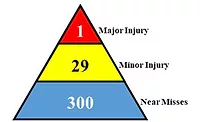
It's the concept that we all are familiar with. So many near misses lead to an analogous number of first aid injuries and onward through the logic to recordables and ending in the inevitability of a fatality.
This inevitability of disaster has always bothered me. If I cross the railroad tracks too many times I will die, or drive to work too many times or something else like that. I am not a fatalist, so what is there that will enable the industrial workplace to overcome this fatalistic teaching?
My work with companies and individuals that have done both well and poorly in safety always leads to individual behaviors as a key factor after workplace conditions, training and safety standards are addressed. So how do we attack the fatalism of Heinrich's triangle?
If we build a safety triangle (pyramid) on the "stone" of excellent fundamentals that modify behaviors and actions, we can limit the base of improper activities that lead to 98 percent of the injuries in Heinrich's model. Each time I have gone down this road the results have been similarly excellent.
Focus on fundamentals
The fundamentals of upper management visibility in safety, middle management involvement, focused supervisory performance, hourly employee active involvement and training that both teaches and reinforces these basics of excellence has significantly reduced injuries. The approach has direct similarities to the six sigma process of continuous improvement (define, measure, act, improve, control). Here's how it applies to safety:
- Define the correct behaviors that eliminate unsafe acts and injuries;
- Train all personnel in these behaviors;
- Measure that personnel are indeed doing these correct behaviors;
- Reward their accomplishments of these correct behaviors.
By eliminating dangerous behaviors there are never enough dangerous actions to get us to a more serious level of safety injuries in Heinrich's pyramid. The key is to not focus on compliance, or reward "acceptable injury levels/goals." Instead, concentrate on the fundamentals that eliminate the activities/behaviors that move us up the Heinrich inevitability triangle.
Looking for a reprint of this article?
From high-res PDFs to custom plaques, order your copy today!




.webp?t=1721257160 "download (1).jpg")