LED technology reduces explosion risks
The complex and hazardous nature of confined spaces presents numerous risks for workers. Because of this, many businesses that operate in hazardous locations make use of explosion proof lights to prevent the ignition of flammable gases and dust particles. LED technology has contributed to the features of explosion proof lights by making them more reliable, sturdy and cost-effective.
Currently, the global adoption of explosion proof LED lights is increasing at an average annual rate of 5.9 percent. ElectroniCast, a market and technology research firm, predicts consumption to reach $206.5 million by 2018 (compared to $137.8 million in 2011). Leading the adoption of explosion proof lighting products are oil-related establishments in the Europe, Middle East and African (EMEA) region.
Robust design and application
Explosion proof lights are designed to isolate sparks within the unit to prevent explosions from escaping. During an explosion, this greatly minimizes the risk of the explosive reaction from spreading, or igniting volatile substances in the area. The products feature a thick casing that covers the lights, though it should be noted that the units are not air tight. The design of the light forces gas to take a long, complex route through various pathways and channels; as it cools down the gas to a safer temperature.
Confined spaces offer an ideal environment for dangerous gases and vapors to accumulate. These areas are poorly ventilated, isolated and usually difficult to maintain compared to other active sections of the facility. Due to the sensitive nature of confined spaces, explosion proof lights must be used to eliminate or greatly decrease the possibility of fire hazards. Examples of confined spaces include chemical storage tanks, silos and tanker rail cars. The locations are typically segregated away from the main operating hub of the plant, which entails limited access to such areas.
Traditional explosion proof lights incorporate the use of incandescent and fluorescent fixtures. The lights are not as efficient to meet the needs of hazardous working environments, compared to LEDs. Incandescent units offer a lifespan of 1,200+ hours, a 10-17 lumens-per-watt ratio and have difficulties operating under extreme temperatures and humidity. Fluorescent units provide roughly 8,000+ hours of lighting with a 40-70 lumens-per-watt ratio. Both types of lights require careful handling and break easily due to glass parts and filaments found inside the products.
By comparison, LEDs boast an average lifespan of 50,000+ hours and a superior lumens-per-watt ration of 40-100. Plus, LEDs are highly resistant to vibration and can withstand rough treatment due to its compact design. The lighting option also consumes over 20 percent less energy compared to other units, and is eco-friendly (LEDs do not use mercury or lead).
Classification requirements
Businesses that are interested in deploying explosion proof lights in their facility must understand the light’s classification requirements. Such units come with various ratings, depending on the type of hazardous location and gases/dust present in the applicable environment. Classifications are broken down into the following criteria: Class, Divisions and Groups. Article 500 in the National Electric Code defines the Class/Division classification (article 505 covers the Class/Zone):
• Class I, Div. 1 - Where ignitable concentrations of flammable gases, vapors or liquids are present continuously or frequently within the atmosphere under normal operation conditions.
• Class I, Div. 2 - Where ignitable concentrations of flammable gases, vapors, or liquids are present within the atmosphere under abnormal operating conditions.
• Class II, Div. 1 - Where ignitable concentrations of combustible dusts are present within the atmosphere under normal operation conditions.
• Class II, Div. 2 - Where ignitable concentrations of combustible dust are present within the atmosphere under abnormal operating conditions.
• Class III, Div. 1 - Where easily ignitable fibers or materials producing combustible flyings are present within the atmosphere under normal operation conditions.
• Class III, Div. 2 - Where easily ignitable fibers or materials producing combustible flyings are present within the atmosphere under abnormal operating conditions.
The group elaborates that the lights must meet the respective classification or a higher rated classification in order to ensure compliance. This condition is set forth in ANSI/NFPA 70:500.8(A)(2): “Equipment that has been identified for a Division 1 location shall be permitted in a Division 2 location of the same class, group, and temperature class.” In addition, the guidelines suggest that the operating temperature of the units must not be greater than the minimum combustible temperature of the hazardous gases present in the facility.
Types of explosion proof lights
In addition to complying with lighting classifications, businesses should also consider choosing explosion proof lights that are designed for the applicable working environment. For example, explosion proof LED string lights are mostly used for tank inspection and close work. Such equipment comes with a hook that attaches to bars and scaffolds. Explosion proof LED manhole lights can be found in storage tanks and ship tanks, where entry is limited to a 21-inch man-way opening. The circular unit is designed to rest on the lip of the opening while providing adequate lighting in the hazardous location.
Portable explosion proof lights in the form of handheld, wireless flashlights are applicable for on-the-go lighting requirements, or confined spaces with obstructions that limit the use of standard equipment. Such units usually run on rechargeable batteries and offer waterproof and non-slip grip features.
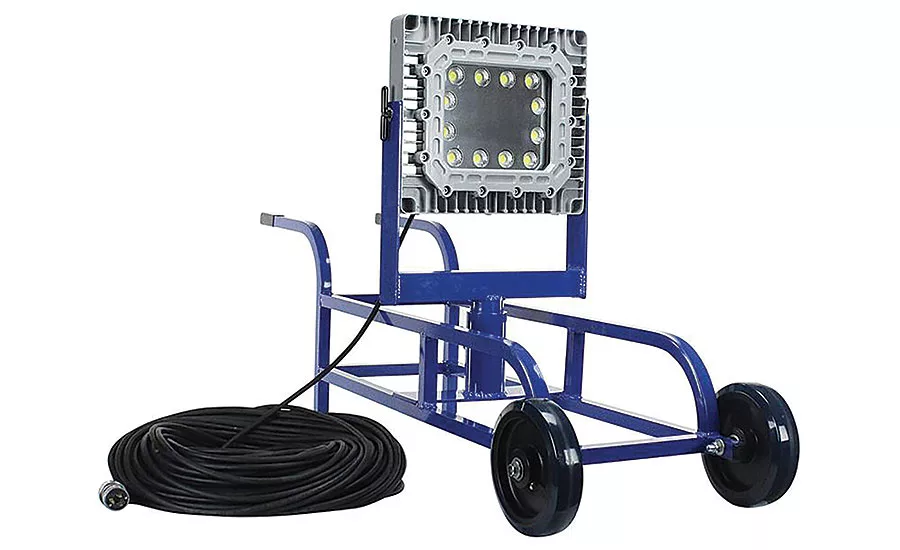
For large-scale operations, individuals may use explosion proof LED tank lights. The units are supported by a tripod or cart for easy transportation and setup. Such lighting options reach over 100-300 watts with an average of 20,000+ lumens. Majority of explosion proof lights also incorporate long explosion proof cords and plugs.
Looking for a reprint of this article?
From high-res PDFs to custom plaques, order your copy today!