Understanding lockout-tagout regulations
When are automated control systems allowed?
Lockout or tagout?
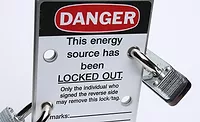
Since January 2, 1990, lockable isolation devices have been required when installing new machines and equipment and are required to be added to old machines “whenever replacement of major repair, renovation or modification of a machine or equipment is performed” (OSHA). If any unmodified, pre-1990 machines are still in use, a tagout system is required. This is a system of securely fixing tags to the isolating device to indicate that the equipment must not be used. However, if a machine is capable of being locked out, then in almost all cases, tagout must not be used.
Lockout exclusions
There are two important exclusions from the OSHA LOTO standard. First, “normal production operations are not covered by this standard. Servicing and/or maintenance that takes place during normal production operations is covered by this standard only if an employee is required to remove or bypass a guard or other safety device or an employee is required to place any part of his or her body into an area on a machine or piece of equipment where work is actually performed upon the material being processed or where an associated danger zone exists during a machine operating cycle.” Second, “minor tool changes and adjustments, and other minor servicing activities, which take place during normal production operations, are not covered by this standard if they are routine, repetitive and integral to the use of the equipment for production, provided that the work is performed using alternative measures which provide effective protection.”
The LOTO standard does not apply to activities that are either “normal production operations” or meet the above exception criteria for “minor and routine” servicing. For the latter, “alternative measures” must be used.
Remote lockout systems
According to Richard E. Fairfax, director, Directorate of Enforcement Programs at OSHA in an Interpretation Letter from July 15, 2003, “a circuit that meets the control reliability and control-component-failure-protection requirements of the American National Standards for machine tools (ANSI B11.19-1990) would provide alternative safe guarding measures with respect to the minor servicing exception contained in 1910.147 (a) (2) (ii).”
Use of control devices such as contactors, relays and (typically) a safety-rated PLC instead of directly padlocking the isolating switch is referred to in ANSI Z244.1 as a “remote low-voltage lockout system.” However, currently, Z244.1 does not give any specific technical requirements for such systems. Although the ANSI standard allows these systems instead of lockout, they are only permitted by the OSHA standard for the minor/routine servicing exception. For other tasks, such as major servicing, traditional lockout is required and use of a remote low-voltage lockout system would need approval (i.e. variance letter) from OSHA.
Use of control systems
On January 5, 1998, OSHA issued a letter of “Interpretation/Variance” for a “safety disconnect system” that used redundant and monitored control circuits to implement an alternative system intended for use even in applications not covered by the minor servicing exception. The letter highlighted several key features of the system:
- Measures and ensures no motive force to the drive system
- Provides fail-safe verification; that is, defaults to the safe position
- Verification is provided by a system which actively confirms zero-energy state to the drives before the verification light comes on
- When an individual initiates the lockout sequence by opening the system switch and placing a lock on it, the verification light will come on if the machine is at a zero-energy state.The system is designed such that failure of any component in the system will not result in the light coming on when the machine is in an unsafe mode
- The system is contained in a sealed, protected box
- The [components] used are certified by a nationally recognized testing laboratory (NRTL)
- An independent laboratory did a system risk analysis and determined the proposed system presented the lowest risk to the operator
The letter concluded, “Based on the information enclosed in your letter, your ‘safety disconnect system’ has been evaluated as an inherently fail-safe system which performs the same function as an energy isolating device…”
Because the letter was (in part) titled “Interpretation,” it was, for many years, widely regarded as a statement by OSHA that any similar system would meet the intent of the OSHA regulations even beyond the “minor and routine” exception.
Several companies now sell equipment based on some or all of the principles outlined in the letter. However, there is no published U.S. standard for such equipment. Hence, they can only be listed for electrical safety — fire and shock hazards — not for their safety function.
The January 1998 OSHA letter has been “archived” by OSHA and is no longer available on their website. OSHA’s position in formal letters issued since then has been to stand by their strict definition of “energy isolating device” and to assert that any other means, unless covered by the exceptions, is a deviation from the standard. However, in 2007 OSHA did restate that it is possible for an employer to apply for a “variance,” which, if granted, would permit them to deviate from the OSHA standard.
Proposed standard UL 6420
In May 2008, Underwriters Laboratories Inc. (UL) published a draft of a proposed Standard for Equipment Used for System Isolation and Rated as a Single Unit, UL 6420. The scope is “isolating equipment incorporating electromechanical contactors remotely controlled and monitored to provide remote isolation status indication with a defined integrity level. This equipment is intended for use as an additional isolating means on the load side of the required supply-disconnecting device and over current protection. […] The System Isolation Equipment is expected to be used both as a means for removal of power for prevention of unexpected start-up of a stopped machine and as an isolator to provide protection from electric shock by ensuring the removal of electrical energy.”
In response to the comments that were received on the 2008 draft, a new version has been under preparation. As of March 2011, UL is working with the submitter to finalize the proposed standard so that it can be sent out for ballot. If the standard is eventually adopted as a UL standard, manufacturers of remote low-voltage lockout systems would be able to have their products “listed” by UL or another NRTL. Several manufacturers and potential users hope this would influence OSHA to allow increased use of such devices.
Conclusion
Traditional lockout, as defined by OSHA, can be inconvenient and slow, especially in large installations with several sources of energy to isolate and dissipate. Correct implementation depends on trained employees following written procedures, which can be complex. As with any manual procedure, errors can and do occur, sometimes resulting in death or serious injury when the lockout procedures are not followed correctly. OSHA frequently issues citations and fines to employers for failure to comply with LOTO regulations.
Automated control systems that allow a LOTO procedure to be implemented by “remote lockout” exist and are in common use. However, in the U.S., their use is currently restricted to “minor and routine” servicing, unless a variation is obtained from OSHA. If the proposed UL 6420 is adopted by UL, OSHA may review their position and, perhaps, allow wider use.
For more in-depth information on definitions used by OSHA, visit www.osha.gov.
Looking for a reprint of this article?
From high-res PDFs to custom plaques, order your copy today!