NIOSH Policy Statement: Respiratory protection recommendations for airborne exposures to crystalline silica
|
|
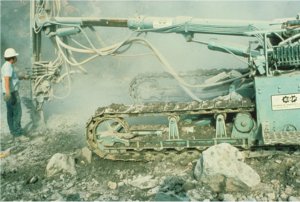
The following describes the NIOSH policy for respiratory protection against airborne exposures to crystalline silica.
Recommendation
NIOSH recommends the use of half-facepiece particulate respirators with N95 or better filters for airborne exposures to crystalline silica at concentrations less than or equal to 0.5 mg/m3. OSHA also specifies the use of at least a 95-rated filter efficiency [29 Code of Federal Regulations (CFR) 1910.134]. The recommendation for a 95-rated filter efficiency reflects the improved filter efficiency of N95 filters over the earlier dust and mist (DM) filters. A comprehensive respirator program must be instituted prior to the use of 42 CFR 84 respirators. The requirements for a comprehensive respirator program may be found in the OSHA respiratory protection standard (29 CFR 1910.134).
Background
In 1974, NIOSH published the Criteria for a Recommended Standard: Occupational Exposure to Crystalline Silica recommending that occupational exposure to respirable crystalline silica be controlled so that workers are not exposed to concentrations greater than 50 micrograms per cubic meter of air (50 μg/m3) as a full-shift sample for up to a 10-hr workday during a 40-hr workweek to prevent silicosis.
The NIOSH recommended exposure limit (REL) remains 50 μg/m3 today. The 1974 criteria document listed the “single use (valveless type) dust respirator” as the acceptable respirator type for use at concentrations of free silica of less than or equal to 5 times the REL (5×) and “quarter or half mask respirators with replaceable dust filter or single use (with valve) dust respirators,” or “type C, demand type (negative pressure), with quarter or half mask facepiece” for use at concentrations of less than or equal to 10 times the REL (10×).
In testimony at the 1988 OSHA hearing on the proposed rule on air contaminants, NIOSH cited data to indicate that crystalline silica meets the OSHA definition of a potential occupational carcinogen as defined in 29 CFR, Part 1990, and recommended that OSHA label crystalline silica a potential occupational carcinogen [IARC 1987, NIOSH 1988]. NIOSH also reaffirmed the REL of 50 μg/m3.
Consequently, only the most protective respirator (i.e., self-contained breathing apparatus [SCBA]) was recommended based on the NIOSH cancer policy at that time of controlling exposures to potential occupational carcinogens to the lowest feasible concentration. In 1994 NIOSH replaced the SCBA respirator recommendation with recommendations for the use of half-facepiece air-purifying respirators with high-efficiency particulate filters (10×) and powered air-purifying respirators (PAPRs) with high-efficiency particulate filters [NIOSH 1994].
The reasoning for the initial high-efficiency filter recommendation is supported by the NIOSH Respirator Users Notice: Differences and Limitations Between Part 11 Particulate Respirators and Part 84 Particulate Respirator [NIOSH 1996]. However, the 1994 NIOSH recommendation for high-efficiency filters for silica concentrations of 0.5 mg/m3 was not based on a need for a 99.97% filter efficiency but instead reflected a limitation of the efficiency of the DM mask in filtering smaller particles (<2 μm mass median aerodynamic diameter). The improved filtering efficiency characteristics of the particulate filters certified according to 42 CFR 84, compared to DM filters, result in filter efficiencies of at least 95% for all sizes of silica dust; consequently, 100-rated filter efficiency (99.97%) is not required to achieve an APF of 10 in a properly fitted half-facepiece particulate respirator for crystalline silica exposures.
References
ANSI [1992]. Practices for Respiratory Protection. Washington, DC, American National Standards Institute.
IARC [1987]. Silica and Some Silicates. IARC Monographs on the Evaluation of Carcinogenic Risk of Chemicals to Humans, vol. 42. Lyon, France: International Agency for Research on Cancer. 289 pp.
NIOSH [1974]. NIOSH Criteria for a recommended standard: occupational exposure to crystalline silica. Cincinnati, OH: U.S. Department of Health and Human Services, Public Health Service, Center for Disease Control, National Institute for Occupational Safety and Health, DHEW (NIOSH) Publication No. 75–120. [www.cdc.gov/niosh/75-120.html].
NIOSH [1981]. Current intelligence bulletin 36: silica flour: silicosis (crystalline silica). Cincinnati, OH: U.S. Department of Health and Human Services, Public Health Service, Centers for Disease Control, National Institute for Occupational Safety and Health, DHHS (NIOSH) Publication No. 81–137. [www.cdc.gov/niosh/81137_36.html]
NIOSH [1987]. NIOSH respirator decision logic. Cincinnati, OH: U.S. Department of Health and Human Services, Public Health Service, Centers for Disease Control, National Institute for Occupational Safety and Health, DHHS (NIOSH) Publication No. 87–108.
NIOSH [1988]. NIOSH testimony to the U.S. Department of Labor: statement of the National Institute for Occupational Safety and Health. Presented at the public hearing on OSHA proposed rule on air contaminants: silica, crystalline-cristobalite (respirable), August 1, 1988. NIOSH policy statements. Cincinnati, OH: U.S. Department of Health and Human Services, Public Health Service, Centers for Disease Control, National Institute for Occupational Safety and Health.
NIOSH [1996]. Respirator user notice: Differences and limitations between Part 11 particulate respirators and Part 84 particulate respirators. June 20, 1996. [www.cdc.gov/niosh/npptl/usernotices/run-062096.html]
To receive documents or other information about occupational safety and health topics, contact NIOSH at:
Telephone: 1–800–CDC–INFO (1–800–232–4636) TTY: 1–888–232–6348E-mail: cdcinfor@cdc.gov or visit the NIOSH Web site at www.cdc.gov/niosh.
For a monthly update on news at NIOSH, subscribe to NIOSH eNews by visiting www.cdc.gov/niosh/eNews.
Looking for a reprint of this article?
From high-res PDFs to custom plaques, order your copy today!



