Select the right respirator for safe breathing in explosive environs
More specifically, an area where fire or explosion hazards exist due to flammable gases or vapors, flammable liquids, combustible dust, or ignitable fibers or flyings is called a Hazardous Classified Location (HazLoc). Typically, these materials are also respiratory hazards. Because of this, proper selection of personal protective equipment (PPE) is particularly critical to protecting the worker from both respiratory hazards and from explosions. This article will provide an overview of HazLoc work areas with specific regard to those where powered air purifying respirators (PAPRs) are employed.
OSHA standards
First, a proper hazard assessment should be performed, evaluating both the fire/explosion hazard and the respiratory hazard. At least two key OSHA standards must be followed: 1910.134 for Respiratory Protection and 1910.307 for Electrical Hazardous (Classified) Locations. OSHA standard 1910.307 describes these locations in terms of Classes, Divisions and Groups. 1910.399 is also a great additional resource for definitions.
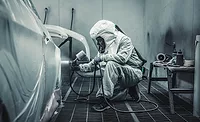
Classes: Classes define an area with respect to the type of hazard presiding in the area. Class I environments have potentially explosive concentrations of gases, vapors or liquids, such as in a petroleum refinery, spray finishing area or pharmaceutical manufacturing plant. Class II environments have potentially explosive concentrations of dusts, such as in grain elevators, flour mills, coal preparation plants and pharmaceutical manufacturing plants. Class III environments have potentially explosive amounts of fibers and flyings, such as in textile mills, cotton gins and saw mills.
Divisions: Divisions further define an area with respect to whether potentially explosive conditions reside normally or abnormally. Division 1 locations may have ignitable concentrations under normal operating conditions or on a frequent basis due to leakage or repairs. Division 2 locations include locations where volatile materials are used but could only reach ignitable concentrations under abnormal conditions such as in the case of an accident, rupture, equipment failure or some other occurrence of an unusual operating condition. The quantity of flammable material that might escape in case of an accident, the adequacy of ventilating equipment, the total area involved, and the record of the industry or business with respect to explosions or fires are all factors that merit consideration in determining the specific classification of each location.
Groups: Groups further define Class I and Class II areas by the nature of the flammable substances.
• Group A classifies acetylene environments
• Group B classifies atmospheres such as hydrogen (or gases or vapors equivalent in hazard to hydrogen)
• Group C describes atmospheres such as cyclopropane, ethyl ether, ethylene, or gas or vapors of equivalent hazard
• Group D describes atmospheres such as acetone, alcohol, ammonia, benzene, benzol, butane, gasoline, hexane, lacquer solvent vapors, naphtha, natural gas, propane, or gas or vapors of equivalent hazard
• Group E describes atmospheres containing metal dusts
• Group F describes atmospheres containing such materials as carbon black, charcoal dust, coal and coke dust
• Group G describes atmospheres containing grain dusts, flour, starch, cocoa and similar types of materials.
Designing the right equipment
Three ingredients are necessary for a fire or explosion: a flammable material (such as the gas, vapor or dust), an oxidizer (like air or oxygen), and an ignition source (such as a spark or high heat).
Equipment used in HazLoc areas is designed with the prevention of a fire or explosion in mind. Equipment designers employ a variety of techniques to prevent their equipment from being an ignition source. Some techniques keep the equipment from coming in contact with flammable materials or with oxidizers that can fuel a fire.
Enclosures can be designed so that the flammable material stays outside the enclosure, any sparks stay inside the enclosure, and only a limited supply of air (oxidizer) exists within the enclosure.
Selected materials minimize or eliminate the potential for a spark generated from friction or impact.
Circuits are designed to minimize or eliminate the potential for electrical sparks.
Further design considerations limit the temperature rise of the equipment to prevent surface ignition, which can occur at the Auto-Ignition Temperature (AIT) — the temperature at which a hazardous substance will spontaneously ignite without further energy.
Finally, design techniques can be taken to limit energy.
These protective techniques have names that include explosion-proof, dust ignition-proof, dust-tight, non-incendive and intrinsic safety.
Powered air purifying respirators
Powered air purifying respirators (PAPRs) are often selected as the PPE in HazLoc environments due to their combination of high protection factors and comfort. HazLoc PAPRs are typically designed with one of two protective design techniques: non-incendive or intrinsic safety. According to the Fire Protection Handbook, intrinsic safety is defined as “…equipment and wiring incapable of releasing sufficient energy under normal or abnormal conditions to cause ignition of a specific hazardous atmospheric mixture.” This protective technique (and others) can receive certification for Class I, II and III Division 1 environments.
Non-incendive equipment is incapable, under normal operating conditions, of causing ignition of a specified flammable gas-air, vapor-air or dust-air mixture due to arcing or thermal means. This protective technique (and others) can receive certification for Class I and II Division 2 and Class III Division 1 and 2 environments. In most cases you won’t see the protective technique listed on the product label, only the areas for which the product is certified for use, which is the most important piece of information when selecting a HazLoc PAPR.
Several factors determine the type of certification a piece of electrical equipment will receive. For a battery-powered device such as a PAPR, the amount of energy in the battery, the operational voltage, the location and method of battery contact, and the inductance of the motor are all factors.
PAPR designers must balance the features requested by the customers with the limitations imposed by the certification standards, and many PAPR users often desire features in the blower unit that make achieving the highest hazardous classified location certifications difficult. Higher airflow and longer battery run time require higher levels of energy. Removable batteries, which allow for sharing a blower across shifts, make battery contact design very challenging.
The implication is that the higher the performance of the PAPR, the more challenging it may be to bring a PAPR to market with the same protective technique as another PAPR. Again, the protective technique is not the critical piece of information; the approved locations listed on the product label determine where a PAPR may be used while maintaining compliance.
Key points to remember
• Equipment used in any Hazardous Classified Location must match the classification of the location.
• Assess the location properly first, then select the appropriate equipment.
• For example, Class I products are for Gas and Vapor environments and aren’t automatically approved for Class II (Dust) Environments and Class III (Fibers and Flyings) environments.
• The presence of a flammable substance isn’t the sole criteria to determine Division 1 or Division 2 designation (see 1910.399).
• The concentration level of the substance is a key determining factor.
• Ventilation may also be a key determining factor.
Resources
Underwriters Laboratory (UL) North American Protective Techniques Comparison
http://www.ul.com/global/documents/offerings/services/hazardouslocations/CI_protection_methods.pdf
Factory Mutual (FM) Hazardous Locations Resources
http://www.fmglobal.com/page.aspx?id=50010107
Canadian Standards Association (CSA) HazLoc Certification in North America
http://www.csa-international.org/product_areas/hazloc_equip/hazloc_for_north_america/
OSHA’s Hazardous Classified Locations Outreach Training
http://www.osha.gov/doc/outreachtraining/htmlfiles/hazloc.html
Looking for a reprint of this article?
From high-res PDFs to custom plaques, order your copy today!