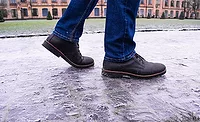
Most falls are due to slips and trips on the same walking surface level
Leading cause of death in workplace
Slips, trips, and falls constitute the majority of general industry accidents, according to federal OSHA. They cause 15% of all accidental deaths, and are second only to motor vehicles as a cause of fatalities. The OSHA standards for walking/working surfaces apply to all permanent places of employment, except where only domestic, mining, or agricultural work is performed.
Walking/working surfaces are addressed in specific standards for the general industry, shipyard employment, marine terminals, longshoring, and the construction industry.
Hazards and Solutions
There are many situations that may cause slips, trips, and falls, such as ice, wet spots, grease, polished floors, loose flooring or carpeting, uneven walking surfaces, clutter, electrical cords, open desk drawers and filing cabinets, and damaged ladder steps, says OSHA.
The controls needed to prevent these hazards are usually obvious, but too often ignored, according to OSHA, such as keeping walkways and stairs clear of scrap and debris; coiling up extension cords, lines, and hoses when not in use; keeping electrical and other wires out of the way; wearing lug soles in icy weather; clearing parking lots, stairs, and walkways in snowy weather; and using salt/sand as needed. The following references provide information on walking/working surfaces hazards and prevention.
Small Business Handbook. OSHA Publication 2209-02R, (2005). Also available as a 588 KB PDF, 56 pages.
Stairways and Ladders: A Guide to OSHA Rules. OSHA Publication 3124-12R, (2003). Also available as a 155 KB PDF, 15 pages.
Safety and Health Information Bulletins (SHIBs). OSHA.
Use of Floor Locks on Ladders. (1991, February 15).
Hazard of Potential Sidewalk Grate System Failure . (2004, December 30).
Construction Hazards [69 KB PDF*, 1 page]. OSHA Quick Card.
Construction Personal Protective Equipment (PPE). OSHA Quick Card. Also available as a 19 KB PDF, 1 page.
Walking-Working Surfaces [3 MB ZIP*]. OSHA assists trainers conducting OSHA 10-hour general industry outreach training for workers. Since workers are the target audience, the material emphasizes hazard identification, avoidance, and control — not standards. No attempt has been made to treat the topic exhaustively.
Scaffolding. OSHA Safety and Health Topics Page.
Construction. OSHA eTool. A Spanish version is also available. Helps workers identify and control the hazards that cause the most serious construction-related injuries.
Teen Worker Safety in Restaurants. OSHA eTool. Discusses slips, trips, and falls throughout the eTool.
The price that is paid: billions of dollars
Slips, trips and falls on the same level exact a substantial toll in terms of death, personal injury and suffering, workers’ compensation, loss in productivity, and civil liability.
The 2007 Liberty Mutual Workplace Safety Index indicated that falls on the same level were the second leading cause of all workplace injuries in 2005, accounting for 13.6 percent of direct costs associated with such injuries, or more than US$6.6 billion.
Additionally, the National Safety Council (NSC) estimates that workers’ compensation and medical costs associated with employee slip-and-fall accidents are approximately $70 billion per year. And Liberty Mutual cautions that the problem keeps growing with the costs associated with injuries that result from falls on the same level growing 25.6 percent between 1998 and 2005, a time when most other causes of workplace injuries experienced a substantial reduction in their rate of growth.
Loss of productivity is often an unfortunate side effect.
On average, workers who are injured as a result of a slip and fall accident spend more days away from work (median: 8 days) than those who are injured as a result of other causes (median: 6 days).
Most troubling, nearly 30 percent of same-level falls result in more than 21 workdays lost.
And the problem certainly goes beyond a loss of productivity. The National Safety Council reports that slips and falls are the leading cause of death in the workplace and the cause of more than 20 percent of all disabling injuries.
When considering workplace falls, most people immediately think of falls from a height, yet, according to the Bureau of Labor Statistics (BLS), the majority of fall-related injuries (65 percent) occur as a result of falls from same-level walking surfaces.
And the problem is especially troublesome in specified industries. Of particular interest, the services, wholesale, and retail trade industries together accounted for the greatest proportion of injuries that resulted from same level falls (over 60 percent), while the manufacturing sector alone accounted for 16 percent of injuries that resulted from same-level falls.
What Standards Apply?
OSHA: Walking-Working Surfaces, General Requirements – 29 CFR 1910.22
Provision for the Slip Resistance on Walking/Working Surfaces (ANSI/ASSE A 1262-2-2012)
What Are the Potential Hazards and Possible Controls Associated With Walking/Working Surfaces?
The causes of slip and fall incidents are varied and include:
- Walkways that are wet, oily, or otherwise contaminated
- Floor surfaces that are in disrepair
- Loose or unanchored mats or rugs
- Spills
- Weather hazards (such as ice, rain or snow)
- Lack of employee training
- Inappropriate footwear.
The OSHA Walking-Working Surfaces Standard, General Requirements and the Provision for the Slip Resistance on Walking/Working Surfaces (ANSI/ASSE A 1262-2-2012) both provide a framework for addressing the underlying causes of slips, trips, and falls in the workplace.
The OSHA Walking-Working Surfaces Standard, General Requirements sets forth the following:
- All places of employment, passageways, storerooms, and service rooms shall be kept clean and orderly and in a sanitary condition.
- The floor of every workroom shall be maintained in a clean and, so far as possible, dry condition.
- Every floor, working place, and passageway shall be kept free from protruding nails, splinters, holes, or loose boards.
- Aisles and passageways shall be kept clear and in good repair with no obstruction across or in aisles that could create a hazard.
- Permanent aisles and passageways shall be appropriately marked.
- Where mechanical handling equipment is used, aisles shall be sufficiently wide.
The ANSI Standard for the Provision for the Slip Resistance on Walking/Working Surfaces (ANSI/ASSE A 1262-2-2012) applies to industrial and workplace situations and sets forth common and accepted practices for providing reasonably safe walking surfaces:
- Consideration shall be given to the slip resistance of footwear to maximize traction.
- Mats and runners shall be used in areas where individuals may encounter slippery contaminants or foreign materials on the floor surface.
- A housekeeping program, including appropriate cleaning and maintenance procedures and employee training, shall be implemented to maintain safe walking surfaces.
- Warnings shall be provided where slip/fall hazard has been identified.
Looking for a reprint of this article?
From high-res PDFs to custom plaques, order your copy today!