Before you enter ...
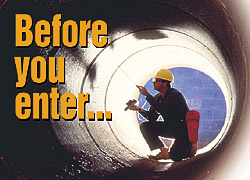
Confined spaces can contain many serious hazards to worker health and safety:
Atmospheric hazards include oxygen deficiency — the number one cause of confined space fatalities; oxygen enrichment and combustible gases, which pose fire/explosion risks; and toxic gas levels.
Physical hazards can burn, maim or crush workers.
Corrosive hazards (such as chemicals) can burn and irritate eyes and internal organs.
Other significant hazards are poor visibility and harmful noise levels.
Fortunately, a wide range of safety equipment is available to help protect workers from many of these threats.
Gas detection instruments
Since most confined space fatalities are due to atmospheric hazards, air monitoring should be the first step. Atmospheric testing results will have a direct impact on your protective equipment selection and may also dictate the duration of worker exposure to the environment. Battery-powered, direct-reading instruments are the most practical devices for spot-checking a confined space atmosphere on a semi-continuous basis.Single-gas monitors are available for detecting oxygen deficiency, combustible gases and toxic gases. Audible and visible alarms alert the worker if the gas concentration exceeds a preset level.
Oxygen indicators generally measure concentrations over a range of 0 percent to 25 percent oxygen in air. Combustible gas and vapor monitors are designed to monitor hydrocarbon vapors.
Gases such as carbon monoxide (CO) and hydrogen sulfide (H2S) can be measured with toxic gas detectors. These devices are well suited for use in sewers, waste treatment plants, “sour crude” processing stations and confined spaces containing motors or engines.
Multigas monitors can detect two combinations of gases: oxygen and combustible gases; or oxygen, combustible and toxic gases. In applications where it is necessary to determine oxygen and combustible gas levels simultaneously, two-in-one diffusion-type devices can be used. Sensors measure 0 percent to 100 percent of the LEL and oxygen from 0 percent to 25 percent. Remote sampling requires either a pump module or an aspirator bulb adapter.
Three-in-one, four-in-one and five-in-one monitors are available for toxic gas detection or for simultaneously measuring the combustible gas LEL, oxygen levels and toxic levels in parts per million (ppm). Remote sampling pump adapters can convert diffusion-type instruments into pump-style instruments.
Photoionization detectors (PIDs) are used to monitor toxic gases and vapors. PIDs use ultraviolet light to ionize molecules of chemical substances in a gas or vapor state. Depending upon calibration input, gases and vapors are measured over a 0.1 to 10,000 ppm scale.
Detector tube sampling systems are recommended for quick evaluations of potential hazards that cannot otherwise be measured. Detector tubes use a manually operated sampling pump to draw a known volume of air through the tube. If gas or vapor is present, chemically treated granules in the tube are stained a different color, enabling users to determine concentration levels.
Respiratory protection
Once you analyze the atmosphere of a confined space, the next step is to select the proper respiratory protection equipment.Self-contained breathing apparatus (SCBA) provide the highest level of respiratory protection and are designed to protect workers in oxygen-deficient atmospheres and/or in atmospheres immediately dangerous to life and health (IDLH) often found in confined space applications. SCBA are equipped with a user-worn air cylinder that offers a dependable yet limited supply of air without any hoses or tethers to limit movement. SCBA are useful in confined spaces with entrances large enough to accommodate an entrant wearing the apparatus and the cylinder. Low-profile cylinders are available for tight confined space entrances.
Combination-type dual-purpose SCBA merge the capabilities of an air-line unit with those of an SCBA. They generally have a regulator with two inlet ports — one connects to the air cylinder; the other connects to an air-supply hose. These units offer the mobility of an SCBA when used without the air-line but also offer an extended air supply when used with the air-line.
Air-line respirators with escape cylinders also “combine” the capabilities of an air-line device with those of an SCBA. However, they are generally equipped with smaller (5- or 10-minute) cylinders and are used for emergency escape purposes only. These units provide the lowest profile of any IDLH-approved respirator.
Escape respirators provide a means of escape from IDLH atmospheres. These lightweight units generally are carried by the worker and feature a 5- or 10-minute air cylinder that delivers respirable air to a hood.
Head, eye & hearing protection
Confined spaces often present hazards that require head, eye, face or hearing protection, which should be applied before entering a confined space work area.Head protection commonly consists of a Type I or Type II helmet, which should meet the performance requirements of ANSI Z89.1-1997. These helmets are designed for top impact and penetration (Type I) or top and lateral impact and penetration (Type II). Both types may provide electrical protection, depending on the classification as outlined in Z89.1-1997.
Eye protection, in the form of protective glasses with sideshields or goggles, helps shield workers’ eyes from airborne debris. ANSI Z87.1 is the relevant standard. For additional protection, full faceshields protect the face from splashes and flying debris.
Hearing protection is important since confined spaces tend to reverberate and amplify even small sounds. Hearing protectors, available as earplugs, standalone ear muffs or ear muffs attached to the helmet, should be worn in environments where cutting, grinding or high levels of mechanical noise are present.
Communications equipment
Reliable communications equipment allows workers to communicate between themselves and with the attendant stationed outside of the work area. If there is an emergency, communications equipment allows help to be summoned quickly.Battery-operated, voice-activated systems are frequently used in confined spaces. PASS alarm devices, designed to sound if the wearer does not move during a specifiied period of time, are also useful.
Entry & retrieval equipment
For easier and safer confined space entry and exit, worker and equipment retrieval systems can be used. Retrieval equipment is useful for lowering workers into a confined space environment. Additional work hoists are frequently used to raise and lower tools and equipment. Hoists on lifting equipment should be outfitted with durable retrieval lines and should be self-braking to prevent free falls and to hold personnel in place when raising and lowering has stopped.When used in conjunction with safe work practices, these tools can be invaluable in helping protect workers from many of the serious hazards of confined spaces. So how does your checklist look?
Sidebar: Ready to go?
Make sure you have these essentials before entering a confined space:- Gas detection instruments
- Respiratory protection
- Head, eye & hearing protection
- Communications equipment
- Entry & retrieval equipment
Looking for a reprint of this article?
From high-res PDFs to custom plaques, order your copy today!


