"Cutting" costs and injuries
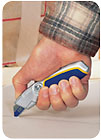
If you don’t think utility knives and blades make a major impact on your plant’s productivity and safety record, think again. According to statistics from the Consumer Product Safety Commission, 39 percent of the 330,000 medically treated injuries attributed to manual workshop tools in the United States involved knives and retractable blades. Such injuries may occur from blades that break, accidental cuts while changing blades, and the mishandling of utility knives.
Have you noticed all of the applications around your facility that require cutting with a utility knife? They may include opening boxes or wrap, trimming wire, cutting production material, fixtured cutting in the assembly process and general maintenance cutting. Almost all workers have something to cut. Utility knives are never farther away than their pocket or tool belt.
Unfortunately, this most common of tools can also be one of the most dangerous. And, since not much has changed over the years, we often take these tools for granted. The good news is that newer, innovative blades are rapidly changing the way managers perceive the importance of these hand tools.
Lost productivity & high risk
Expectations are low for traditional carbon steel utility blades. Frustrated employees must stop working to turn them around, change them out and then go retrieve more. Blade changes can be a tedious process, lasting anywhere from 30 seconds for a simple turn-around, to more than two minutes for a full blade substitution. That’s 335 hours for a facility that uses 10,000 blades a year.Another problem with traditional utility blades is that cutting can be a dangerous operation. As carbon steel blades dull, workers press harder, exposing them to a potential injury from their cutting hand slipping off the work-piece, or more seriously, the blade shattering. The risk of getting cut is never higher than during blade changes, when workers directly handle blades. As a result, cuts top the list of workplace injuries recorded in plants and facilities today. You pay the price in terms of lost time, insurance fees and other liabilities. By changing the tools you use and employing safe cutting practices, you can reduce the risk of injury. (See “Safe cutting practices†sidebar.)
Cutting-edge solution
Utility blades have improved with the introduction of bi-metal technology, a process that fuses two metals together through electro-beam welding. One of the metals is high-speed steel, which yields sharpness; the other is a flexible spring steel that flexes but does not break. These bi-metal utility blades have a significantly longer life, translating to a sharper edge for your workers and fewer blade changes.Linda Hobbs, purchasing supervisor at Vantage Industries (a division of Leggett & Platt), has seen strong productivity increases in her facility. “We converted to bi-metal utility blades from carbon steel blades,†says Hobbs. “The bi-metal blades were unbreakable and lasted six times longer than carbon steel counterparts in our manufacturing application, where we use the utility blades to remove baked-on residue from rollers.†Since bi-metal utility blades are unbreakable, they are safer for workers. “We are constantly looking for tools to maximize employee safety,†said Rachel Champion, safety manager at Yamaha, North America. “Shattered utility blades can lodge chards of steel in the skin or the eyes. Unbreakable bi-metal blades reduce our risks of catastrophic injuries.â€
With bi-metal blades offering the potential to dramatically reduce the total costs in the area of cutting and to decrease liability, production and safety managers are increasingly taking a sharp look at utility knives and blades. Improving your safety program may be as easy as upgrading these everyday tools.
SIDEBAR: Safe cutting practices
1. Always wear safety glasses.2. Wear protective gloves, especially on the hand that holds the work-piece to be cut.
3. Always use a sharp blade.
4. Make sure footing is secure and stable.
5. Pull the knife toward you when cutting on a flat surface.
6. Keep your free hand (non-cutting) away from the line of cut.
7. When using a straight edge to cut, clamp it securely.
8. Never make a blind cut. Always check the length of the cut to ensure a clear path.
9. Change your blade whenever it starts to tear the work piece.
10. Pure carbon steel blades are brittle and shatter easily. Don’t bend them or apply side loads to them by using them to pry objects loose.
Looking for a reprint of this article?
From high-res PDFs to custom plaques, order your copy today!