Deciphering OSHA's first aid requirements
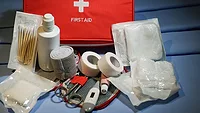
What exactly is “first aid,” and what do you need to do to comply with regulations for the construction or electrical industries?
To answer this question, this article presents 15 recommendations to construct an OSHA-compliant program.
1 — Know your requirements. Check your state’s Department of Labor Web site, as well as www.osha.gov, for guidance in this area. Although federal OSHA sets national standards, more than 20 states have their own OSHA equivalent.
2 — Size doesn’t matter. States an OSHA Letter of Interpretation: “There are no exemptions from [OSHA First Aid Regulations] due to a company’s size… All industries are required to comply with [OSHA First Aid Regulations] regardless of the type of work performed… the employer’s first aid program must correspond to the hazards which can be reasonably expected to occur…”1
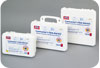
3 — Access matters. Specifically for the construction and electrical industries, OSHA’s 1926.23 “First aid and medical attention” declares, “First aid supplies shall be easily accessible when required.” This rule applies to treatment of minor injuries that occur in the workplace. 1926.50(d)(2) further adds that contents shall be individually wrapped and placed in a weatherproof container, and Appendix A states that an example of the minimal contents of a generic first aid kit is described in ANSI Z308.1- 2003. The contents of the kit listed in the American National Standard Institute standard should be adequate for small worksites.
4 — Determine the need for additional kits, equipment and supplies, and enhanced kits for unique or changing first aid needs if you are a larger operation or have multiple operations at the same location. If it’s reasonably anticipated that your employees will be exposed to blood or other potentially infectious materials (OPIM) while using first aid supplies, you’re required to provide personal protective equipment (PPE) in compliance with OSHA’s 1910.1030(d)(3).2 (56 FR 64175).
5 — Purchase only bilingual first aid kits. Even if you have no Englishas- a-second-language employees at this time, you — or a subcontractor — may in the future.
6 — Make sure kits meet or exceed OSHA guidelines. Look for industry-specific first aid kits. You’ll be surprised how many are out there — among them welder first aid kits, logger’s first aid kits, even contractors’ first aid/ construction first aid kits. If you are in a specific field with specialized OSHA first aid requirements, don’t guess whether or not a kit meets your needs; find one designed specifically for you.
7 — Do not be misled. OSHA does not “approve” any manufacturer’s products. It is up to the first aid kit manufacturer or supplier to ensure the kits fulfill the OSHA first aid kit requirements, and thereby state that the kits are “OSHA compliant” or that the kit “meets OSHA First Aid Kit Guidelines.”
8 — Don’t forget about bloodborne pathogens and PPE. While Medical and First Aid issues are the 19th most frequently cited of all OSHA violations, PPE violations rank ninth and bloodborne pathogens citations rank tenth.3
Next to each first aid kit, cabinet or station, there should be a bodily fluid pickup kit or personal protection kit. These kits usually contain eye and hand protection, fluid absorbents, sanitizing and disposal products, and a CPR mask.
9 — Know your training requirements. OSHA 1926.50(c), Medical Services and First Aid, states: (a) The employer shall ensure the ready availability of medical personnel for advice and consultation on matters of occupational health, (b) Provisions shall be made prior to commencement of the project for prompt medical attention in case of serious injury, and (c) In the absence of an infirmary, clinic, or hospital that is reasonably accessible in terms of time and distance to the worksite, which is available for the treatment of all injured employees, a person who has a valid certificate in First Aid Training… that can be verified by documentary evidence, shall be available at the worksite to render first aid.
10 — Know your response time. An OSHA Letter of Interpretation gets more detailed: “In areas where accidents resulting in suffocation, severe bleeding, or other life-threatening injury or illness can reasonably be expected, a 3 to 4 minute response time, from time of injury to time of administering first aid, is required… where a life-threatening injury is an unlikely outcome… a 15 minute response time is acceptable.” 4
11 — Train at least part of your staff in first aid. Rare is the operation with no life-threatening potential. Offer training on a company-paid but voluntary basis.
12 — Know specific “first aid” skills that must be taught. The clearest description of what constitutes “adequate training” comes from CFR 1926.950 (e), which states that the employer shall provide training or require that his employees are knowledgeable and proficient in procedures involving emergency situations and first aid fundamentals including resuscitation.
Required training includes responding to a health emergency, surveying the scene, basic adult cardiopulmonary resuscitation, basic first aid intervention, universal precautions, first aid supplies, and trainee assessments.5
13 — Don’t assume that training a construction site supervisor in “Basic First Aid” will cover your obligations. It does not. Training should be made available to all employees, so others are on hand should the site supervisor be away. And training only in first aid leaves you open to liability regarding bloodborne pathogen exposure and sudden cardiac arrest or other cardio- or cerebro-vascular incidents.
14 — Train your employees in a combination course including CPR, OSHA first aid, and bloodborne pathogens (BBP). Most training organizations now include training in automated external defibrillator (AED) principles as part of their CPR curriculum.
15 — Don’t wait until you have an accident, inspection, or citation. Find yourself an economical but thorough OSHA book or CD, equip your facility with adequate and appropriate first aid and safety equipment, and schedule lifesaving training for your staff.
References
1. John B. Miles, Jr., Director, Directorate of Compliance Programs, OSHA, in a letter dated July 24, 1995, to Villanova University.
2. Mancomm’s Federal OSH/29 CFR Standards--1926 OSHA Construction Industry Regulations Book, ISBN 0-9669664-8-1.
3. Citation frequency rates are based on filed OSHA citations from October 2003 through September 2004.
4. Roger A. Clark, Director, Directorate of Compliance Programs, OSHA, in a letter dated Nov. 19, 1992, to County Fresh Environmental.
5. Department of Labor OSHA Directive Number: CPL 2-2.53.
Looking for a reprint of this article?
From high-res PDFs to custom plaques, order your copy today!