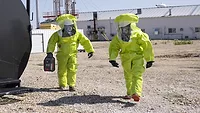
Hazmat safety
Numerous federal and state agencies define hazardous materials differently, based on their missions and objectives. For example, the United States Department of Transportation defines a "hazmat" based on its being transported in commerce. OSHA defines it as a "hazardous chemical" or "hazardous substance" as it relates to employee safety in the workplace. The Environmental Protection Agency (EPA) defines it as a "hazardous substance" related to its adverse effect on the environment. Each state may have its own definition of a hazardous material, such as Virginia, which defines it in a much broader scope than each of the agencies above.
Do the right thing
Regardless of which agency is involved, the bottom line is this: If there is a release or leak of something that can hurt you, other people, property or the environment, it is a hazardous material. If such a release occurs, what should you do?What actions you take are based on your level of training in hazardous materials. When a release occurs involving hazardous materials, it is as critical to know what not to do as much as what to do. In a hazmat response, doing something that proves to be the wrong thing is worse than doing nothing.
At the hazardous materials "awareness" level of training, the focus is on detecting the problem and, without directly contacting or touching the material, knowing how to notify the appropriate people and secure the area to prevent others from entering it. It may also include evacuating others out of the area, if necessary.
Six hazard types
If a hazardous material spill occurs, there are six types of hazards that can be present, depending on the material released. The type of harm that can be experienced can be remembered by the acronym, T-R-A-C-E-M.T - Thermal: a thermal release, related to excessive heat or excessive cold.
R - Radiation: radioactive material can be either ionizing or non-ionizing. A - Asphyxiation: causing simple or chemical asphyxiant hazards, it either displaces oxygen from the air or chemically attaches at the cellular level within red blood cells.
C - Chemical: this results from exposure to toxic (health-related) or corrosive materials.
E - Etiological: resulting from exposure to pathogens and their toxins.
M - Mechanical: resulting from contact with physical hazards, usually outside the danger zone; includes slips, trips, falls and strike hazards.
If you have limited or no hazardous materials response training you must understand the hazards and potential exposures with hazardous materials to ensure you do not become part of the problem. Knowing the hazards can provide a reasonable defensive response that protects you, co-workers, and the environment.
Action plan
Once the hazards are understood based on the type of material that has leaked or spilled, you can begin to make an action plan on what to do. There is a six-point method to help you "decide" what to do, using the acronym, D-E-C-I-D-E.D - Detect the presence of a hazardous material. Knowing that hazardous materials are present in a given area gives you the first clue that there is potential for a problem. Whether you are entering a chemical storage area, a workshop, a hydraulic pump room, a warehouse or shipping/receiving area, or other area, being aware that a hazmat is present should put you on guard to look for a spill.
E - Estimate likely harm without any intervention. At the point where you find a spill or unplanned release of a material, you must quickly assess the situation. What will happen with and to this material if you don't do anything? Is it a "non-event" that won't hurt anything? Can it get in the water system and drains? Can the vapors cause injury or death to anyone exposed to them? Can the spill create an explosion or fire hazard? These types of questions will help you determine the extent of a response required.
C - Choose your response options. Response options at the awareness level are simple - secure the area, then run or stay where you are. This is why step "E" above is critical and necessary to do before this step.
I - Identify your action options. What actions must be taken to deal with this material? Will the area need to be evacuated? Who needs to be contacted - safety, environmental, your supervisor, 9-1-1?
D - Do your best action option. After identifying your options, choose the best one and do it.
E - Evaluate your progress. As time goes by, evaluate the action(s) taken and assess your situation. Is the spill getting bigger? Is the wind now blowing the vapor cloud over other people? Is the spilled liquid heading for the water and sewer system? Did the right people get notified and are they present or on their way? You may or may not need to change your action(s) depending on changing conditions.
Life and death
This process cannot work unless you have some basic knowledge, which is why knowing the Hazard Ccommunication standard is important. Take some time to periodically review the material safety data sheets (MSDSs) on the materials in your work area. Use the correct personal protective equipment (PPE); know how to use, handle, transport and store the material properly; learn what the material can do in the event of a spill or release. This information is included on the MSDS for the particular product.Knowing the materials in your work area is much more than a compliance issue. A citation from OSHA for non-compliance pales in comparison to someone dying from a substance due to your ignorance.
The HazCom standard is a requirement of the employer. Your knowledge of the chemicals and materials you work with regularly is a requirement of your quality of life. Don't put that onus on your employer or OSHA. After all, it is YOUR life.
Looking for a reprint of this article?
From high-res PDFs to custom plaques, order your copy today!




.webp?t=1721257160 "download (1).jpg")