ISHN logo
search
cart
facebook twitter linkedin youtube
  • Sign In
  • Create Account
  • Sign Out
  • My Account
ISHN logo
  • NEWS
    • Today's News
    • Global Safety News
    • Government Regulations
  • PRODUCTS
    • Product Innovations
    • Featured Products
  • TOPICS
    • Environmental Health and Safety
    • Facility Safety
    • Workplace Health
    • Occupational Safety
    • PPE
    • More Topics
  • CONSTRUCTION
  • TECHNOLOGY
  • COLUMNS
    • Best Practices
    • Dave Johnson: What’s going on
    • Editorial Comments
    • Leading Safety
  • MULTIMEDIA
    • ISHN Podcast
    • Videos
    • Cold Stress Education Quiz
    • Webinars
    • White Papers
  • MORE
    • Buyer's Guide
    • Newsletters
    • Convention Companion
    • Polls
    • Events
    • ISHN Store
    • Sponsor Insights
  • EMAGAZINE
    • eMagazine
    • Archived Issues
    • Contact
    • Advertise
  • JOIN TODAY!

NASA's safety culture - Part Three: Widespread & systemic change
July 1, 2005
In the first installment of this series, the initial assessment of NASA’s culture and safety climate was described and the agency-wide results presented (see ISHN May 2005 issue). The second installment outlined the pilot culture enhancement initiatives at Glenn Research Center, Stennis Space Center, and two directorates of Johnson Space Center (see ISHN June 2005 issue). In this third and final installment, we will review some of the results that have emerged.

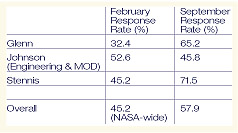
Table 1

Data in various forms

The initiative began in the three pilot locations in mid-April of 2004. As the work progressed, various forms of data became available.

Anecdotal data — Soon after implementation began we started hearing anecdotal evidence that the effort was having an effect. Some examples:

“I wasn't sure of this thing in the beginning. Now I am convinced that it will help us; we need to support it. I have invited observers to my meetings; I encourage you to do the same.” – Division Chief

“I found myself conducting my branch meetings and day-to-day interactions differently as part of this effort.” – Division Chief

Other examples:

  • Training evaluations consistently indicated that participants arrived as skeptics and left as believers.

  • Division Chiefs were giving each other feedback in staff meetings, referring to behaviors focused on in the coaching process.

    Behavioral data — As data began to accumulate from the behavioral observation and feedback process, we started seeing improvement in the percentage of times that a critical behavior was observed being used, rather than observed as a missed opportunity.

    The BST Culture and Safety Climate Survey — Approximately six months after the start of the culture enhancement efforts, the safety climate and culture survey was re-administered to the groups where culture enhancement work had begun. The same survey from the initial assessment was used, as well as the same email-prompted, web-based administration method. At most locations the response rate exceeded the response rate obtained in the original (February 2004) survey administration (Table 1).

    The Glenn Research Center and Stennis Space Center had survey scores during the initial assessment that were low compared to the NASA overall averages. The Johnson Space Center had scores that were high relative to the NASA average.
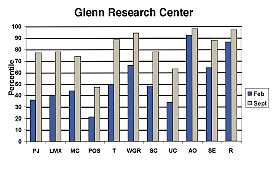
    Figure 1

    Glenn Research Center and Stennis Space Center results

    All scales on the basic Safety Climate and Culture survey showed improvement at the Glenn Research Center (GRC). These results are shown in Figure 1. The September results (after intervention) show significant improvement over the February results (pre-intervention.)

    Comparing managers’ responses to non-managers’ responses, we found that there was greater change in survey scale results among managers than among non-managers. This is consistent with what we would expect after just six months: the culture enhancement strategy worked with leadership as the mechanism for driving culture enhancement, and initial activity was focused primarily on managers at all levels.

    Results from the Stennis Space Center were very similar to those from GRC. All survey scores improved, and comments were consistent with these results.
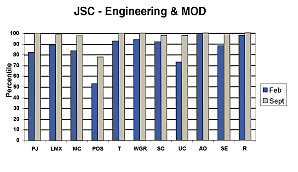
    Figure 2

    Johnson Space Center

    The survey was administered at JSC to the Engineering Directorate and the Mission Operations Directorate, the two groups within JSC where culture strengthening efforts were focused.

    All scales on the survey showed improvement for these two JSC organizational units. Results are shown in Figure 2. The September results show significant improvement over the February results.

    JSC had generally high scores on most scales prior to the culture change efforts. In the survey conducted after the initial efforts, every scale showed some level of improvement.

    Comparing managers’ responses to non-managers’ responses, we again found that there was greater change in survey scale results among managers than among non-managers. As noted in discussing the GRC results, this was consistent with what we would expect.

    As would be expected in the early stages of a major change effort, comments indicate that there appears to be a segment of the population that is seeing positive change and is optimistic about the direction the organization is moving, and another segment that is skeptical. But overall perceptions, measured by the survey scores, indicate that there is solid movement in the desired direction.

  • Share This Story

    Looking for a reprint of this article?
    From high-res PDFs to custom plaques, order your copy today!

    Recommended Content

    JOIN TODAY
    to unlock your recommendations.

    Already have an account? Sign In

    • forklift safety

      Exploring the latest technologies in forklift safety

      With more staff and more stock in warehousing now more...
      Workplace Training Strategies
      By: Josh Cramer
    • welding

      All about welder’s flash or arc eye

      A flash burn is a painful inflammation of the cornea,...
      Environmental Health and Safety
    • dangerous jobs

      The 10 most dangerous jobs in the U.S.

      On-the-job deaths have been rising — hitting the highest...
      Transportation Safety
      By: Benita Mehta
    Manage My Account
    • eMagazine Subscriptions
    • ISHN Newsletter & Other Newsletter Alerts
    • Online Registration
    • Manage My Preferences
    • Subscription Customer Service

    More Videos

    Sponsored Content

    Sponsored Content is a special paid section where industry companies provide high quality, objective, non-commercial content around topics of interest to the ISHN audience. All Sponsored Content is supplied by the advertising company and any opinions expressed in this article are those of the author and not necessarily reflect the views of ISHN or its parent company, BNP Media. Interested in participating in our Sponsored Content section? Contact your local rep!

    close
    • man wearing the the Sundström SR200 Full Face Mask Respirator
      Sponsored byOHD

      5 Fit Testing Mistakes That Could Cost You

    • This image shows Magid AcuSpex polarized blue mirrored safety glasses.
      Sponsored byMagid Glove and Safety

      Construction PPE Guide: What Crews Need for Each Task

    • lone worker in confined space
      Sponsored byAlphasense Ltd.

      GET THE LEAD OUT of your Safety Oxygen Sensors!

    Popular Stories

    SpaceX 7 launch

    OSHA Investigating Fatal Fall at SpaceX Starbase

    Automated loading dock equipment

    After March 2026 Rivian Death, Safety Managers Reassess Loading Dock Systems Under OSHA's Warehouse Emphasis Program

    psychology in the workplace

    Most Workplaces Measure Psychological Safety, Ignoring Psychosocial Risks

    top 10 most dangerous jobs

    Poll

    Seasonal Readiness

    With the federal heat stress prevention rule on the horizon, which area of your safety program needs the most attention?
    View Results Poll Archive

    Products

    Surviving an OSHA Audit A Management Guide, 2nd Edition

    Surviving an OSHA Audit A Management Guide, 2nd Edition

    See More Products

    ISHN Podcasts

    Related Articles

    • NASA's safety culture - Part One: Assessment

      See More
    • NASA's safety culture - Part Two: Implementation

      See More
    • Perceptions clash on NASA's safety culture

      See More

    Related Products

    See More Products
    • 1119772133.jpg

      Delivering Safety Excellence: Engagement Culture at Every Level

    • human resources.jpg

      Human Resources and Change Management for Safety Professionals

    • 9781138749573.jpg

      Occupational Health and Safety Management: A Practical Approach, Third Edition

    See More Products
    ×

    Become a Leader in Safety Culture

    Build your knowledge with ISHN, covering key safety, health and industrial hygiene news, products, and trends.

    JOIN TODAY
    • RESOURCES
      • Advertise
      • Contact Us
      • Directories
      • Manufacturing Division
      • Store
      • Want More
    • SIGN UP TODAY
      • Create Account
      • eMagazine
      • Newsletters
      • Customer Service
      • Manage Preferences
    • SERVICES
      • Marketing Services
      • Reprints
      • Market Research
      • List Rental
      • Survey/Respondent Access
    • STAY CONNECTED
      • LinkedIn
      • Facebook
      • YouTube
      • X (Twitter)
    • PRIVACY
      • PRIVACY POLICY
      • TERMS & CONDITIONS
      • DO NOT SELL MY PERSONAL INFORMATION
      • PRIVACY REQUEST
      • ACCESSIBILITY

    Copyright ©2026. All Rights Reserved BNP Media, Inc. and BNP Media II, LLC.

    Design, CMS, Hosting & Web Development :: ePublishing