MANAGING BEST PRACTICES: Ready for a harmonized world?
Globalization is the increasing integration of economies around the world. Reasons why understanding globalization should be important to U.S. EHS pros include:
- Ninety-five percent of potential customers for American products live outside the U.S.;
- Approximately one out of every five factory jobs in the U.S. depends on foreign trade; and,
- Foreign-owned companies directly employ more than 6.4 million workers in the U.S.
The concept of globalization is demonstrated within the automotive industry. BMWs are designed in Germany and built in South Carolina. Hondas are built in Ohio. Toyotas are built in Texas. Ford owns Volvo and Jaguar. GM’s Zeta program (design headquarters in Australia) will sell cars in Australia, Europe, Asia, and North America. Globalization continues to blur the distinctions of what products and services are foreign or domestically made.
Business conducted in such an integrated, trans-national way requires harmonization. This includes making EHS laws and practices compatible worldwide. For example, major automakers such as Ford require all their suppliers, in whatever country, achieve ISO 14001 (environmental management) certification.
OSHA’s use of ICSC is a prime example of how harmonization works. The preamble to OSHA’s 1983 hazard communication standard committed the agency to pursue international harmonization of hazard communication requirements. Since then OSHA has worked with the International Labor Organization and the United Nations on the development of a globally harmonized chemical classification and labeling system. The UN formally adopted the Globally Harmonized System of Classification and Labeling of Chemicals (GHS) in 2002. All countries are encouraged to fully implement the GHS by 2008.
American values
Most Americans support the concept of globalization. About 73 percent of Americans agree with the statement, “I regard myself as a citizen of the world as well as a citizen of the United States,†according to the Program on International Policy Attitudes (PIPA) at the University of Maryland. There’s even more support for harmonization. A 2004 report by PIPA finds that nearly nine out of every 10 Americans believe that U.S. companies should abide by U.S. EHS standards when they operate in other countries.Narrow views
Too many people in the U.S., however, hold the narrow view that U.S. EHS standards are the world’s best practices and all other countries should follow our lead. In some cases our practices are best, and other cases the U.S. falls short.Studies, for example, find that employees on the shop floor comprehend an ICSC up to 23 percent better than an MSDS typically used in the U.S. ICSC are accurate while many MSDSs are not. Then why are so many U.S. EHS pros reluctant to use ICSC in their hazard communication programs? Is it the “not invented here†mentality that holds them back?
Ask someone what they think about China’s commitment to workplace environmental management practices. You’ll likely hear horror stories not based in fact. Over 5,000 workplaces in China have been certified to ISO 14001 while the U.S. only has about 3,400 workplaces that have achieved this standing. Japan, UK, Spain, Germany, and Italy all lead the U.S. in ISO 14001 certifications.
If the argument is that U.S. workplaces don’t have to demonstrate their commitment to ISO 14001 because they know they’re good, then opportunities for improvement are being lost.
Think globally
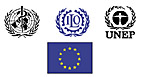
Do you think globally? Try this test. Can you identify the insignias of the ICSC endorsing organizations in Figure 1?The insignia at the far left, with the serpent and staff, belongs to the World Health Organization. WHO was established in 1948 and is the United Nation’s specialized agency for health.
The center top insignia belongs to the International Labour Organization. ILO was established in 1919 by the Treaty of Versailles (end of WWI) to help “establish universal peace and promote social justice by improving working conditions and labor rights throughout the world.†ILO became a specialized agency of the UN in 1946 and is represented by governments, employers, and workers.
The UNEP, established in 1972, is the United Nations Environmental Programme — the UN’s environmental voice.
The insignia (actually a blue background with circle of yellow stars) is the European Union (EU) flag. The EU is “a family of democratic European countries, committed to working together for peace and prosperity.†There are currently 25 countries in the EU, 10 of which joined in 2004.
Treaties
Treaties are one means by which countries harmonize actions across international borders. The ILO, for example, establishes treaties through conventions. Conventions are internationally recognized minimum labor rights. The ILO has about 70 conventions that deal with occupational safety and health matters. Conventions may be supported by recommendations, codes of practice, and other means.
A convention does not have official standing with the ILO until it is ratified by at least two member countries. A convention is not binding on a member country until it has been ratified by that member country. Although the U.S. often considers itself the torch bearer for labor rights, the U.S. has only ratified about 15 of nearly 200 ILO conventions.
Maternity protection
ILO maternity protection conventions provide an excellent historical example of how an EHS issue is treated globally and where the U.S. may lag behind with best practices.The first Maternity Protection Convention (No. 3) was adopted in 1919, at the formation of the ILO, to protect working women before and after childbirth. The convention was revised in 1952 (No. 103) and 2000 (No. 183); the latter gaining official standing in 2002. Among other things these conventions address health protections for pregnant workers such as conducting risk assessments. The EU also directs (92/85/EEC) member countries to conduct risk assessments for pregnant workers.
The U.S. supports the concept of risk assessments for pregnant workers but will not ratify ILO Maternity Protection Conventions because the conventions require some actions which the U.S. does not want to comply with, such as paid maternity leave. The U.S. and Australia are alone in the developed world in not offering paid maternity leave for pregnant workers.
Country views on ILO maternity protection can be found at http://www-ilo-mirror.cornell. edu/public/english /standards/ relm/ilc/ilc88/pdf/rep-iv2a.pdf.
Spending time at WHO, EU, ILO, and UN web sites will help you better understand EHS globalization and harmonization. And you may find best practices there that are not yet universally applied within the U.S.
Looking for a reprint of this article?
From high-res PDFs to custom plaques, order your copy today!


