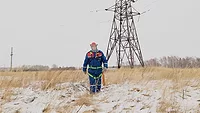
Monitoring confined spaces
"This would not have happened in a properly run safety program. No one would have been hurt or killed," says Schroll. Entry supervisors and attendants assess degree of risk and decide who shall and who shall not enter your confined spaces, and for what reason. If conditions are hazardous, both have life-or-death responsibilities. If something goes wrong, they'll have serious questions to answer. It's a critical job, but many confined space programs don't get a second look once they're up and running. With operational changes and employee turnover, do you have confidence in your supervisors and attendants?
You would think individuals thrust into these roles, whether on a full- or part-time basis, would receive extra consideration, perhaps special training. But according to confined space experts this is not always the case, and definitely not the rule.
So what can you do to make sure yours are knowledgeable, alert, and protecting the safety of your employees? Experts say you should look at your training and the workload placed on entry supervisors and attendants.
Training requirements
Entry supervisors have sign-off authority, their signature must be on every permit prior to an employee's entry into a hazardous space. OSHA requires that entry supervisors be knowledgeable of confined space hazards including exposure information, emergency evacuation and test plans, when to cancel entry operations, removing unauthorized entrants and ensuring that entry operations remain consistent with the entry permit.Attendants are actually on the scene when employees enter hazardous confined spaces. They're responsible for communicating with entrants, monitoring their work, and knowing rescue and evacuation procedures.
OSHA expects supervisors and attendants to be trained on these responsibilities, but leaves the details to employers. "OSHA says, 'This is the outcome we expect you to get', then it's up to the company to figure out how to obtain it," says Mary DeVany, CSP, CHMM, DeVany Industrial Consultants. DeVany is also the immediate past chair of the confined space committee for the American Industrial Hygiene Association. Training should not be generic, but focus on the exact conditions of confined spaces on site. "Entry supervisors must know what hazards exist in a confined space, and know how to eliminate or control them, which is the single most important aspect of-and the intent of-the [OSHA] law.
"Most supervisors rely on on-the-job training rather than formal classwork, says consultant Schroll, a CSP who is president of the firm Firecon. That's because "an entry supervisor in a chemical plant will run into different situations than one in a steel mill," he says. Training should also take into account the background and experience of the person assigned to be the entry supervisor and/or attendant (sometimes it's the same person). This varies greatly from company to company, says Schroll. The job might go to a maintenance engineer or a foreman more often than to a full-time safety person.
Some experts would like to see OSHA's confined space training requirements tightened up. But that's not on the agency's "to do" list, according to OSHA press officer Susan Fleming.
What about workload?
OSHA's confined space rule says nothing about the workload put on supervisors and attendants, but think about it: In a facility packed with confined spaces, one entry supervisor or attendant might not be enough, especially if those areas are entered frequently. If you have one entry supervisor or attendant tending to many jobs in a short amount of time, they can get fatigued and lose track of important procedural details.Mike Wright, director of health, safety and environment for the United Steelworkers of America, is concerned about such prospects and says this is a problem which should be taken seriously. "Some small companies with few confined spaces may have only one qualified entry supervisor," says Wright. "But we would expect a larger company with more [confined spaces] to have enough qualified entry supervisors so that one is always available, even if there are multiple operations going on at the same time."
Consultant DeVany says attendants should not monitor more than one confined space at a time, and should not handle any other duties while monitoring workers in a confined space. She also brings up another point: For permit-required confined spaces to be temporarily reclassified as non permit required ones, all hazards must be eliminated, not just controlled. DeVany thinks this portion of the standard is one of the most unclear. "This is often misinterpreted," she says. "Disconnecting a chlorine line only controls the chlorine hazard, but does not eliminate it. Someone could still come along and reconnect the line."
Making improvements
"Competence is the deciding factor [with regard to qualifications for entry supervisors and attendants]," says Schroll. "One may possess a degree or a lengthy amount of job experience, but there really is no true certification."Training entry supervisors and attendants on the exact conditions of a company's confined space program will build competence. You should also monitor the amount of entries handled by the two on a daily basis so each can complete his duties most effectively.
Looking for a reprint of this article?
From high-res PDFs to custom plaques, order your copy today!