Preventing chemical emergencies
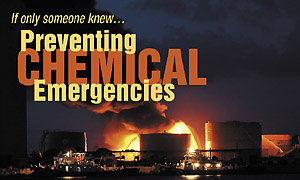
Whether your workplace is one simple building or a manufacturing complex with specialized facilities spread over acres, what will happen should a chemical or other spill occur? Where are the containment structures? Are they large enough to contain the failure of the largest tank? Where are the outfalls? Can they be controlled?
The key to having answers to these and other critical questions lies in knowing what and who you are working with.
Know your plant
A tank at a tar paper company failed, spilling 800,000 gallons of roofing asphalt. Existing dikes could not contain the spill, allowing an unknown amount to flow into storm drains. Because no one knew exactly where the catch basins were located and where the outfalls discharged, nearly 700,000 gallons of heated asphalt flowed through nearly 7,000 feet of piping, then into a commercial fishing and recreational area. Cleanup lasted more than six months. If only someone knew the plant.
Chemical research or quality assurance laboratories can be particularly difficult places to manage. Prior to performing any facility upgrades or renovations, be sure someone knows the building — inside and out — to avoid health and safety problems down the road.
Know your materials
Aluminum phosphide or magnesium phosphide, packaged in specially treated paper, can be used for fumigating insecticides. Moisture in the air wicks through the paper, making contact with the active phosphide compound. Phosphide reacts with the moisture, producing phosphine gas. This is a safe and reliable system for fumigating equipment and buildings.Because the system relies on moisture contacting the active phosphide, phosphine gas generators are shipped in sealed, waterproof Mylar7 bags. In one plant, approximately 500 bags of insecticide were at the end of their shelf life. A maintenance worker was directed to tear each bag open and throw it in a Dumpster®. This posed no problems until the Dumpster® was emptied at a transfer station, where moisture reacted with the phosphide to produce gas. Free water reacts with phosphide to produce gas and heat. Heat ignited both the phosphine gas and the surrounding garbage. The resulting fire hospitalized eight responders and forced the evacuation of a neighborhood.
If only someone knew the products they were working with and how to properly handle them. If someone managed the inventory, the 500 phosphine generators would not have been lying around for years, then thrown improperly and illegally into the municipal garbage system.
Know your management system
A maintenance foreman for a nationwide fuel distribution system complained that benzene in the new, supposedly environmentally friendly fuel was affecting tank cleaners. After several hours cleaning storage tanks, nearly all workers were overcome, literally crawling from the tanks and vomiting. The foreman knew this was from benzene.To help crews properly enter the tanks, the organization bought oxygen and flammable gas monitors. To comply with confined space entry procedures and ensure safety, tanks were monitored before anyone was allowed to enter. Oxygen levels of 19.5 percent to 23.5 percent and a lower flammable limit of five percent were set as safety standards. Unfortunately, no one informed the foremen on duty that three conditions must be monitored: oxygen, flammable gases, and known or suspected gases.
Using some general assumptions about vapors produced by the fuel at different times of the year and different geographic locations, workers were exposed to between 10 and 50 times the established permissible exposure limits (PELs) or threshold limit values (TLVs) for specific components of the fuel. Corporate safety people were satisfied with the system because the fuel was flammable and safe levels of oxygen were maintained. If only someone really knew the proper management system for entering confined spaces.
Know your people
One way to know your people, their strengths and weaknesses, their capabilities and capacities, is to watch them work. A new operator, fully trained and qualified, was assigned the night shift on a weekend. Knowing that the sight glass on the tank of 99.95% hydrazine was broken, he planned to fill the tank half-full, twice. Unfortunately, he couldn’t stop the hydrazine flow, overfilling the tank and the sight glass. This spilled hydrazine onto a fiberglass-insulated pipe. Hydrazine dissolved the glue on the insulation covering, allowing hydrazine to be adsorbed in exposed fiberglass. A fire instantly broke out.
If only someone knew the operator well enough to understand his strengths and weaknesses — that he could run the plant when it was working well, but not when there were problems.
Know emergency response plans
A response crew knew that sodium posed a water-reactive hazard. It was decided the safest way to eliminate the hazard was by detonating approximately eight pounds of sodium with dynamite in a vacant field. The shot was successfully fired, with minimal fire from the oil that had been used to stabilize the sodium. For about 15 seconds, everything seemed good. Then thousands of small pieces of sodium fell out of the detonation cloud, instantly setting the disposal field on fire. Several heavy dews reacted the sodium, leaving the field contaminated with caustic soda.If only someone knew that a good emergency response plan included all phases of managing emergencies, from hazard recognition to safe, legitimate disposal of residues and debris.
By knowing a few basic facts, hazards to people, the environment and equipment can be controlled or eliminated.
Looking for a reprint of this article?
From high-res PDFs to custom plaques, order your copy today!


