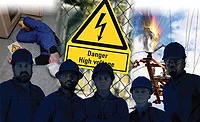
"Shock and Arc"
Working close to electrical circuits places individuals at risk for serious accidents and injuries. If you have electrical equipment operating at 50 volts and higher, you should take every precaution to protect your company’s most valuable assets — your employees.
The current standard, NFPA70E-2009, does not constitute a comprehensive and effective electrical safety program on its own. The most effective design and implementation of an electrical safety program requires a joint effort involving electrical subject matter experts and safety professionals.
Your first line of defense
The first line of defense against all electrical hazards and the primary focus of your electrical safety program should be the creation of an electrically safe work condition. This means that equipment is fully de-energized and cannot be re-energized while work is being performed.
Procedures leading to an electrically safe work condition should be used in every situation, with the following exceptions:
- When de-energizing equipment introduces additional or increased hazards; prime examples include the use of life-support equipment in hospitals or the use of ventilation equipment in a confined space.
- When de-energizing is not possible due to equipment design, such as when the equipment is part of a larger continuously-operating system.
- When the nature of the work requires that equipment be energized; prime examples include: troubleshooting, testing and checking for the presence of voltage.
Shock hazard analysis
For the shock hazard analysis, you will need to know the voltage to which employees will be exposed and the shock boundary requirements for both qualified and unqualified employees. Specific personal protective equipment (PPE) is necessary to minimize the possibility of electric shock. Insulating rubber gloves and leather protectors must be worn when working around energized equipment as a first line of defense. Also available are insulating rubber blankets, insulated hand tools, dielectric boots and switchboard matting, all of which are designed to help reduce the chance of shock or electrocution.
Employees working close to electrical shock hazards need to be trained in how to release victims from contact with exposed energized conductors, so consideration must also be given to having insulated rescue hooks available where appropriate.
Arc flash hazard analysis
The arc flash hazard analysis includes both the arc flash and arc blast hazards. For this analysis, you need to determine the arc flash protection boundary and the PPE necessary to protect employees within the arc flash protection boundary. Two methods can be considered:
1. Conduct an incident energy analysis involving engineering calculations and physical inspection of the electrical system. This determines the incident energy exposure of the worker in cal/cm2.
2. Use hazard/risk category classifications found in the NFPA 70E-2009. Use of this approach, also known as the table method, is only permitted when the available fault current and clearing time of circuit protection devices are known and are at or below the values indicated in these tables.
Choose appropriate PPE
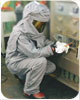
Both these methods require an intimate knowledge of your circuit protection devices (i.e., breakers, fuses) as well as maintenance of these devices according to manufacturer’s instructions and industry standards. Typical types of protection from arc flash hazards include coveralls, jackets, bib overalls, and face shields. These items are given an arc rating value expressed in cal/cm2. This rating measures the thermal performance of the PPE when exposed to arc flashes. The amount of thermal protection should be equal to or greater than the potential thermal hazard to which the worker may be exposed.
Both the shock hazard analysis and the arc flash hazard analysis identify the PPE necessary when live electrical work is performed. Note that generally all tools used for work on energized electrical equipment should be non-conductive.
Remember, electrical safety encompasses protection against shock, flash and blast. These hazards have their own requirements for protection. Careful attention should be paid when selecting the proper PPE for each of these hazards to ensure that they integrate properly and offer the worker the maximum protection available.
Looking for a reprint of this article?
From high-res PDFs to custom plaques, order your copy today!