Electrical safety training: 5 steps
Lecture for one-third; facilitate activities for two-thirds
The jobs in Table S-4 (OSHA 1910.332) face a higher than normal risk of electrical accident if exposed to circuits that operate at 50 volts or more to ground. These employees require training respective to their job assignment in electrical safety-related work practices (OSHA standard 1910.331 through 1910.335). Also, employees permitted by their employer to work on or near exposed energized parts must be qualified by training to acquire the skills and techniques to determine voltage of exposed live parts. These training requirements were established by OSHA in August 1990.
Table S-4
Blue collar supervisors
Electrical and electronic engineers
Electrical and electronic equipment assemblers
Electrical and electronic technicians
Electricians
Industrial machine operators
Mechanics and repairers
Painters
Riggers and roustabouts
Stationary engineers
Welders
Changing needs
Deloitte’s Resources 2015 Study found that 55 percent of businesses plan to generate some portion of their electricity supply on-site; mostly through use of fossil fuels but with a growing interest in creating electricity.
OSHA’s 2014 revised rules for electric power generation, transmission and distribution seek to keep pace with today’s understanding of electrical risk. Understanding of electrical risk is best demonstrated in NFPA 70E® Standard for Electrical Safety in the Workplace. 70E is updated and revised every three years, with 2015 being the latest revision.
Risk, not hazard, is the 70E concept emphasized today. Depending upon risk, an employee in Table S-4 (and other employees not listed) may be qualified for some electrical work but unqualified in other electrical work.
Training expectations
According to OSHA and NFPA 70E, the type and extent of electrical safety training shall be determined by the risk to each employee. NFPA 70E standards, and expectations by OSHA, require training by classroom, on-the-job, or a combination of the two. An instructor-led course as opposed to using a canned video is expected. Retraining under 70E must occur at a minimum every three years, except for emergency response — first aid, CPR and AED that require annual training. Additional or retraining must occur when audits discover deficiencies or when new hazards are introduced. 70E requires training documentation including course content, employee’s name, and date of training.
Training for electrical safety covers broad areas. NFPA 70E 2015 Annex F, Risk Assessment Procedures includes training employees on risk assessment concepts, including use of hierarchy of controls — eliminate hazard first and use PPE last.
NFPA 70E 2015 Annex G includes a sample LOTO procedure. Lockout is the preferred method to control an employee’s exposure to electrical energy risks. OSHA’s generic LOTO standard 1910.147 and associated electrical LOTO requirements at 1910.269 and 1910.333 include training requirements.
NFPA 70E 2015 Annex H provides guidance on selection of PPE. OSHA’s general requirements for PPE selection, use and training are found at 1910.132. OSHA’s electrical PPE requirements are found at 1910.137. Electrical PPE may include hearing protection with training requirements from OSHA’s noise standard at 1910.95.
Training under NFPA 70E 2015 includes first aid responders (know methods for safe release of victims from contact with electricity); employees exposed to chemicals during battery operations (this may connect to OSHA HazCom training at 1910.1200); employees engaged in climbing during electrical work; and employees who may work around electrical equipment, such as tree trimmers.
Update electrical training
OSHA’s August 2015 publication: “Resource for Development and Delivery of Training to Workers” should be reviewed before updating your electrical safety training. Activity-based learning should fill at least two-thirds of training hours (no more than one-third is lecture). Activity-based training can include “learning exchanges” such as drawing upon participant experiences and knowledge. The facilitator’s role is to, “guide discussions, encourage participation, draw out and/or add information as needed, and highlight key issues and points.”
I usually follow five steps when conducting classroom electrical safety training:
1 — The class has the option to view a YouTube video of a man in India electrocuted while standing atop a train car. Classes almost always unanimously want to view the video. Serious discussion ensues as to why the electrocution happened and how the tragedy could be avoided. I guide comments on electrical risk and hierarchy of controls.
2 — When discussion about the electrocution video slows, the class is promptly shown a 15-second YouTube video, “How to find out if your friend is a wuss.” A person pranks his friend into thinking he is electrically shocked. What’s the point of the video? Most classes give very astute feedback about how risk of electricity should be treated.
3 — Following discussion of the two videos, an approximate 10-minute lecture is given on the basics of “what is electricity?” I encourage Q&A — even if the class is full of electricians. Examples of actual workplace hazards and risks, again led by students, follow the basic lecture.
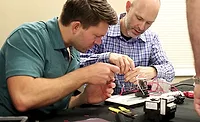
4 — A predetermined needs assessment steers the rest of the class. “Hands-on” training with volt meters, PPE, and other equipment is generally practiced. One or more students can explain the hands-on activities, and they are encouraged to show what they know.
If your budget is tight, provide students access to NIOSH’s 2009 “Electrical Safety: Safety and Health for Electrical Trades” (Student Manual) – document number 2009-113. The manual is in the public domain and may be freely printed. If your budget allows (about $25 each) provide each student with Ugly’sTM Electrical Safety and NFPA 70E® 2015 edition pocket book.
5 — Students must complete a 15-question written test after completion of learning. The written test serves several purposes including training documentation.
Steps 1 through 3 can be completed in one hour. Plan on 2 to 4 hours, and depending upon needs assessment, much longer to complete step 4. Allow 30 minutes for students to complete a 15-question test
Looking for a reprint of this article?
From high-res PDFs to custom plaques, order your copy today!