Heading off heat stress
Keep workers safe and efficient with fans and curtain walls
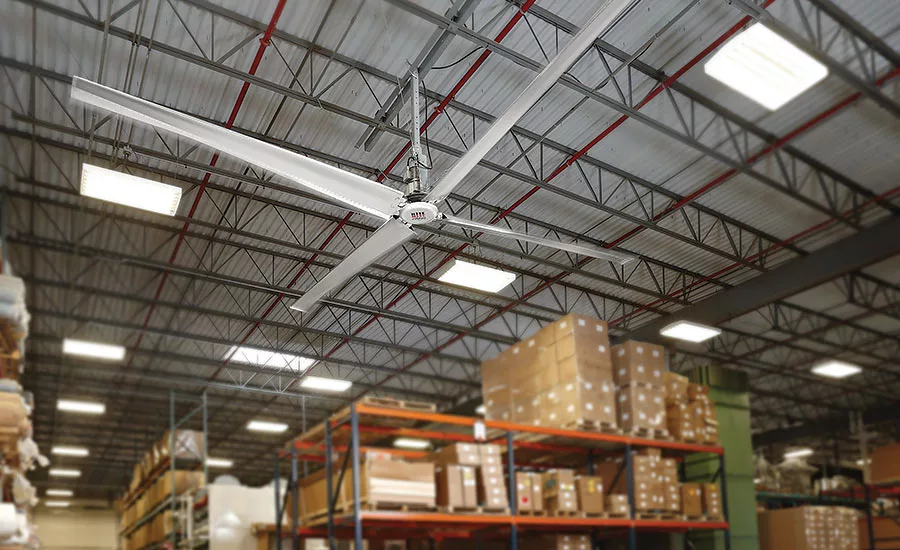
The summer months are great for baseball and beach parties; not so much for working in an industrial facility without air conditioning.
Industrial facilities have always had to combat hot weather, but with online commerce driving an ever-faster pace of shipping and receiving and several high-profile heat stress lawsuits setting precedents, facility managers will be facing a perfect storm of heat-related issues this summer. Fortunately, there are several ways to address this problem – including the use of high volume, low speed (HVLS) fans and industrial curtain walls.
What is heat stress?
Heat stress can manifest itself in a variety of forms. The mildest forms are heat fatigue, in which workers begin to lose concentration and perform erratically, and heat rash, which occurs when sweat ducts get plugged and skin becomes agitated and painful. Heat stress may also cause heat cramps in the back, arms, legs and abdomen. Dehydration and electrolyte imbalance caused by prolonged sweating are typically its causes.
Heat exhaustion, heat syncope (fainting) and heat stroke are among the most serious types of heat stress disorders. Heat syncope usually happens because of a pooling of blood in the lower extremities and dilated vessels of the skin, leading to low blood pressure and sudden unconsciousness. Heat exhaustion can occur on its own or as a prelude to fainting. Common symptoms are similar to heat fatigue, but can also include diarrhea, nausea and disorientation. Heat stroke is the most serious heat stress disorder and requires hospitalizations. It occurs when the body’s systems of temperature regulation fail and body temperatures rise to potentially fatal levels. It can be marked by an absence of sweating, as well as confusion, fainting and/or convulsions.
Hot heads make more mistakes
An uncomfortably hot facility not only lowers employee morale, it makes them less efficient. As more blood pumps to the skin in an attempt to cool off the body, less blood is available for vital organs like the brain, leading to mental errors. In fact, a study done by NASA concluded that when in-plant temperatures rise to 85 degrees, worker output drops by 18 percent and errors increase by 40 percent. OSHA recommends a temperature range between 68 and 76 degrees.
Factors affecting heat stress control
Unfortunately, most loading docks are not air-conditioned and most dock staging areas have tall ceilings, making them hard to cool even if they are air-conditioned. Doors that frequently open and close add another challenge to heat moderation.
The ongoing expansion of online retailing and overnight shipping is another relevant trend, as companies like Amazon push fulfillment employees to work faster than ever. Though several of the largest online retailers have faced employee complaints and high-profile lawsuits in recent years, there is no reason to think this trend will change.
Addressing heat stroke
From a physical standpoint, water breaks should be encouraged and workers being transferred from a cooler part of the plant (or coming back after vacation) given time to acclimate, with unit-output requirements gradually worked back to standard levels. Obviously, anyone who displays heat stress symptoms should be moved to a cooler area and anyone suffering a heat stroke immediately taken to the nearest hospital.
From an infrastructure standpoint, there are a number of facility upgrades that can have an immediate impact, such as using HVLS fans to provide cooling breezes and fabric curtain walls to create specific air-conditioned areas or to enclose heat-generating production equipment.
How HVLS fans help control heat
While adding air conditioning is the best-case scenario, it isn’t always practical due to cost considerations and building configurations. With or without air-conditioning, most facilities will benefit immensely from HVLS fans.
Although smaller, floor-mounted fans can be helpful in limited spaces, their high wind speed and noise levels may cause problems. They also use a relatively high amount of electricity. On the other hand, HVLS fans use relatively little energy and provide a gentle, quiet breeze.
According to the U.S. Department of Health and Human Services paper, “Workers in Hot Environments,” a 2 to 3 mph air speed creates an evaporative cooling sensation of 7 to 11 degrees. To put this in perspective, the effective temperature of an 84-degree warehouse environment can be dropped to 73 degrees by adding a fan moving air at 3 mph. This cooling effect can make workers up to 35 percent more productive.
A technically advanced HVLS fan can move large volumes of air up to 22,000 square feet and replace as many as 10 to 20 floor fans. By mixing air through a process called destratification, HVLS fans also help air-conditioning systems work more efficiently, allowing them to be operated at a set point up to 5 degrees lower.
Keeping cool with curtain walls
Industrial curtain walls are similar to traditional solid walls in that they define and divide spaces, offering different types of environmental control. By separating environments within industrial buildings into smaller areas, walls allow HVAC systems to work more efficiently and help workers stay comfortable and productive.
Because of their construction, curtain walls offer a higher degree of flexibility than traditional walls, and are far less expensive and quicker to construct. Their time, cost and flexibility benefits provide facility managers the freedom to divide and control their interior space as business needs dictate, with changes in space allotments made as necessary – not as can be afforded. In addition to their simple setup, insulated curtain walls can provide up to 40 degrees of temperature separation.
The use of HVLS fans has gained increased attention as a practical and affordable solution to improving air movement, reducing heat stress, and creating better environmental control. Combined with industrial curtain walls, they are rapidly gaining recognition as valuable supplements to help facility designers and engineers control energy costs and improve employee comfort and productivity.
Improving the workplace environment with HVLS fans and curtain walls won’t only make employees more comfortable, it can make them safer and more productive. Before the heat negatively impacts the well-being of workers and directly impacts the bottom line, make a heat stress plan and consider preventative measures.
The information provided is a general reference regarding the use of the applicable products in a specific application. This information is provided without warranty. It is your responsibility to ensure that you are using all mentioned products properly in your specific application and in accordance with all laws and regulations.
Looking for a reprint of this article?
From high-res PDFs to custom plaques, order your copy today!