Curtain walls and fans keep workplaces cool, clean
Tools for IAQ
Although largely invisible, indoor air quality is a key concern for any industrial facility. During summer months, workers must be shielded from the dangers of heat stress, while in winter cold drafts and dry air may cause problems. For food industry facilities, maintaining appropriate humidity levels between work areas can be a problem.
Although traditional heating, ventilation and air conditioning (HVAC) systems are often the starting point for IAQ programs, a number of additional weapons can be added to the arsenals of facility managers. These tools include high volume, low speed (HVLS) fans and industrial curtain walls.
Heat stress in the workplace
Industrial facilities have always had to combat hot weather, but with online commerce driving an ever-faster pace of shipping and several high-profile labor disputes in the news, facility managers will be facing a perfect storm of heat-related issues this summer.
An uncomfortably hot facility not only lowers employee morale, it makes them less efficient. In fact, a study done by NASA concluded that when in-plant temperatures rise to 85 degrees F, worker output drops by 18 percent and errors increase by 40 percent. OSHA recommends a temperature range between 68 and 76 degrees.
HVLS fans help control heat
From a physical standpoint, water breaks should be encouraged and anyone who displays heat stress symptoms should be moved to a cooler area immediately. Employees suffering a heat stroke should immediately be taken to the nearest hospital.
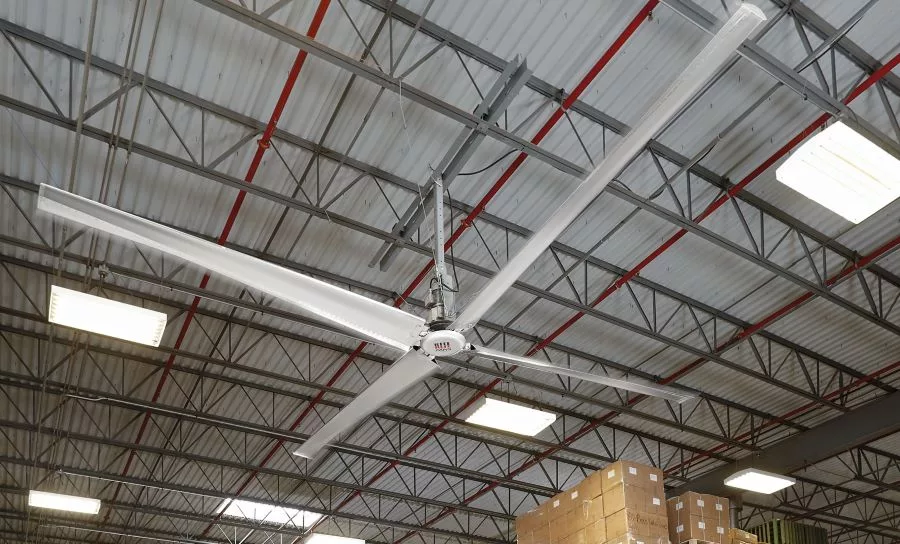
From an infrastructure standpoint, there are a number of facility upgrades that can have an immediate impact such as using HVLS fans to provide cooling breezes. While adding air conditioning is the best-case scenario, it isn’t always practical due to cost considerations and building configurations. With or without air-conditioning, most facilities will benefit immensely from HVLS fans.
HVLS fans pull air from the fan and push it down in a conical shape to the floor below. Air travels in this cone shape until it hits the floor and then moves in a horizontal stream away from the diameter of the fan.
According to the U.S. Department of Health and Human Services paper, “Workers in Hot Environments,” a 2 to 3 mph air speed creates an evaporative cooling sensation of 7 to 11 degrees F. To put this in perspective, the effective temperature of an 84-degree warehouse environment can be dropped to 73 degrees by adding a fan moving air at 3 mph. This cooling effect can make workers up to 35 percent more productive.
Although smaller, floor-mounted fans can be helpful in limited spaces, their high wind speed and noise levels may cause problems. They also use a relatively high amount of electricity. On the other hand, HVLS fans use relatively little energy and provide a gentle, quiet breeze.
A technically advanced HVLS fan can move large volumes of air up to 22,000 square feet and replace as many as 10 to 20 floor fans. By mixing air from top to bottom of a space, HVLS fans also help air-conditioning systems work more efficiently, allowing them to be operated at a set point up to 5 degrees higher.
Keeping cool
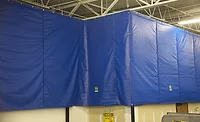
Fabric curtain walls can also help HVAC systems work more efficiently. By separating conditioned air environments into smaller areas, fabric curtain walls allow a facility’s HVAC to use less energy to reach the desired setting for keeping workers stay comfortable and productive.
Because of their construction, curtain walls offer a higher degree of flexibility than traditional walls, and are far less expensive and quicker to construct. Their time, cost and flexibility benefits provide facility managers the freedom to divide and control their interior space as business needs dictate, with changes in space allotments made as necessary — not as can be afforded.
In addition to their simple set-up, insulated curtain walls can provide up to 40 degrees F of temperature separation. And because of their flexibility and custom applications, they also can be used to enclose heat-generating production equipment.
“Micro-climate” spaces
Compartmentalizing space with fabric curtain walls also makes sense for facilities looking to create microclimate spaces with different temperature or humidity requirements than other areas of the building.
Separating a higher humidity space from a lower humidity space generally requires mechanical chilling equipment and a barrier. This situation could occur in a food warehouse, for example, with a high humidity environment for short-term storage of vegetables, such as lettuce and spinach.
Insulated curtain walls with vinyl-covered surfaces work well in this application as a barrier between two different humidity zones. Their surface is waterproof and the insulation inhibits the transfer of heat away from the outer surface, keeping the outer surface temperature above the dew point of the exterior air so there is no condensation.
Even if microclimates are not needed, fabric curtain walls and other barriers can play an important role in creating separate work spaces, proper distance between employees and external visitor entry points — key considerations for facilities in the midst of the COVID-19 pandemic. Curtain walls are particularly well suited for this, as they are flexible, customizable and can be moved if necessary. Additionally, they are available with washdown capabilities for regular cleaning.
Conclusion
Indoor air quality is an ongoing concern for almost every type of industrial facility. While traditional approaches, such as the use of HVAC, are certainly important steps toward controlling IAQ, lesser known tools such as HVLS fans and fabric curtain walls can augment their effectiveness and significantly reduce facility costs – ultimately keeping workers and products safe and secure.
Author disclaimer: The information herein is provided as a general reference regarding the use of the applicable product(s) in specific applications. This information is provided without warranty. It is your responsibility to ensure that you are using all mentioned products properly in your specific application and in accordance with all laws and regulations.
Looking for a reprint of this article?
From high-res PDFs to custom plaques, order your copy today!