Selecting matting for worker comfort
It’s part of an overall ergonomics process
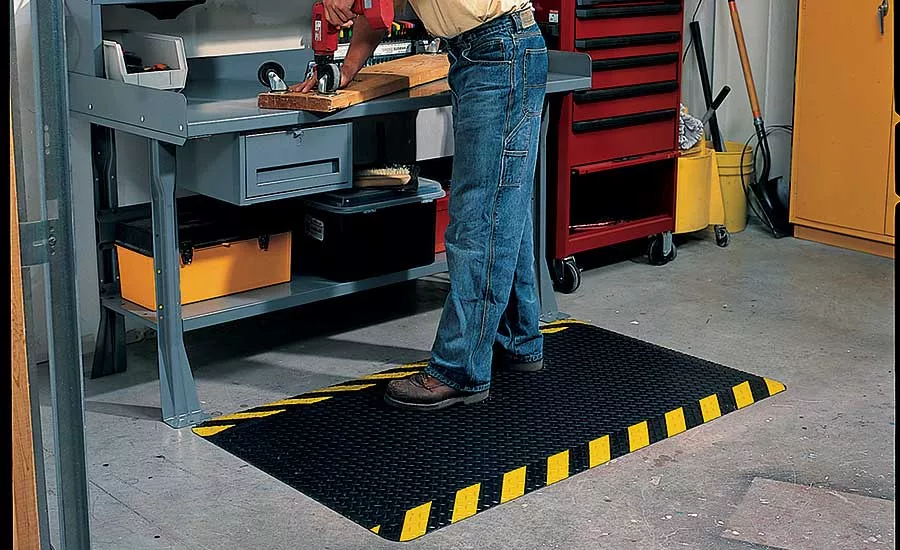
In recent times, health concerns related to prolonged sitting on the job have received considerable attention within the workplace wellness community. With the focus on getting sedentary employees off their bottoms and on their feet, it’s important to remember that excessive standing is just as detrimental to long-term health as excessive sitting. In those environments where employees regularly spend hours on their feet, anti-fatigue matting is a tool employers should consider.
Various studies have demonstrated the positive impact anti-fatigue matting can have in improving worker comfort and productivity, while reducing the potential for workplace muscular skeletal disorders (WMSDs). But with so many matting choices from which to choose, how can an employer make the best decision for his or her workplace? While many variables come into play when selecting an anti-fatigue mat focusing on application, area of coverage needed and frequency of use will help direct the employer to the best solution.
Regulatory requirements and studies
While OSHA currently has no general industry standard requiring the use of anti-fatigue matting, OSHA does make reference to the value of these mats in their guidelines for employers in the retail trade and restaurant industries¹.
In the absence of a regulatory mandate to supply anti-fatigue mats, OSHA and ergonomic experts recognize the benefit they provide. Science has also documented the positive impact that matting can contribute to worker comfort. A 2012 University of Michigan study, conducted by Neal Wiggermann, Robert A. Werner and W. Monroe Keyserling² found that test subjects who were tasked with performing four hours of standing work reported less discomfort when anti-fatigue matting was added to the work floor. This was based on the subjective response of the individuals in the test.
In the Wiggermann, Werner and Keyserling study, the discomforts reported by the test subjects included fatigue, sore feet, lower back pain and stiffness in the neck and shoulders. And while these short term discomforts are unpleasant, another study (Long-Term Muscle Fatigue After Standing) published in 2015 by Maria-Gabriela Garcia, Thomas Läubli and Bernard J. Martin³ showed the physical fatigue experienced continues to impact the body for at least 30 minutes after the standing ceases. What’s particularly interesting is that the fatigue could be measured within the test subject’s bodies even after they were no longer subjectively reporting feeling fatigued.
Choosing the correct anti-fatigue mat
Before getting into the selection keys, it’s good to have a basic understanding of how anti-fatigue mats function. They’re more than just a soft, cushioning surface. In fact, too much cushioning can cause just as much soft tissue fatigue as too little cushioning. To put this in perspective, just imagine how it would feel to spend more than five hours each day walking around on your mattress.
In a good anti-fatigue mat, the cushion or flex of the mat stimulates minute, undetectable muscle movement in the leg and calf muscles as the body continuously adjusts to remain stable. These almost imperceptible biomechanical adjustments increases blood flow to-and-from the area, and the improved circulation reduces pain and discomfort. In addition, matting also offers insulation from cold/damp floors. Exposure to cold temperatures can exacerbate the effects of all risk factors associated with WMSDs.
Application basics
When it comes to selecting an anti-fatigue mat, the first thing to consider is the application. Will it be placed in an area exposed to water or moisture? Is there a possibility of chemical contact? Will the workers using the mat be primarily standing, or will there be more walking taking place?
In a setting where there’s water or moisture, you’ll need to avoid a mat that will absorb the liquid. An open-surfaced mat allows for superior drainage in wet environments. In areas that are more damp than wet, a solid mat with a sealed exterior and textured or ribbed surface may be sufficient. If there will be exposure to chemicals, you’ll need to verify chemical compatibility with either the matting manufacturer or a reputable matting distributor. Anti-fatigue mats are constructed from a variety of materials, natural rubber, PVC, nitrile and polypropylene are some of the most common, and the chemical or chemicals you’re working with dictate your matting material options. And if the workers will be standing on the mat more than walking across it, you can consider a slightly softer, more-cushioned mat. If the workers are walking on the mat, something a bit firmer is best to prevent sinking into the mat with each step.
Coverage area
Another area that needs consideration when selecting an anti-fatigue mat is the area of coverage. If the mat is needed for a standard size rectangular or square configuration, then a continuous mat off the rack will typically work. For longer runs, matting suppliers can custom produce some mats to lengths as long as 45 to 60 feet. When a manufacture custom makes a run of anti-fatigue mat, they’ll bevel the full perimeter, as they do for their stock sizes, so the mat doesn’t create a tripping hazard. If a non-conventional size is needed – like integrating a mat into a production line or around a piece of machinery – then a modular anti-fatigue mat may be the best solution.
You get what you pay for
One last key factor to consider in the selection process is the anticipated frequency of use for the mat. If the mat will be used on a limited basis, then a more economically priced anti-fatigue mat is an option. But in situations where the mat will experience regular use throughout the work day, it’s best to invest in a higher quality mat that will withstand the wear and tear. Generally, the longer the manufacture warranty, the higher the quality of the anti-fatigue mat. And cost goes up with quality. With matting, as with most things, you get what you pay for.
Bottom line
While anti-fatigue mats can help improve the comfort and productivity of employees who spend time on their feet, they’re not a magic bullet in the prevention of WMSDs. They’re a tool that can be used as part of a comprehensive workplace ergonomics process. The ideal solution for employers is to develop a work environment for their employees that incorporates a healthy balance between standing, moving and sitting.
References
- OSHA’s Guidelines For Retail Grocery Stores, 2004. https://www.osha.gov/Publications/osha3192.pdf
- The Effect of Prolonged Standing on Touch Sensitivity Threshold on the Foot: A Pilot Study. Neal E. Wiggermann, Robert A. Werner, W. Monroe Keyserling, 2012. https://experts.umich.edu/en/publications/the-effect-of-prolonged-standing-on-touch-sensitivity-threshold-o
- Long-Term Muscle Fatigue After Standing Work. M.G. Garia, T Laubli, B.J. Martin, 2015. https://www.ncbi.nlm.nih.gov/pubmed/26048874
Looking for a reprint of this article?
From high-res PDFs to custom plaques, order your copy today!