Clearing the air: Selecting a respirator for confined spaces
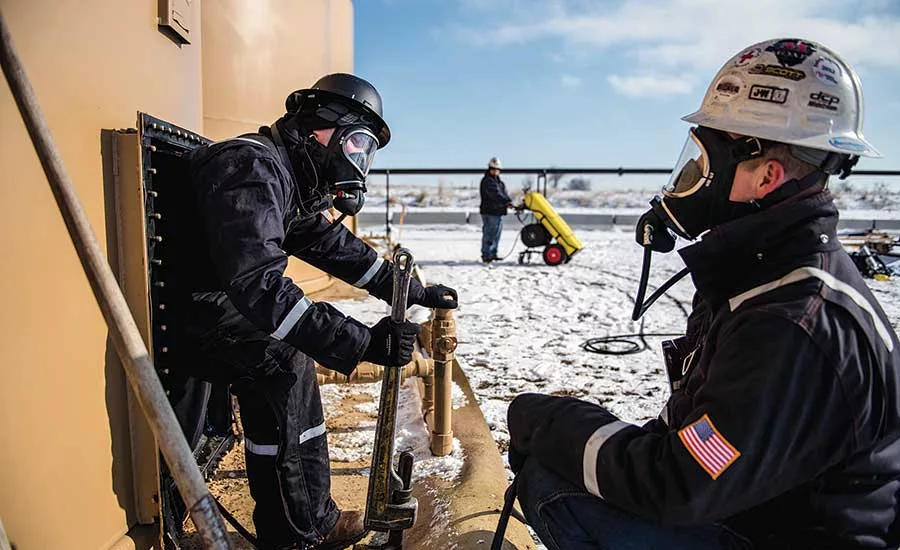
The world of confined spaces is diverse, ranging from holds, manholes and tanks to ducts, silos, vaults and pipes— all of which can be deadly. The Bureau of Labor Statistics reports 136 people in the United States alone died in accidents when working in confined spaces and containers in 2015.1 Not only can these accidents occur during everyday work, but also in rescue scenarios. Whether a sanitation worker loses consciousness due to oxygen-deficient atmospheres during a routine maintenance check, or a firefighter is overwhelmed by toxic gases during a rescue situation, respiratory protection is paramount to any confined space entry.
OSHA defines a confined space as an area that is large enough for workers to enter and perform certain jobs, has limited or restricted entry or exit and is not designed for continuous occupancy.2 In confined spaces, conditions can rapidly change — toxins can accumulate, or oxygen deficient environments can cause asphyxiation. To combat — or at a minimum mitigate — these risks, the foundation of respiratory protection is built upon the recognition of these hazards and the understanding of what is necessary to protect against them.
Know your hazards
On any worksite, and particularly those that contain confined spaces, the first step should always be to conduct a risk assessment to identify potential respiratory hazards. One of the key factors influencing the final respirator decision is to address the environment’s volatility — as certain locations are subject to more atmospheric changes than others.
Performing clearance measurements before operations begin allows safety managers to match a respirator’s abilities to the demands of the confined space. Clearance measurement can help determine which substances are present and what preparations are required in order to perform work in the area. It is important to ascertain whether lack of oxygen is a possibility. When measuring samples, consider the physical properties of the gases and the confined space’s ventilation patterns, temperature and type or shape.
Light versus heavy gases
Understanding a gas’s properties, and subsequently where a gas accumulates, allows clearance measurement experts to know they’ve taken an accurate, representative sample. If a sample is drawn from the top of a confined space and it identifies the presence of hydrogen sulfide (H2S), this should alert immediate danger and trigger standard operating procedures. Since the molar mass of H2S (34 g/mol) is significantly heavier than air (29 g/mol), the greatest concentration of H2S would be found at the bottom of a space.
Similarly, testing for lighter gases, like methane, at the bottom of a space would be incorrect — especially since these lighter gases mix with the surrounding air. If methane were detected in this scenario, it could present an immediate risk of explosion since most of the methane may already be concentrated at the top of the container.
Ventilation patterns
Identifying where gas can flow in and out of a confined space impacts the reading. Air currents influence the position and concentration of air clouds, making it vital that a testing expert be aware of these possible manipulations and subsequent impact on the sample.
Temperatures
When heat is added to a substance, it impacts the rate at which its molecules and atoms vibrate. If the sun has been shining on the container for the majority of the day and the clearance measurement was performed prior to sunrise, it’s likely that the reading no longer reflects an accurate picture given the rate of increased diffusion.
Type/shape
Factoring in the gas’s physical properties plays an important role in assessing the space in which it is found. Containers may be positioned on a slope, where the highest point would be in the corner toward the top of the inclined surface. This may place worker entry closer to heavy gas accumulations (H2S). In addition, any bulges or deformities of the confined space will influence how the ventilation circulates and how the temperature varies—indicating that where the best sample is drawn may change from moment to moment.
What respirator fits the bill?
Marrying a confined space’s environment to a respirator’s capabilities is an important union. Regardless of everyday use or emergency escape, the right respirator selection addresses reliable protection and efficiency.
OSHA stipulates that respirator selection will be based on the maximum use concentration (MUC), which is calculated by multiplying the assigned protection factor (APF) by the recommended exposure limit (REL).3 Referring to the H2S identified during the clearance measurement in the previous example, the following respirator types are suggested for the following specific concentrations:
- 0-10 ppm: No respirator is needed, below REL
- 10-100 ppm: Powered Air-Purifying Respirator (PAPR), Full Face Mask Cartridge Respirator or Self-Contained Breathing Apparatuses (SCBA)
- 100-100,000 ppm: SCBA or Supplied Air in positive pressure mode
When comparing which device best suits the environment, safety managers should also weigh the equipment’s ease of use, knowing that time can quickly become a precious commodity. Guiding questions include, but are not limited to:
- Is it easy to don — user friendly and light weight?
- Is it compact and transportable?
- Where would this be stored so it could easily be accessed in emergency scenarios without being damaged?
- What is the device’s lifespan/required maintenance?
Selecting the right respirator is akin to selecting the right boot — not only should one conduct research and understand how the design will afford the greatest protection for the stress it will undergo, but it should slide seamlessly into one’s routine. One should never waste time considering whether or not one should bring their favorite boot — or respirator — to work.
1 https://www.bls.gov/news.release/cfoi.nr0.htm
2 https://www.osha.gov/SLTC/confinedspaces/
3 https://www.osha.gov/Publications/3352-APF-respirators.html
Looking for a reprint of this article?
From high-res PDFs to custom plaques, order your copy today!