Construction safety Q&A
All about falls, silica, cranes, overlooked training, confined spaces & best practices
What are the most common problem areas with construction safety?
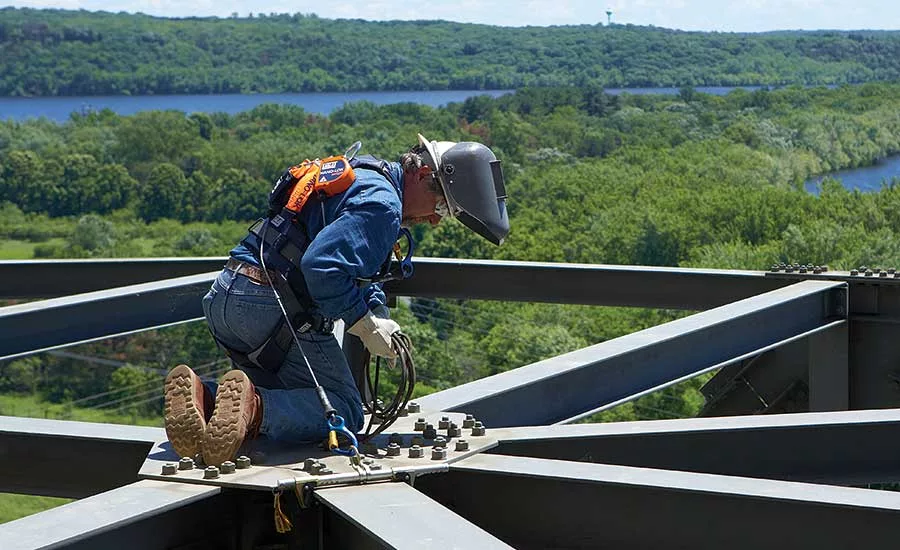
Any site can have its own challenges, but fall protection is certainly one of the biggest problems in construction. In 2015 according to the Bureau of Labor Statistics, falls in construction accounted for 364 out of 937 total fatal accidents – 38.8%. Struck by, electrocution and caught between accidents accounted for another 25% of the total. According to OSHA, fall protection was the most cited regulation in the construction industry in fiscal year 2016.
Another concern in construction is the new silica regulation – 29 CFR 1926.1153. OSHA estimates that it will impact over 2 million construction workers when it is implemented starting 23 June of this year. OSHA has estimated that full implementation of the regulations in both construction and general industry will prevent over 900 new cases of silicosis annually.
Crane safety is a third concern. Few things on a construction site, in a matter of seconds, can simultaneously cause the death of multiple workers, destruction of hundreds of thousands of dollars of property, and lead to a complete shutdown of a job site. A crane accident can.
What do construction workers most often overlook or need further training on when it comes to safety?
This is a difficult question to answer as construction sites are so variable, and the tasks a contractor in one trade may do will be very different from a contractor working in another trade. As an industrial hygienist, I know that a major concern is worker training on the hazards of chemicals they are using and the proper methods to protect them from overexposure.
Per OSHA, Hazard Communication was the second most cited regulation in construction in fiscal 2016; along with that regulation would be proper training on personal protective equipment. For instance, hard hats, ear plugs and safety glasses may appear to some to be simple items, but they must be used within their design limits, and worn and maintained per the manufacturer’s recommendations to provide proper protection to the worker.
What are the most dangerous hazards at a construction site and how can safety and health professionals combat those hazards?
As noted above, data shows that falls rank as the most common killer on construction sites. Noise-induced hearing loss is often a common health hazard of construction sites. Training of workers, especially young workers new to the trades is critical. Training must be designed not just to deliver OSHA required information (which is obviously important), but also to motivate a behavioral change (e.g. wearing and tying off fall protection when working at heights or properly wearing hearing protection when exposed to excessive noise levels). The training needs to acknowledge and address the workers’ needs and concerns about wearing protective equipment (e.g. can I don it properly, will it really protect me, and how can I make it fit right?).
How does the new confined spaces in construction rule affect training?
Construction had a requirement, 29 CFR 1926.21(b)(6), to train workers who entered confined spaces before the promulgation of Subpart AA. However, the General Safety and Health Provisions of Subpart C perhaps could be easily overlooked. Subpart AA may potentially make more contractors aware of the requirements to train workers. Subpart AA also elaborates on how the training should be conducted, who needs training, and what needs to be covered (e.g. workers not authorized to make confined space entry rescues must be trained in the hazards of attempting a rescue). A significant portion of all confined space deaths are would-be rescuers who fall victim to the same hazard that felled the initial entrant.
What are the best practices for developing a construction safety training program?
First, know your audience and tailor everything to that audience and their particular worksite – visuals, language, terms used and clothing worn. For example, to other industrial hygienists I can discuss the silica permissible limit and mention 50 micrograms per cubic meter, and they will appreciate the impact; for an electrician or laborer, that reference will likely lack context and may be meaningless. But if I show him or her a bottle containing 50 micrograms of silica and show them a cubic meter, they might see the slight dusting on the side of the bottle, that might be more impactful.
I can tell employees masonry table saws are loud and hearing protection should be worn. However, showing them a video of the saw they actually use with a sound level meter showing the decibel level during a cut – that makes it personal. For a presentation to a group of EHS professionals I may wear a shirt and tie, but to a group of workers, slightly faded jeans, dirty work boots and a polo shirt is the uniform of the day.
Second, be animated. If you deliver a university lecture to workers from a construction site, you’re likely to get an audience counting the holes in the ceiling tiles.
What kind of safety training is important for supervisors?
Whatever the workers get, the supervisors get too. It’s important that supervisors are trained for a true safety culture – that, while production is important, everyone going home in the same condition they arrived in is even more important.
Also it doesn’t hurt to give supervisors tips or training on how to win friends and influence people, though that training is often done formally or informally for all new leads, crew chiefs and management (whether for safety purposes or general management purposes).
Looking for a reprint of this article?
From high-res PDFs to custom plaques, order your copy today!